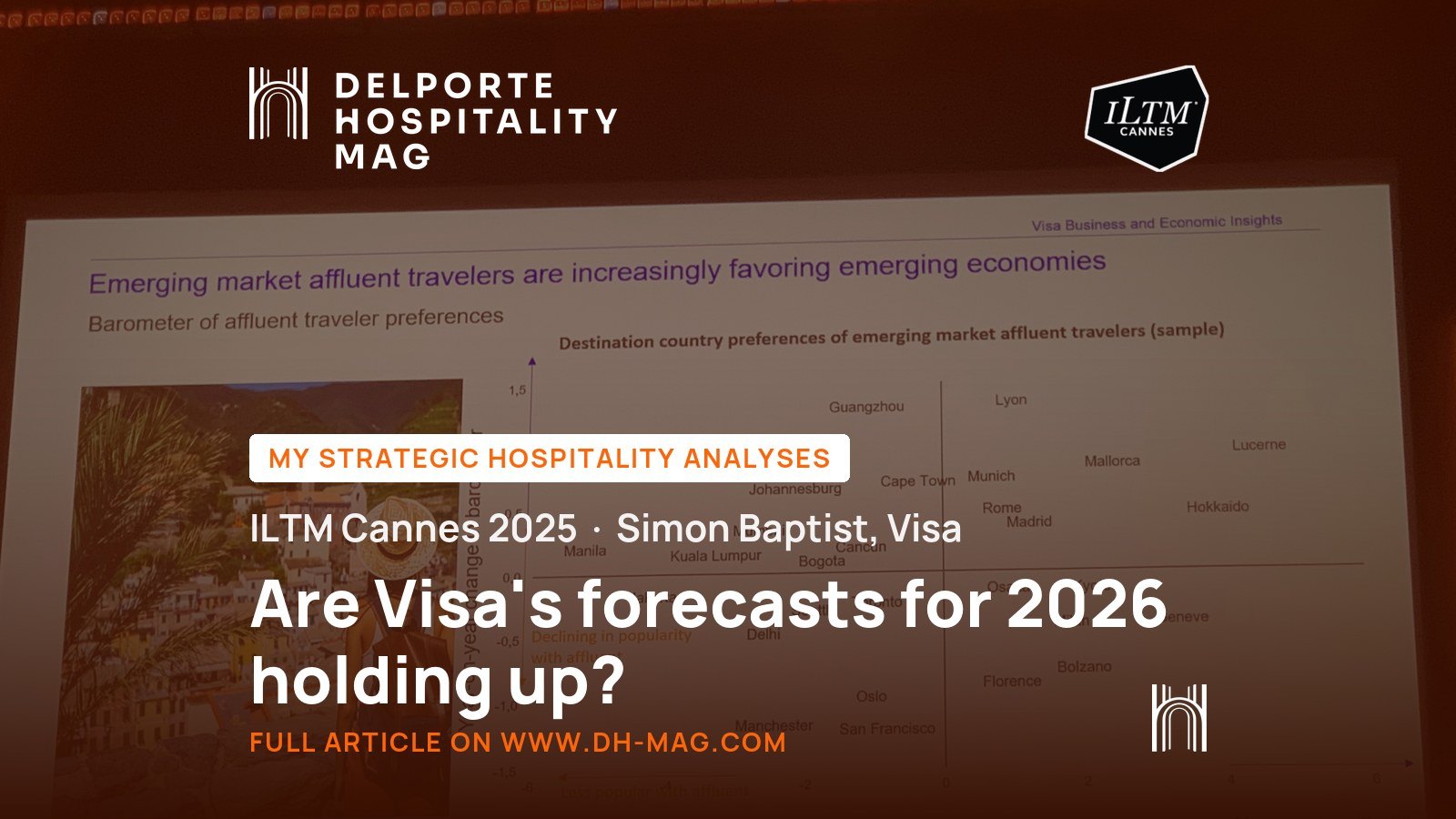
Visa measures the destinations that affluent travellers actually choose, and how that choice shifts from one year to the next. The chart shown at ILTM puts Lyon at the very top, ahead of Lucerne and Hokkaido. Florence, Kyoto and Geneva slide downwards. Few French professionals expected this map.
Having shown where luxury money comes from, Simon Baptist, Visa's chief economist, moved on to the next question before the ILTM audience: where is this money spent, and on what?
The answer comes in three movements. Luxury purchases softened in 2025. The map of desirable destinations has been redrawn. And the very nature of spending has changed, particularly among Asian travellers.
Did the luxury market slow down in 2025?
Yes. Luxury purchases softened in the five major capitals measured by Visa. Dubai remains well ahead, Paris holds up better than London, Singapore and New York, and December concentrates the annual peak everywhere.
The slide's title was blunt: luxury spending softened in 2025, with some places holding up better than others.
Dubai clearly dominates, with a share of cardholders buying luxury far above the other cities. Paris comes next, ahead of London, then New York and Singapore. The overall trend has been pointing downwards since the levels reached at the end of 2023.
The weight of the top tier varies sharply from place to place. In Dubai, more than half of top-percentile cardholders buy luxury every quarter. In Singapore the proportion approaches forty per cent, in New York thirty-eight, and in London it stays below thirty. Yet Simon Baptist insists: below that top percentile, the top five, ten and twenty per cent also buy, and in large numbers.
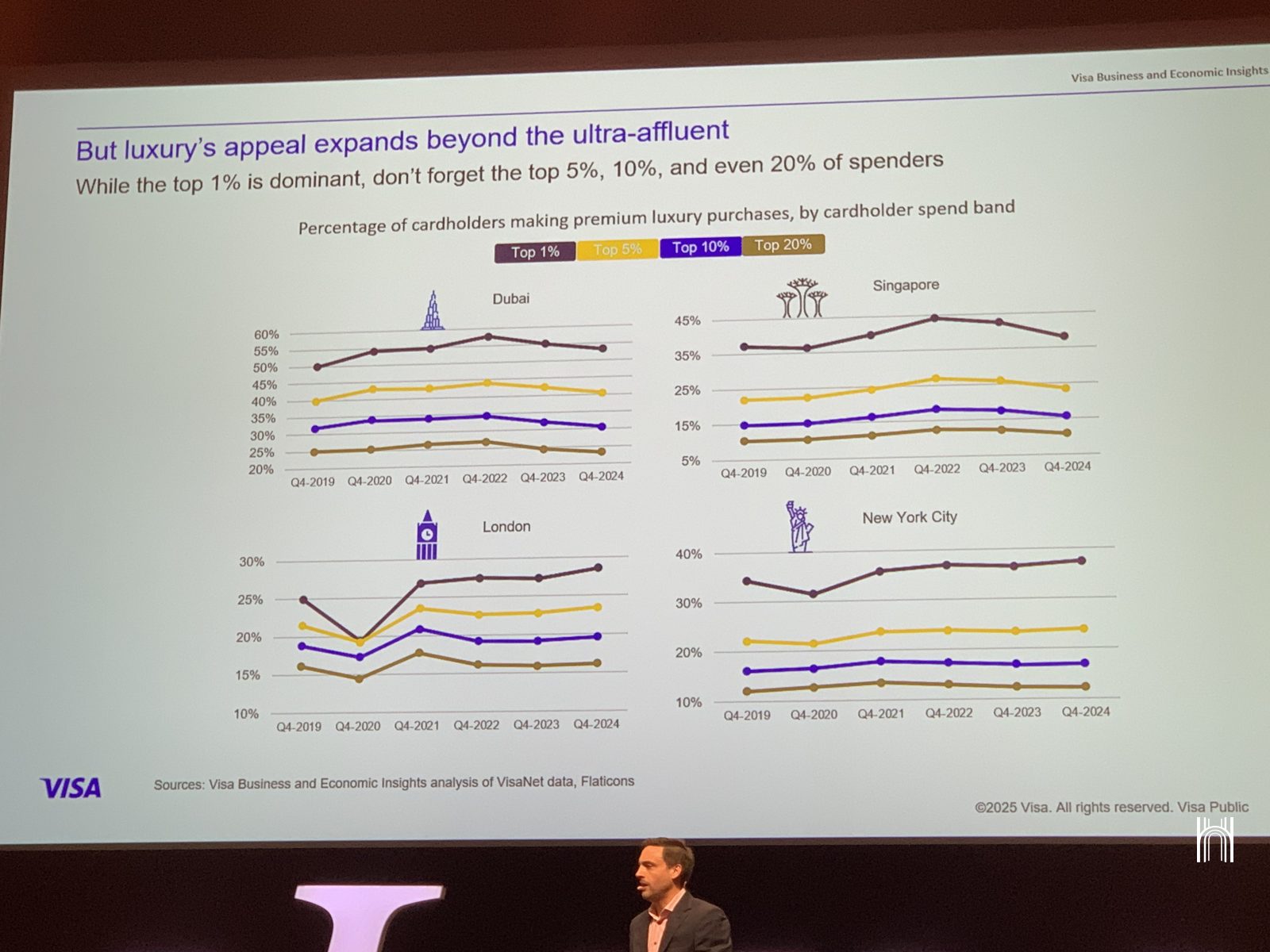
Seasonality tells yet another story. December overshadows everything, in all five cities without exception. Beyond this shared peak, each place has its own rhythm. Dubai rises in June, ahead of the summer departures, then again in October. Paris has a marked summer peak. New York stays stable all year round, apart from a winter dip. Singapore wakes up in February.
A hotel manager who models a sales calendar on generic seasonality is therefore targeting the wrong market. Luxury spending clusters around windows of intensity, and those windows are local.
Which destinations are rising, and which are slipping?
Lyon, Lucerne, Hokkaido and Madrid are gaining appeal among affluent travellers. Florence, Kyoto, Osaka and Geneva are losing ground. Ho Chi Minh City, Mumbai and Manila are growing from a still modest base.
The chart crosses two measures: a destination's absolute popularity among affluent cardholders, and its year-on-year change. Four quadrants, and an immediate reading.
In the most favourable quadrant, that of destinations already in demand and still growing, sit Lyon, Lucerne, Hokkaido and Madrid. Lyon holds the highest position on the entire chart. For French hospitality, this point deserves more than a shrug: the city is capturing a clientele that Paris considers its own, and capturing more of it every year.
In the opposite quadrant, established luxury destinations are losing share with this clientele: Florence, Kyoto, Osaka, Geneva. Luxury remains present there, but its momentum has reversed. These four names share one characteristic: they have long lived on an acquired reputation.
In the quadrant of emerging destinations, still little visited but growing fast, appear Ho Chi Minh City, Mumbai, Manila and Bogotá. These are the destinations that affluent households in emerging markets choose first, before travelling further.
The Japanese surge calls for a careful reading. Arrivals have soared, and Japan posts one of the best performances in the world. But the primary cause is monetary: the yen is forty per cent below its former level, which makes the country forty per cent cheaper. A useful reminder in a sector that likes to attribute its successes to the quality of its offer. The flip side is real: Japanese travellers spend far less abroad, as their trips now cost them twice as much.
Two signals complete the picture. The Middle East records the best performance in the world for international arrivals. North America, by contrast, is seeing arrivals fall from almost every region, from Canada to Asia-Pacific by way of Europe.
What do luxury travellers spend on today?
On experience. Chinese travellers, once focused on luxury goods and retail, now devote the largest share of their budget to culture, leisure and activities.
This is the shift with the most lessons for a hotelier.
Five or ten years ago, Chinese travellers spent mainly on shopping and luxury goods. Today, their largest share of spending goes to experience. The change is structural, and it alters the definition of what a hotel must offer.
The breakdown varies sharply by source market, and these gaps can be put to direct use. Australian and Indonesian travellers devote a significant share of their budget to accommodation. Indian and New Zealand travellers, by contrast, save theirs for retail and spend markedly less on where they stay. Australians and Chinese are the most inclined to spend when travelling.
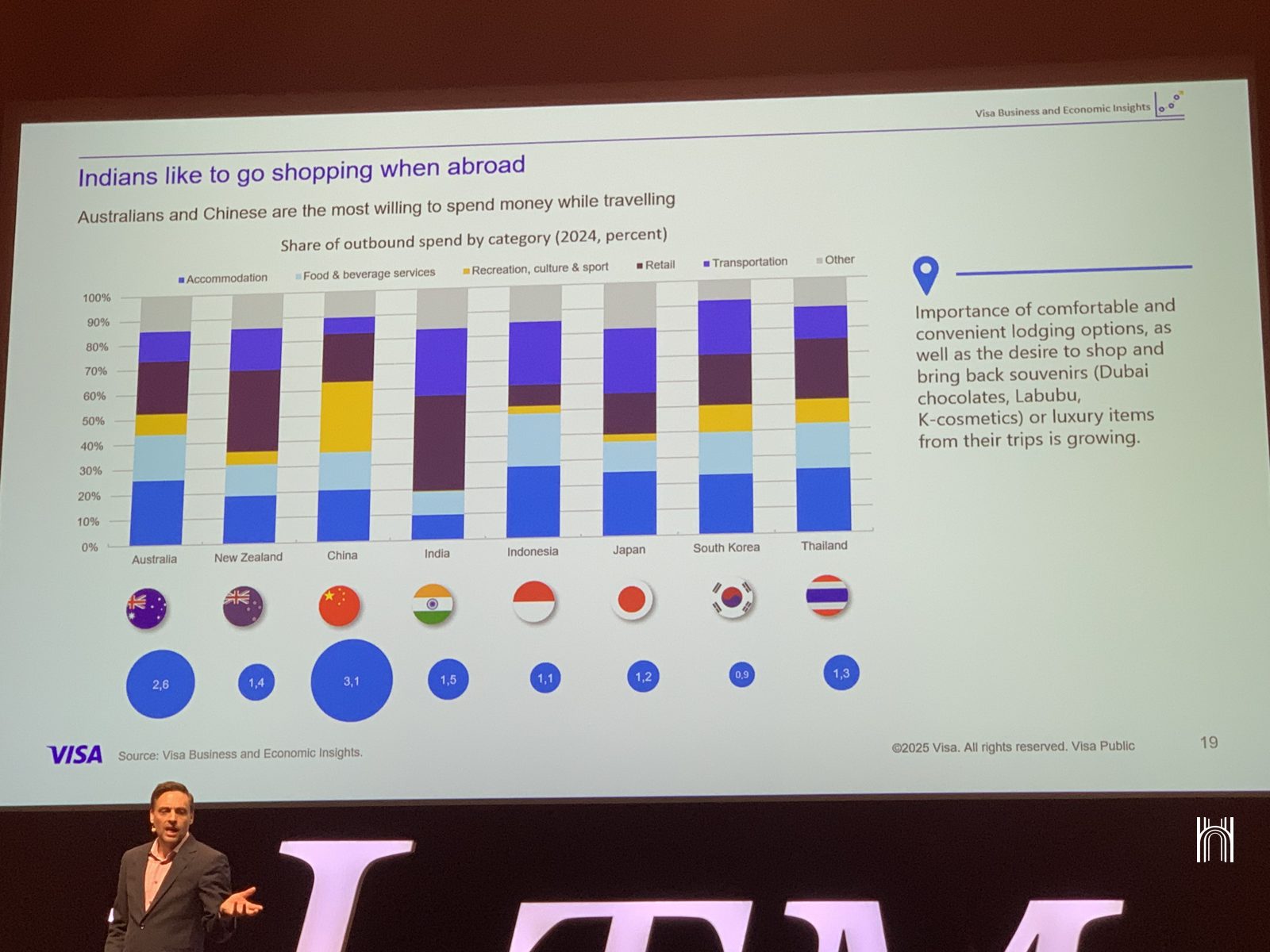
A hotel that targets a clientele without knowing this structure builds an offer that misses demand. Offering a room upgrade to guests who prioritise shopping means pushing the wrong door. Offering a boutique package to guests who invest in their accommodation means leaving money on the table.
The hotel is therefore no longer just a place to stay. It is a stage for experiences, a producer of moments, sometimes a cultural publisher. Standardised services, however flawless, no longer create lasting difference if the experience leaves no trace. The winning hotel is not the one that piles up the most services, but the one that produces the clearest memory.
I often put it this way: a hotel is a maker of memories. Great families once gathered in these houses for birthdays and special occasions, and the hotel knew it was responsible for marking those moments. That role has not disappeared; it has been buried under logistics.
What does Dubai chocolate teach us?
That a micro-trend can shift a consumption curve within a few weeks, and fall back just as fast. Organised scarcity works. It does not repeat itself.
Simon Baptist told the story with a smile, and it is worth remembering.
In Dubai, meal delivery orders usually follow two peaks, lunch and dinner. On one platform in particular, two abnormal peaks appeared, just before lunch and just before dinner. A colleague of the economist first looked for a complicated explanation. The real reason was simple: Dubai chocolate, which had gone viral, was put on sale only in those two time slots.
The shift in consumption was spectacular. Then everyone joined in. Today, the same chocolate sells for two dollars in a convenience store. The same phenomenon is playing out again in Korea with cosmetics, and with the filming locations that travellers want to see with their own eyes.
The opportunity and the trap fit in the same sentence. It is possible to create consumption. But it has to be started over and over again, and each repetition brings in less.
The lesson, then, is not to chase virality. It is to understand the mechanisms at work, time-limited scarcity, social trigger, proof effect, sharing, and then to put them at the service of an experience that would have existed anyway. A table available by reservation only, a ritual that exists only in this house, a cultural collaboration rooted in the place. The difference between artifice and signature comes down to one thing: the signature outlives the end of the trend.
I explored this reflection on ostentation in 2019 with the students of HEC Paris, during a master class on luxury hospitality. They were the ones who alerted me to the ethics of luxury and to the unease felt in the face of extraordinary offers. Enjoying luxury is one thing. Enjoying it under the gaze of those who will never have access to it is another. Six years later, the question has become central.
Laurent Delporte's key insights
This is why I travel. ILTM in Cannes, MIPIM, EquipHotel, the Luxury Hospitality Conference in Milan: I attend the events where economists from the major payment networks, operators and data firms present their findings. What I take away are not trends. They are measured purchasing behaviours, with their date, their amount and their origin.
Knowing your clientele's financial behaviour is the basis of every trade-off. Which month to focus the sales effort on. Which source market deserves an enriched accommodation offer, and which will prefer a concierge service geared towards shopping. Which competing destination is quietly winning the clientele you believe is yours. None of these decisions can be made with a declarative survey.
This is the heart of my consulting assignments and my guest experience audits. I start by looking at what guests actually buy, at what time of year, at what price, and at which point in the journey value is lost, and I anticipate what they will also want to buy. Following buyer behaviour makes it possible to look ahead to the coming years. The recommendation comes afterwards, and it is rarely the one management expected.
Two points from this conference deserve, in my view, to be pinned up in every executive office. The first: December concentrates the peak in all five luxury capitals, but the rest of the calendar is strictly local, and copying it from one market to another is costly. The second: an acquired reputation protects against nothing. Florence, Kyoto and Geneva are learning this while Lyon and Lucerne advance.
The luxury of 2026 will not be won through noise. It will be won through mastery.
Key takeaways
Luxury purchases softened in 2025 in the five capitals measured by Visa. Dubai dominates; Paris holds up better than London, New York and Singapore.
December concentrates the annual peak in all five cities. The rest of the seasonality is local: Dubai in June and October, Paris in summer, Singapore in February, New York stable apart from a winter dip.
Lyon, Lucerne, Hokkaido and Madrid are winning the affluent traveller. Florence, Kyoto, Osaka and Geneva are losing them. Ho Chi Minh City, Mumbai, Manila and Bogotá are growing from a low base.
Japan benefits from a yen forty per cent weaker, which explains most of its success. Japanese travellers, for their part, travel half as far on the same budget.
The Middle East posts the best performance in the world for arrivals. North America the weakest, with declines from almost every region.
Chinese travellers have shifted from retail to experience. Australians and Indonesians devote a large share of their budget to accommodation, Indians and New Zealanders much less.
A micro-trend can shift a consumption curve within a few weeks, then become commonplace. Organised scarcity works once. A signature outlives the trend.
My other articles from ILTM Cannes
Share this article with a colleague, a client or a partner.
That is often how an idea enters a house, and then its habits.
What you say about it matters more than what I say.
A keynote, a mission, an article in the magazine: if my work has been useful to you, a few lines on Google are worth more than any argument.
Leave a review on Google →