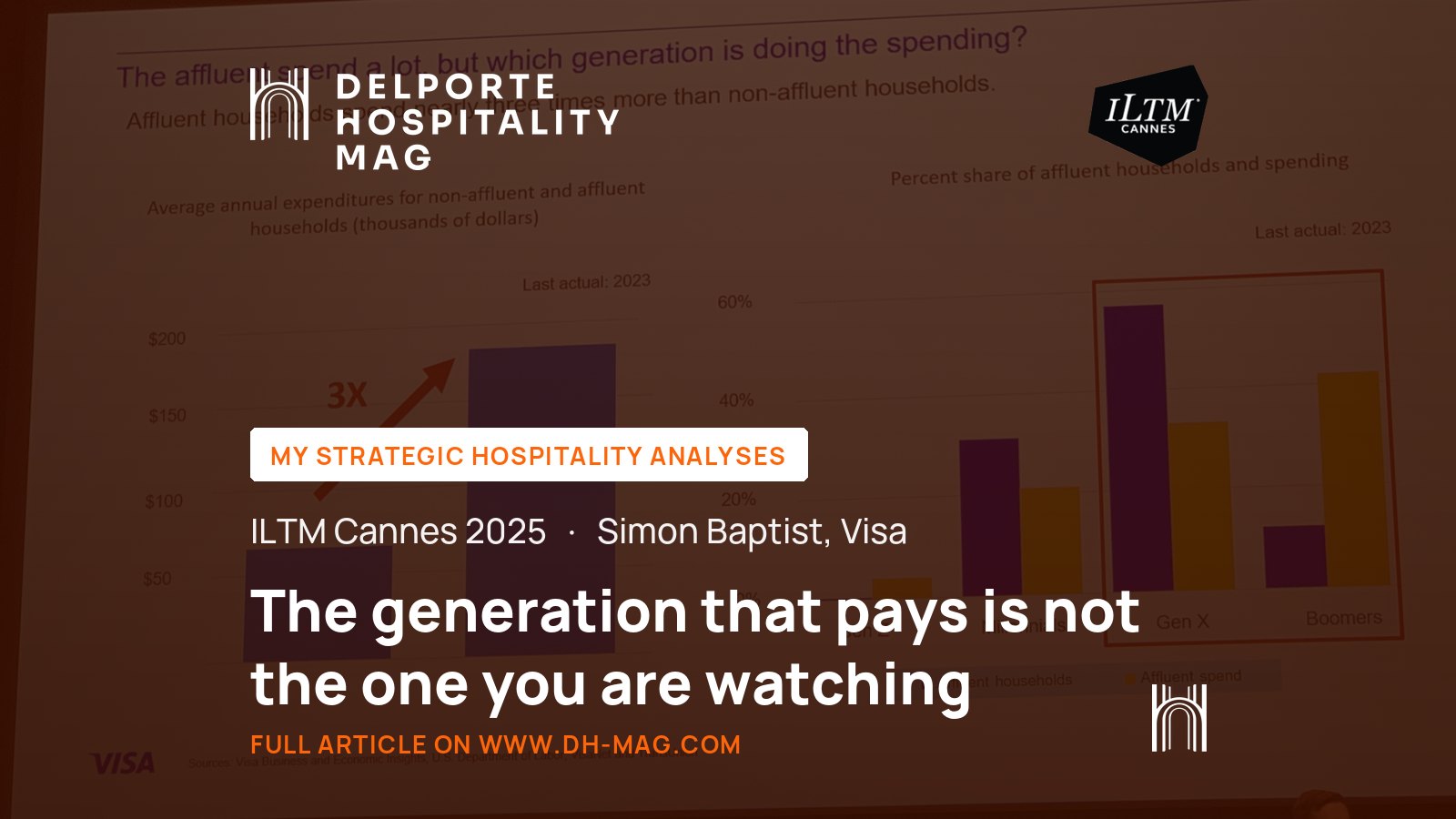
Cannes, December 2025. In front of the audience gathered for the opening conference of ILTM, Visa's chief economist puts up a chart of actual spending. Baby boomers account for 12% of affluent households and 42% of their spending. Generation Z barely shows up at all. And yet, for three years, luxury hospitality has been designing its products for the latter.
ILTM acts as the sounding board of high-end travel. Agencies, hoteliers, destinations and premium brands come every year to test their intuitions against commercial reality. The opening conference has one great merit: it puts the figures back at the centre before the meetings begin.
That day, the talk by Simon Baptist, Visa's chief economist, offered a welcome counterpoint. No brand story, no product promise. Payment records, international comparisons, and a conclusion the room took a few seconds to absorb: the market is not shrinking, it is reshaping itself.
There are two ways of understanding a market. Listening to what customers say they want, or looking at what they buy. The first produces studies of intent. The second produces card payment records. The gap between the two is where the most expensive strategic mistakes are made.
Where does luxury growth really come from?
From the top, and from nowhere else. Over five years, spending has grown by 1% on mass-market cards, 7% on those of affluent households and 15% on those of the very wealthy.
These three figures fit on a single line, and they belong in every hotel executive committee.
The mass market is no longer growing. Affluent households are moving forward steadily. The very wealthy are accelerating. Luxury growth is therefore not a rising tide that lifts all boats. It is a concentration.
Simon Baptist spells out the cause plainly. The spending of the wealthiest follows the performance of financial markets and the valuation of assets. As long as the markets hold, this clientele spends. It is the foundation of demand. It is also the one risk factor over which no hotelier has any control.
Still, it helps to know who we are talking about. Visa sets the threshold: a household enters the wealthiest 10% with at least 210,000 dollars of annual income or a net worth of at least 1.8 million dollars. The figure is American, but the order of magnitude frames the debate. The customer the industry talks about is not an abstraction: they have a threshold.
The geography of this wealth matters as much as its volume. In Switzerland, the United Arab Emirates and Hong Kong, spending is heavily concentrated among the ultra-wealthy. In the United Kingdom, the United States and Australia, the intermediate affluent clientele carries more weight, and the volumes with it. The same hotel product is therefore not calibrated in the same way in Geneva and in Sydney. Not because of climate or culture, but because the structure of wealth is different there.
Reducing luxury to the top one per cent would be a costly mistake. Simon Baptist insists on the intermediate tiers, the top twenty, ten and five per cent, especially in emerging markets. In India, the Philippines and Indonesia, the number of households earning more than one hundred thousand dollars a year is set to rise sharply. Those at the top of the ladder today will be the very wealthy of the next decade.
Which generation really funds luxury?
Baby boomers, by a long way. They account for 12% of affluent households and 42% of their spending, three and a half times their weight. Generation X makes up 57% of these households. Generation Z is almost absent from these amounts.
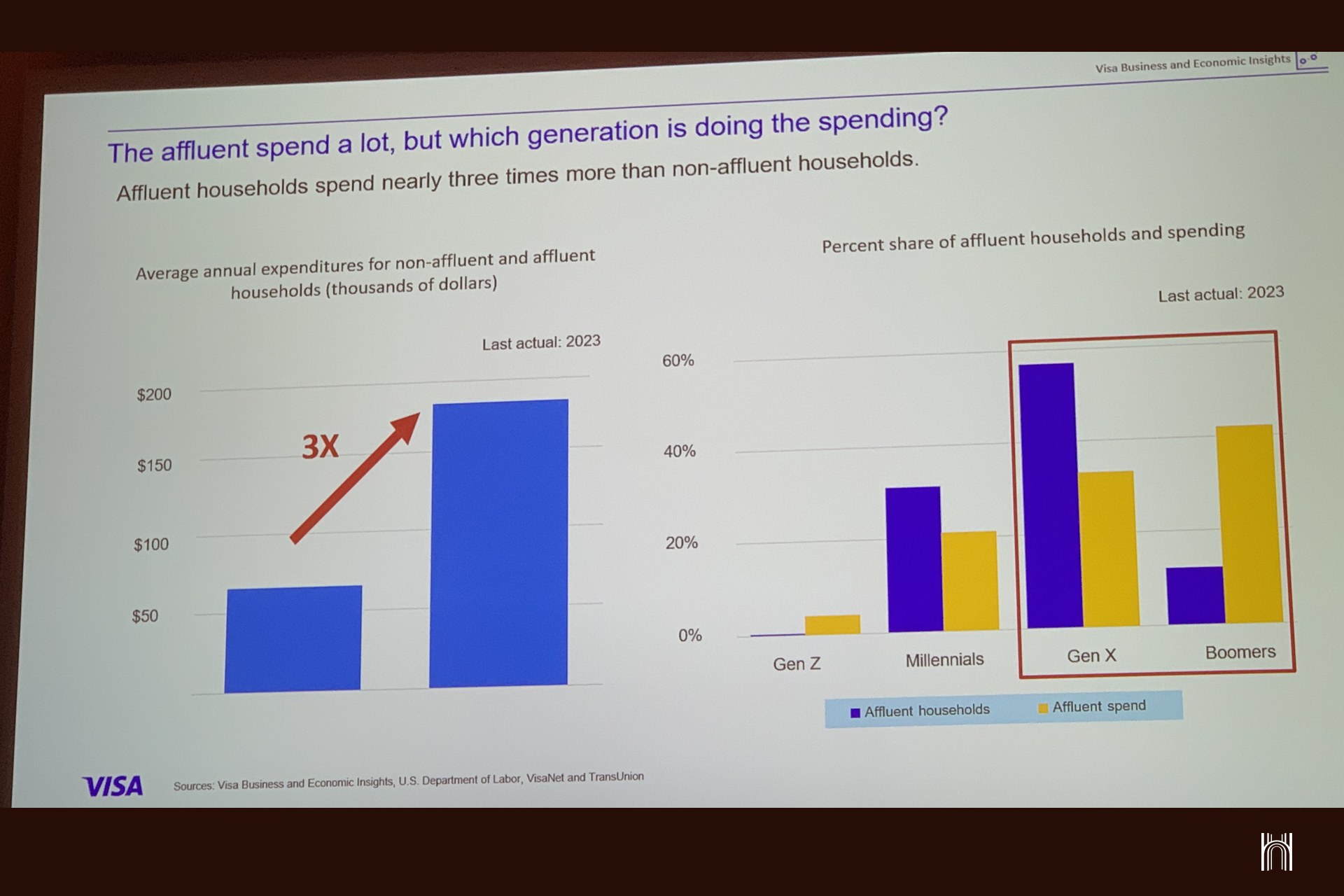
This is the figure our industry should think about most.
Twelve per cent of households, forty-two per cent of spending. The ratio is one to three and a half. The measure covers American households, the only market where Visa publishes this generational breakdown, but it describes a mechanism the ILTM audience immediately recognised. Generation X, the largest in number, spends proportionally less. Millennials spend even less than their demographic weight. As for Generation Z, it represents a marginal fraction of affluent households and a tiny share of the amounts spent.
So let us ask the uncomfortable question. How many hotel projects of the last three years have been conceived, designed, furnished, scored and marketed for Generation Z?
This clientele matters, but not for the reasons the industry puts forward. Its weight is not financial, it is cultural. It shapes imaginations, sets codes, speeds up trends through sharing and turns places into symbols. It prescribes without paying, and it will pay later. Confusing these two roles leads to designing a product for a customer who will not book.

The wealthy sixty-year-old guest, for their part, is not looking for constant novelty. They look for stability, comfort, security, simplicity, and a seamless service that protects their time. They gladly pay a high price when the establishment keeps a silent promise: everything becomes easy, nothing has to be negotiated, and their energy remains free for what they came to experience.
Visa also points out something few management teams have taken on board: the affluent clientele keeps up its discretionary spending much later in life. An ordinary consumer's restaurant spending peaks at around thirty-nine. For an affluent consumer, it peaks at around fifty. The life curve of the wealthy guest is not that of the average guest, and the hotel industry keeps reasoning with the latter.
An establishment designed only for Generation Z will disappoint this clientele by sacrificing comfort and clarity. An establishment designed only for boomers will lose all its power of desire among younger people, and therefore its clientele of tomorrow. The market does not impose a choice between the two. It requires keeping both promises at the same time, which is infinitely more demanding than choosing one.
In my assignments, I put it this way: simplicity for those who pay today, meaning for those who will pay tomorrow. Neither should be funded at the expense of the other.
What should a hotelier do with these figures?
Give up on the average customer, serve two generations with opposite expectations, and treat the entry level as recruitment rather than dilution.
Five decisions follow directly from these data.
Give up on the average customer. The figures show polarisation, not a shift. Designing for a median customer means disappointing both ends of the market.
Serve simplicity and meaning at the same time. The first is owed to the clientele that pays today, which buys the absence of friction. The second is owed to the clientele that will pay tomorrow, which buys meaning.
Check the real age of your solvent clientele. Many management teams work with a picture of their clientele that is five years old. The establishment's payment data, cross-referenced with length of stay and average spend, tell the truth in an afternoon.
Treat the entry level as an investment. In several markets, extra income in an affluent household goes straight to luxury. A well-designed entry offer does not dilute the brand, it recruits the clientele of the next decade.
Stop describing your value and prove it. A customer who compares constantly does not remember adjectives, they remember proof.
Laurent Delporte's keys to understanding
This conference did not give me a list of trends. It reminded me why I travel.
I am regularly at ILTM in Cannes, at MIPIM, at EquipHotel, at the Luxury Hospitality Conference in Milan, at the trade shows and conferences where figures come out before they are published. This is not professional tourism. It is the raw material of my work. A consultant who does not hear the economists of Visa, STR or the major operators advises with last year's data, and last year no longer looks like this one.
What I bring back from these rooms, I turn into decisions for establishments. Knowing the financial behaviour of your clientele is not an analyst's exercise, it is the basis of every trade-off: which room category to renovate first, which service to drop without losing revenue, which entry offer to create without damaging the brand, which month to focus the sales effort on.
This is precisely what my consulting and strategic support assignments are about. I rarely start with a recommendation. I start by looking at what the clientele actually buys, at what time of year, at what price, and where the journey loses value. The recommendation comes afterwards, and it is rarely the one management expected.
Our industry feeds on studies of intent, panels and statements. Payment data do not lie about behaviour: they record what was bought, when, and by whom. The generational figure is the perfect illustration. The industry's attention is on a clientele with immense cultural weight and still marginal purchasing power, while more than four tenths of affluent spending comes from a generation that marketing takes for granted, and has stopped listening to.
Neither of these two clienteles should be neglected. But neither will be satisfied with a product designed for the other.
Key takeaways
Over five years, spending grew by 1% on mass-market cards, 7% among affluent households and 15% among the very wealthy. Luxury growth is a concentration, not a tide.
Visa defines an affluent household as belonging to the top 10%: at least 210,000 dollars of annual income, or 1.8 million dollars of net worth.
Baby boomers account for 12% of affluent households and 42% of their spending, three and a half times their weight. Generation X makes up 57% of these households.
Generation Z carries cultural weight, not financial weight. It prescribes today and will pay later.
The affluent clientele keeps up its discretionary spending much later in life: restaurant spending peaks at around 39 for an ordinary consumer, around 50 for an affluent one.
In Switzerland, the United Arab Emirates and Hong Kong, spending is concentrated among the ultra-wealthy. In the United Kingdom, the United States and Australia, the intermediate affluent clientele carries more weight.
A well-designed entry offer does not dilute a luxury brand: it recruits the wealthy clientele of the next decade.
My other articles born at ILTM Cannes
Share this article with a colleague, a client or a partner.
That is often how an idea enters a house, and then its habits.
What you say about it matters more than what I say.
A keynote, a mission, an article in the magazine: if my work has been useful to you, a few lines on Google are worth more than any argument.
Leave a review on Google →