The hospitality of tomorrow, a new world
Imagining tomorrow's world, and the way we'll live in it, are two essential ingredients for creating the hospitality of the future. Rooted in our culture, our history and our past experiences, it's fairly easy to project ourselves forward. On my travels and stays in many hotels, I analyze every stay: what I liked, what bothered me, what I disliked.
When thinking about the ORIGINE® room, created for the EQUIPHOTEL trade show with the architecture firm AW2, I thought first and foremost about the guest experience and common sense. Today, I want to walk you through one example.
Water is vital to us, and yet…
We need to drink between one and two liters of water a day. It's a vital matter for our health and wellbeing. Our bodies need it. Yet when you stay at a hotel, it's not easy to find the equivalent of two to three liters of water in your minibar. At best, you'll find two 25 to 33 cl bottles. When you travel the world, you know water is a real issue, and that it matters to offer quality water, good to the taste, that reassures the guest.
There's also an ecological dimension, with thousands of plastic water bottles that have traveled long distances. The carbon footprint carries real weight.
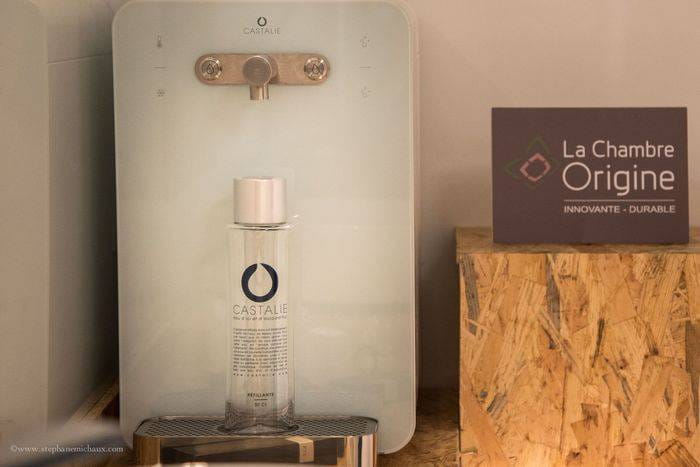
That's why, for the hotel room of the future, I simply imagined the possibility of free access to purified water, warm or cool, still or sparkling. That way, the guest isn't limited in how much they drink, and doesn't depend on anyone to be restocked when needed.
To make this happen, I asked the company Castalie to partner on the ORIGINE® room, because I believe the coming years will see this service gradually roll out in 5-star, then 4-star, hotel rooms.
Thibault Lamarque, founder of Castalie, accepted our partnership and explains his involvement in this vision of the hotel room of the future, the ORIGINE® room: “We were especially drawn to your commitment and the innovative approach of the Origine® room concept, which matches our own values, rooted in sustainability. It's still (too) rare to see hotels take ecological needs into account while also offering a wellbeing solution.”
Plastic bottles, an environmental nonsense
Many hotels promote sustainability, and yet many of them still offer plastic water bottles. They carry a heavy energy cost, from extraction to bottling to the transport needed to bring them to the hotel (imagine seeing French-brand water bottles in China or the United States). What's more, some plastics aren't even recyclable.
Castalie proposes using and filtering tap water. Filtration removes any residual pollutants and makes the water more neutral. It contains 27 times less sodium, and its dry residue is 3.5 times lower than mineral water. That way, guests can drink what they want, and drink it well. Castalie also manufactures glass bottles in France, which can be customized to the hotel's colors and have an unlimited lifespan.
Guests can use the bottle however they like during their stay and refill it whenever they need to: it becomes a new companion that creates a bond with the hotel. They can, for instance, take it with them when they go out. Once cleaned, this glass bottle can be reused every day. It's a genuine, quality service that meets a real expectation from hotel guests. When you spend a whole day in your room, you want to drink water, not just the sodas or alcohol on offer. Water is as vital to us as oxygen. Oxygen is free, so why pay for water, which is just as important, unless hospitality is about to start charging us for the air we breathe 😉, though I doubt it.
Hospitality has already welcomed coffee machines and kettles into hotel rooms. After a bit of training for housekeeping staff, and a little negotiation, hoteliers installed these machines in rooms without much difficulty. So we can imagine that micro-filtered water will develop just as quickly in hotel rooms.
Share this article with a colleague, a client or a partner.
That is often how an idea enters a house, and then its habits.
What you say about it matters more than what I say.
A keynote, a mission, an article in the magazine: if my work has been useful to you, a few lines on Google are worth more than any argument.
Leave a review on Google →