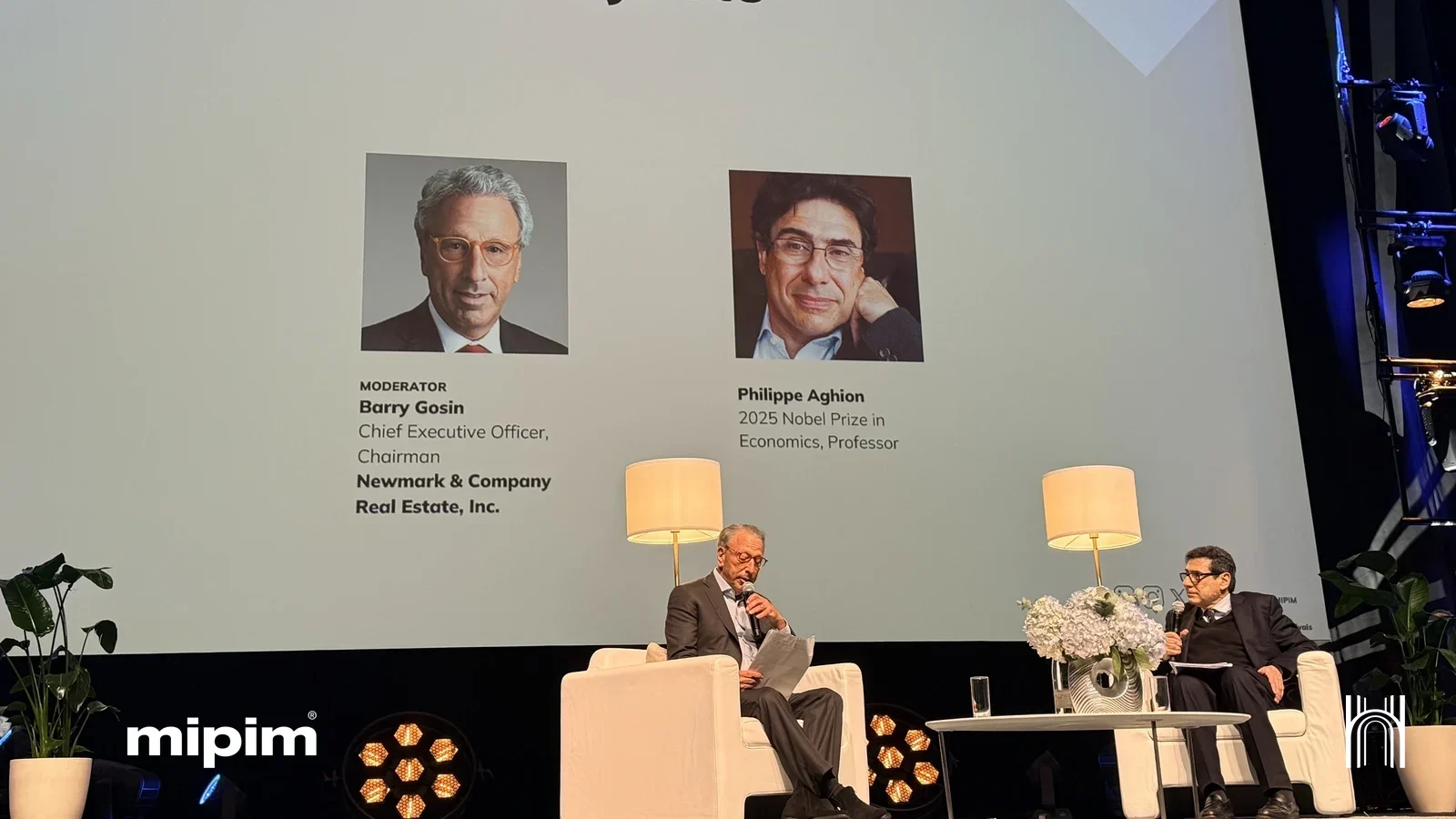
At MIPIM in Cannes, the economist Philippe Aghion, winner of the 2025 Nobel Prize in Economics and professor at the Collège de France and INSEAD, shared his reading of the economic transformation brought about by artificial intelligence and the dynamics of creative destruction. His analysis sheds direct light on the evolution of service professions and, more particularly, those of hospitality.
Today’s technological transformation is profoundly changing organisations, professions and business models. Artificial intelligence accelerates this movement by automating certain tasks, increasing analytical capacity and making it easier to produce new ideas. In this context, companies must rethink the nature of the skills they seek and the way they train their people.
At MIPIM in Cannes, Philippe Aghion, an economist renowned for his work on innovation and economic growth, presented a structuring analysis of this shift. His approach rests on the concept of creative destruction, inspired by the work of Joseph Schumpeter. According to this theory, innovations gradually replace existing models and redefine economic activities.
Philippe Aghion
This dynamic now concerns every sector of the economy. It also affects service professions and, in particular, those of hospitality. Artificial intelligence does more than transform working tools. It redefines the way companies design the guest experience and the place given to human skills.
Creative destruction, a driving force in the transformation of professions
Creative destruction is one of the fundamental engines of economic innovation. Every technological revolution leads to the disappearance of certain activities while creating new opportunities.
Economic history is full of examples of this phenomenon. The automobile replaced animal traction, digital platforms transformed retail and digital technologies overturned the distribution of information. Each stage comes with resistance, because established players naturally seek to protect their positions.
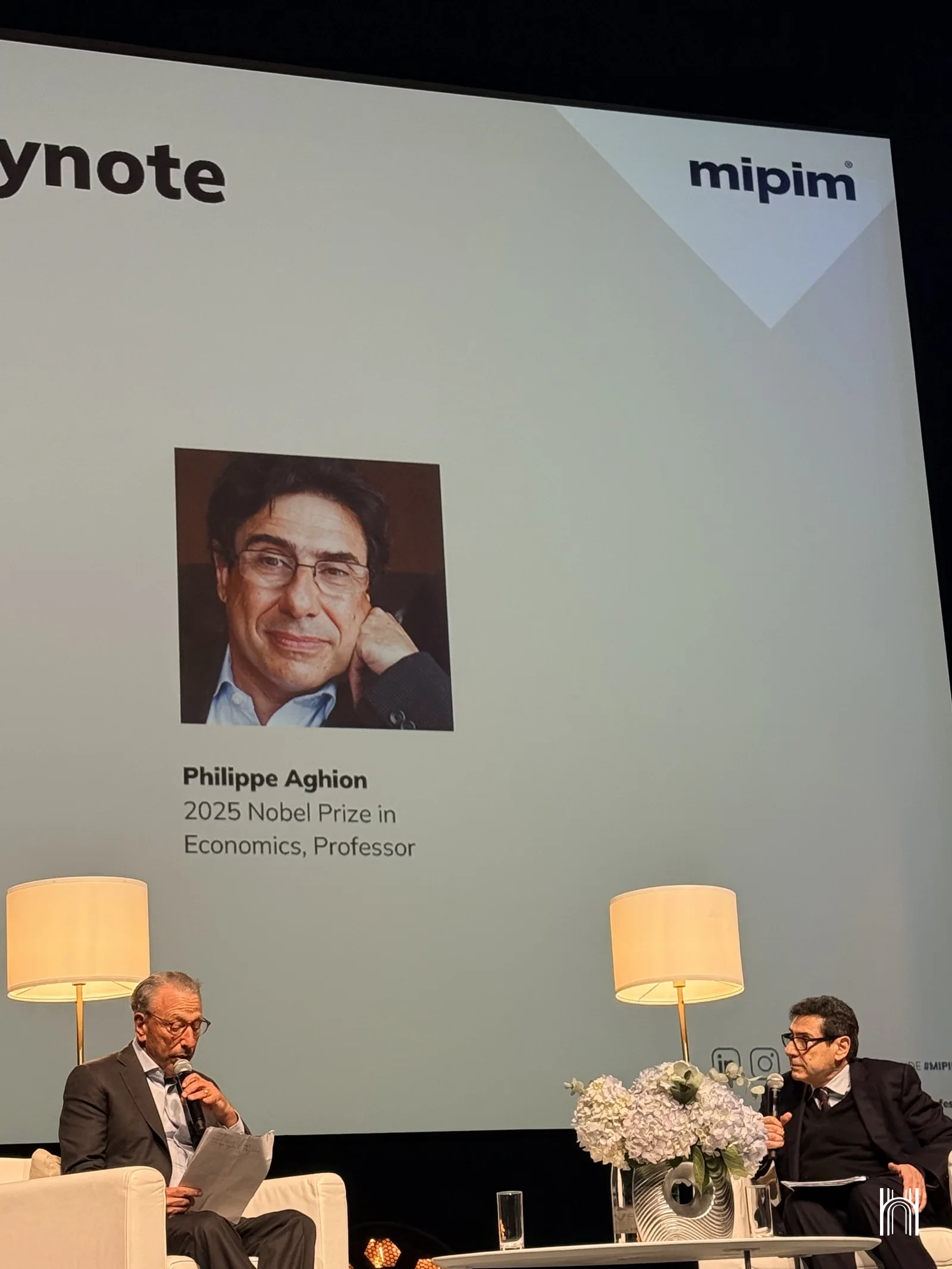
According to Philippe Aghion, this process remains at the heart of today’s economic dynamics. Artificial intelligence now represents a new phase of this transformation. Companies are adopting these technologies to improve their productivity, automate certain tasks and analyse ever larger volumes of data. This evolution is changing the nature of work and the structure of the skills sought.
Philippe Aghion
The transition is therefore not only about replacing professions with machines. Rather, it transforms roles and responsibilities within organisations. Human skills then become a decisive factor of differentiation.
Artificial intelligence as an accelerator of innovation
Artificial intelligence is not only a technological evolution. It represents a new infrastructure for producing ideas and knowledge.
Philippe Aghion
The capacity of these technologies to analyse and recombine information considerably accelerates innovation. Companies can identify new opportunities more quickly, improve their processes and develop new services.
In real estate, hotels and tourism, these transformations are already visible. Predictive demand management tools, energy optimisation systems for buildings and platforms that personalise the guest experience illustrate the growing integration of artificial intelligence into daily operations.
However, Philippe Aghion insists on an essential point: technology alone does not create economic prosperity. Institutions, public policies and education systems play a decisive role in the way societies make these innovations their own. Training individuals thus becomes one of the major challenges of the technological transition.
Training adaptable individuals rather than specialists
One of Philippe Aghion’s central messages concerns the necessary evolution of education systems. In an economy marked by rapid transformation, excessive specialisation can become a weakness.
Organisations now look for individuals who are able to adapt, to learn continuously and to move between several roles in the course of their career.
Philippe Aghion
This approach means valuing the skills that complement artificial intelligence rather than trying to compete with it. Cognitive skills, creativity, analytical ability and teamwork become essential. Soft skills also hold a central place in this transformation. Leadership, collaboration, emotional intelligence and communication are now strategic skills in many sectors.
This evolution particularly concerns service professions, where human relationships are at the heart of the value proposition.
Hospitality, a laboratory of human skills
Hospitality professions illustrate this evolution in concrete terms. In hotels, concierges, receptionists, restaurant teams, chefs, maîtres d’hôtel and guest experience managers all perform roles in which the quality of the human relationship is decisive.
Artificial intelligence is transforming the environment in which these professionals work. Digital tools make it possible to analyse guest preferences, anticipate certain needs and optimise operations. However, these technologies do not replace a professional’s ability to interpret a situation or create a personalised experience.
A concierge no longer simply recommends an activity. The concierge draws on available information, understands the guest’s unspoken expectations and suggests an experience suited to their personality. A receptionist becomes a true conductor of the guest experience, able to coordinate the hotel’s services to create a coherent and fluid journey. In a hotel restaurant, front-of-house teams and chefs must understand the expectations of international diners, adapt their service and turn every interaction into a moment of hospitality.
In this context, several skills become essential for service professionals. Relational intelligence is the first of them: perceiving unspoken expectations, understanding emotions and adapting behaviour. The ability to interpret data also becomes decisive, as technological tools provide a growing amount of information about guests. Adaptability is another key quality in organisations where roles evolve quickly. Finally, creativity and initiative make it possible to turn available information into memorable experiences.
These skills correspond precisely to those that Philippe Aghion considers complementary to artificial intelligence.
At DELPORTE HOSPITALITY, this reflection is now a central focus of the strategic consulting carried out with companies in the sector. In conversations with the leaders of hotels, service companies and real estate groups, the question of the impact of artificial intelligence on welcome professions and the guest experience now comes up systematically. These discussions rest on a simple conviction: technology transforms organisations, but hospitality remains fundamentally a human relationship.
Europe and the challenge of innovation
Philippe Aghion also underlines the importance of the institutional framework in successful technological transitions. Public policies, education systems and social models strongly influence the capacity of societies to innovate.
Europe has several assets in this area. Its human capital, the quality of its universities and its social model form solid foundations for developing an innovative economy.
However, the economist points out that Europe must avoid a relative decline compared with the United States and China. Innovation requires dynamic ecosystems, able to turn scientific research into companies and economic projects.
In this context, the ability to train talent and support career transitions becomes a key factor of competitiveness. Service sectors, and hospitality in particular, play a special role in this dynamic. They represent a significant part of the European economy and offer privileged ground for experimenting with new forms of relationship between technology and human experience.
Key takeaways
The transformation brought about by artificial intelligence marks a new stage in economic history. The dynamics of creative destruction described by Philippe Aghion remind us that innovation is constantly transforming activities and professions.
In service sectors, this evolution does not reduce the value of people. It strengthens it. Technologies automate certain tasks, but they make skills based on understanding individuals, intuition and creativity even more precious.
Hospitality professions offer a particularly enlightening illustration of this transformation. Concierges, receptionists, chefs, front-of-house teams and guest experience managers already embody the skills that tomorrow’s economy will value more highly: empathy, adaptability, relational intelligence and the ability to create experiences.
Training welcome professionals in these new skills becomes a strategic issue for companies and for training institutions.
These reflections are now the subject of many conferences and talks on the future of hospitality. Laurent Delporte notably supports companies in the sector on the transformation challenges linked to artificial intelligence applied to hotels and service professions, exploring the new balance between technological innovation, guest experience and generous hospitality®.
Philippe Aghion’s talk at MIPIM highlights several key ideas for service professions:
About the author
Laurent Delporte is a hospitality expert, speaker and founder of DELPORTE HOSPITALITY. He supports companies in their guest experience strategies, the transformation of service professions and the development of hospitality within organisations.
Through DELPORTE HOSPITALITY MAG, a MIPIM partner, he regularly shares his analysis of the evolution of hotels, places of welcome and hospitality professions. His work focuses in particular on the impact of technological transformation, including artificial intelligence, on the guest experience and on the skills of service professionals.
Share this article with a colleague, a client or a partner.
That is often how an idea enters a house, and then its habits.
What you say about it matters more than what I say.
A keynote, a mission, an article in the magazine: if my work has been useful to you, a few lines on Google are worth more than any argument.
Leave a review on Google →