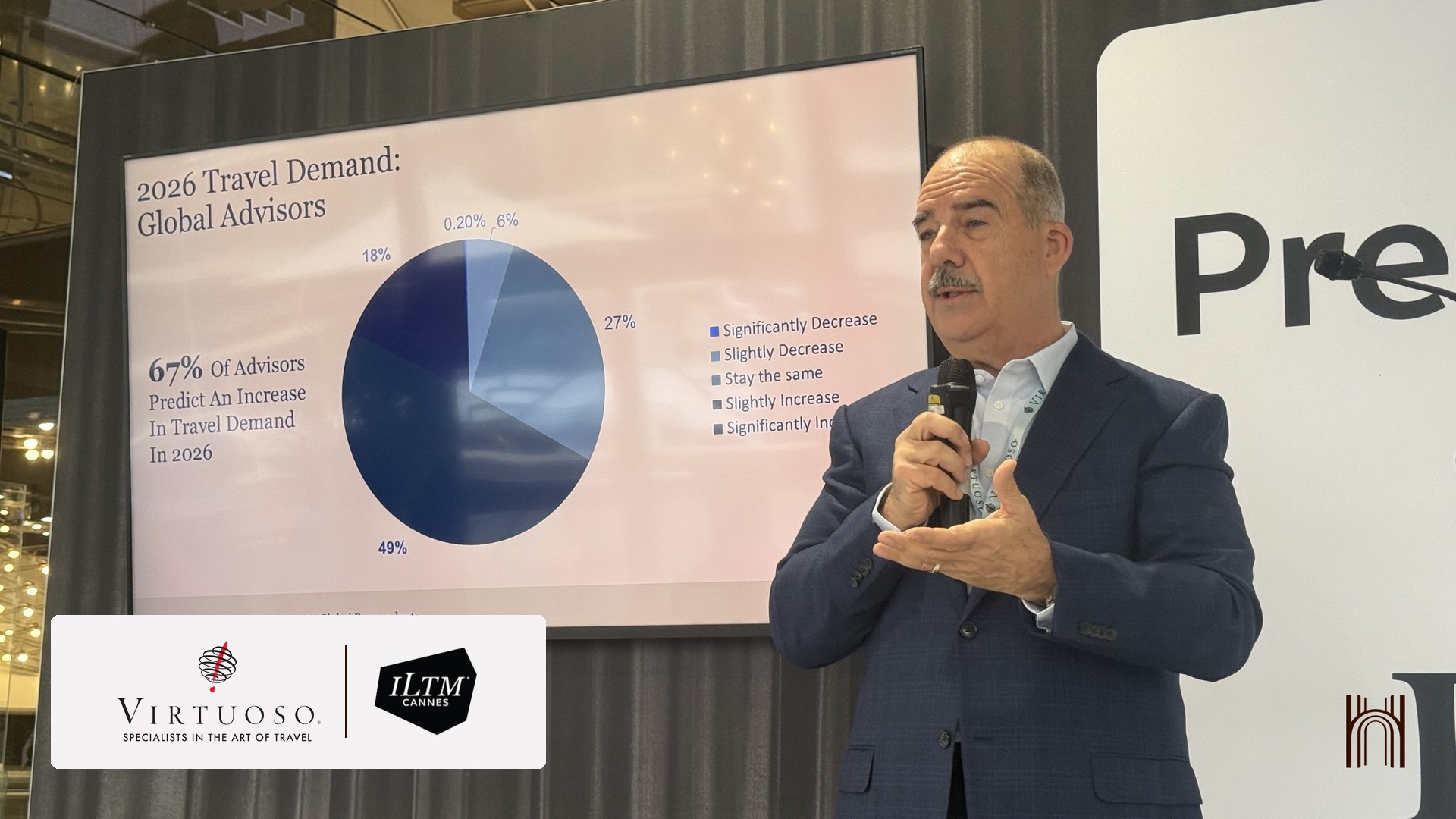
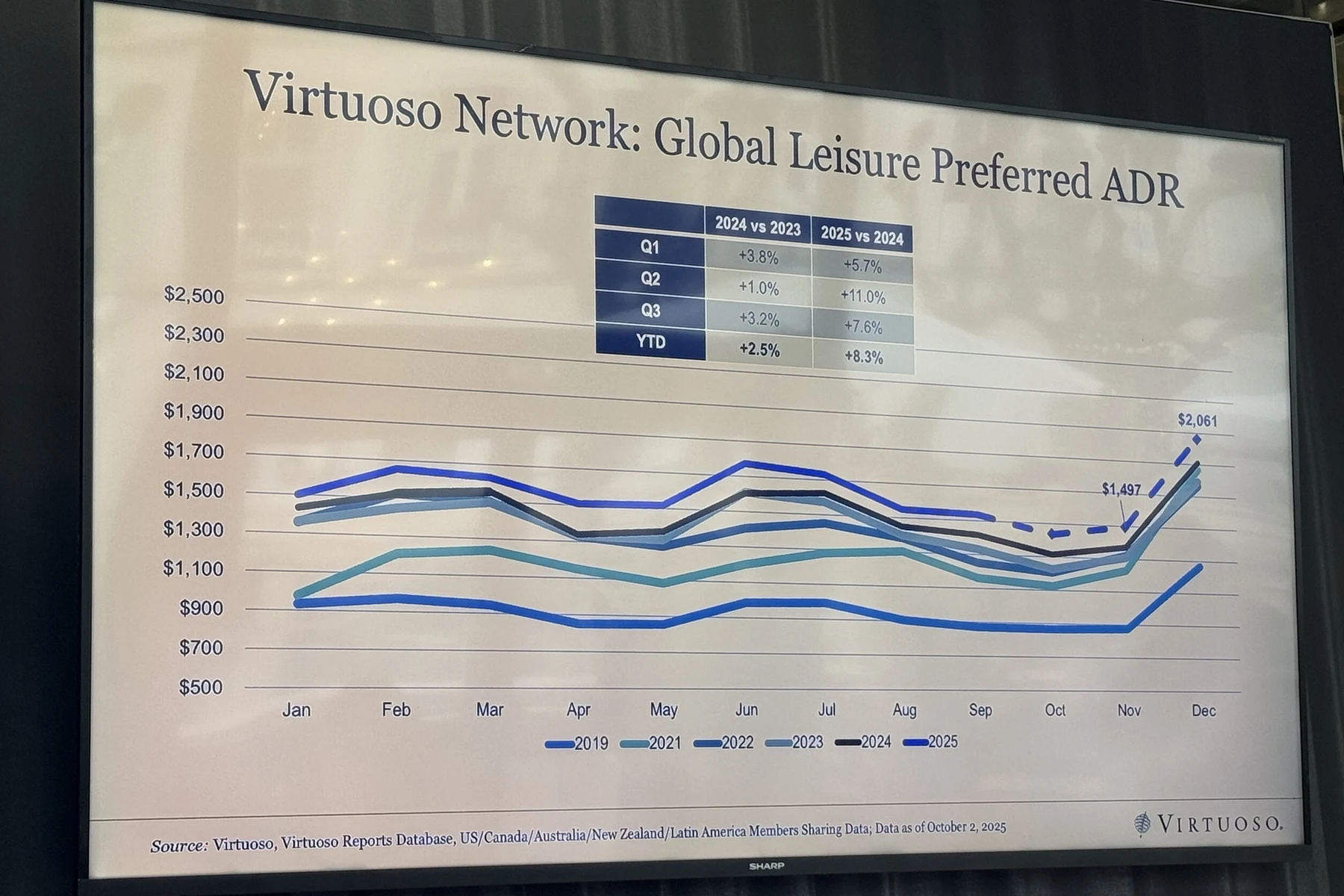
Matthew Upchurch has led Virtuoso for forty years. In Cannes, facing the ILTM press, he began by announcing what he would not talk about: not his pipeline, not his restaurants. Then he gave a figure. The average nightly rate across his preferred partners has just reached two thousand dollars, an all-time high. The question that follows is the only one that matters to a hotelier: what does that price actually buy?
Virtuoso brings together 553 member properties, hand-picks more than twenty thousand travel advisors and represents thirty-five billion dollars. The network sends clients from fifty-eight source markets and opened offices in Dubai and Singapore this year. This is not a travel agency. It is an observatory.
And that observatory has just measured something our industry spent twenty years declaring impossible.
Why has the travel advisor not disappeared?
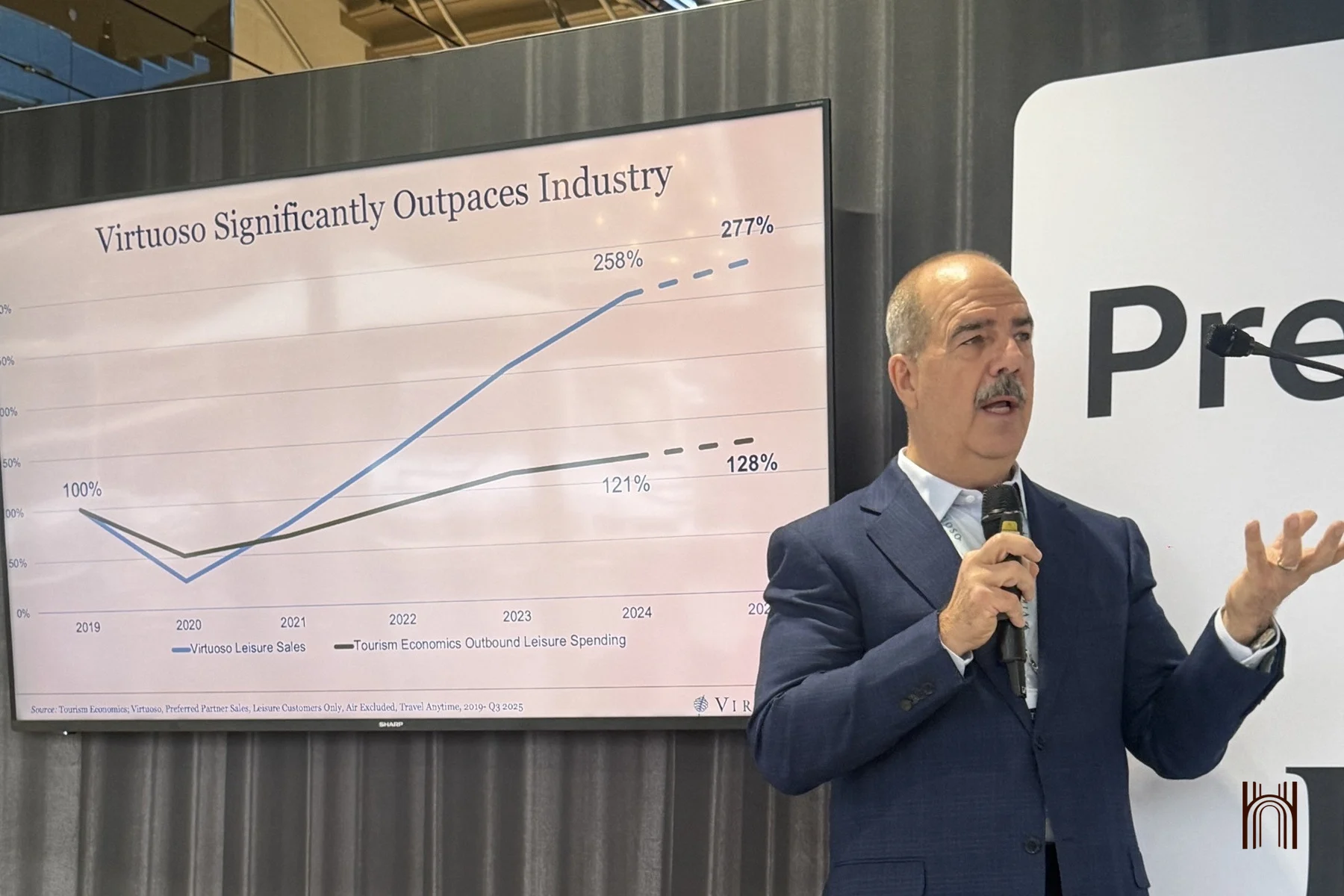
Because the wealthy client is not buying a booking. He is buying the fact of not having to make it. Since the pandemic, global leisure travel has grown by 128 %. The Virtuoso network has grown by 277 %.
Those two figures deserve a pause.
With every generation, Matthew Upchurch has heard the same prediction. Millennials would do everything from their phones. Then Generation Z would make the human intermediary irrelevant. Then technology would finish the profession off. The opposite happened, on a scale nobody had anticipated.
He explains it with a line he credits to millennials themselves, and it is the finest definition of luxury I have heard this year. Of course I could do it myself. I do not want to. Because I do not have to.
That sentence belongs above every hotel executive's desk. Contemporary luxury is no longer defined by what the guest receives, but by what he no longer has to do. Searching, comparing, weighing, booking, confirming, chasing, paying. Every gesture spared carries a value, and that value can now be quantified.
The study Virtuoso conducted with YouGov puts a number on it. For an equivalent trip, a client guided by a network advisor spends three times more than the client of an advisor outside the network, and four times more than a traveller who arranges the trip himself.
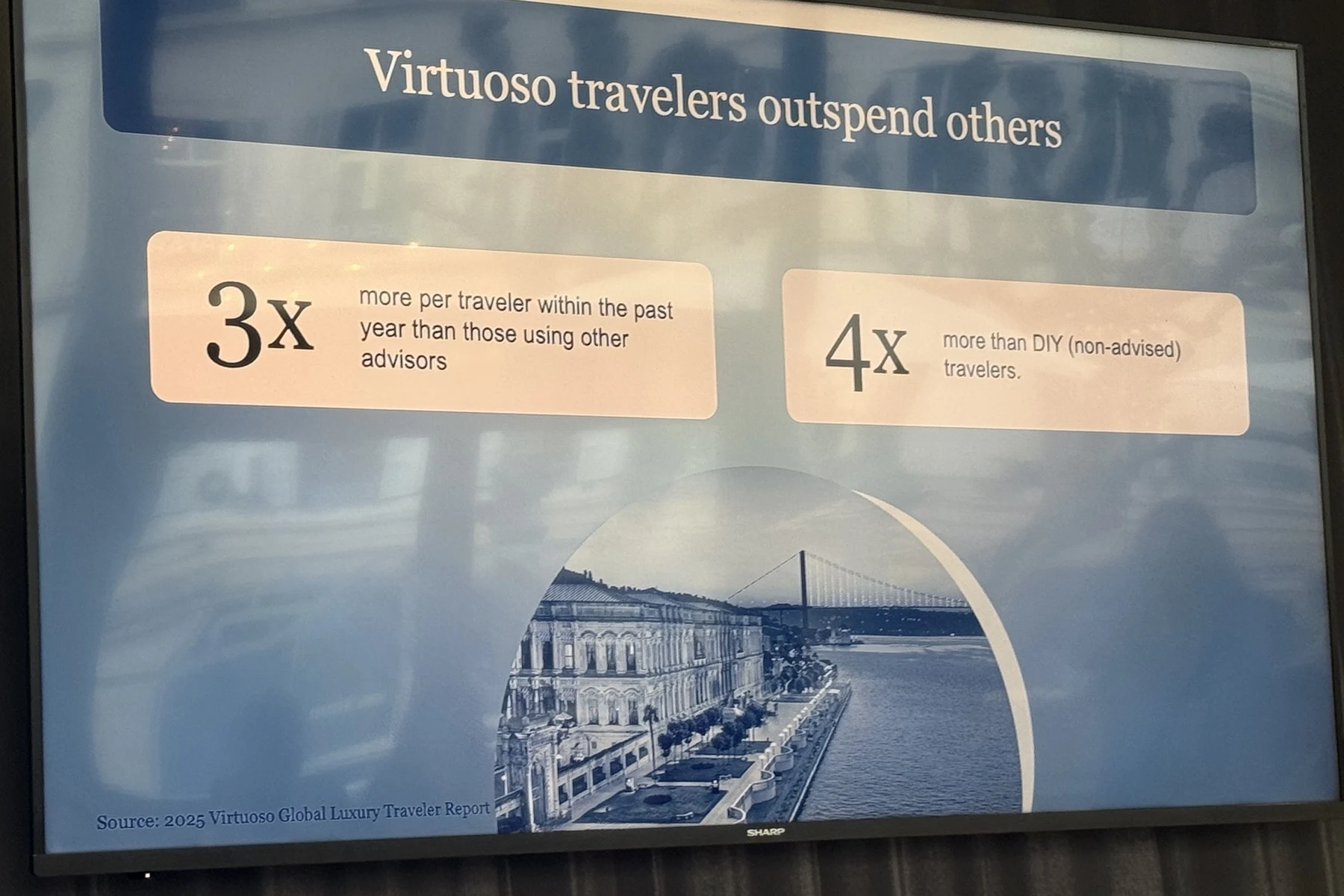
Three times. Four times. These gaps explain why general managers and revenue directors now look at this profession differently. Matthew Upchurch notes, with a hint of irritation, that financial owners still speak of distribution. He rejects the word: delivering a sack of potatoes and selling the nuance of luxury are two different trades.
The argument he sets against it is unanswerable. Which group of consumers has a trusted advisor in absolutely every area of life? Wealthy people. Wealth management, law, health, art, their children's education. There is no reason travel should be the exception.
What do the two-year order books reveal?
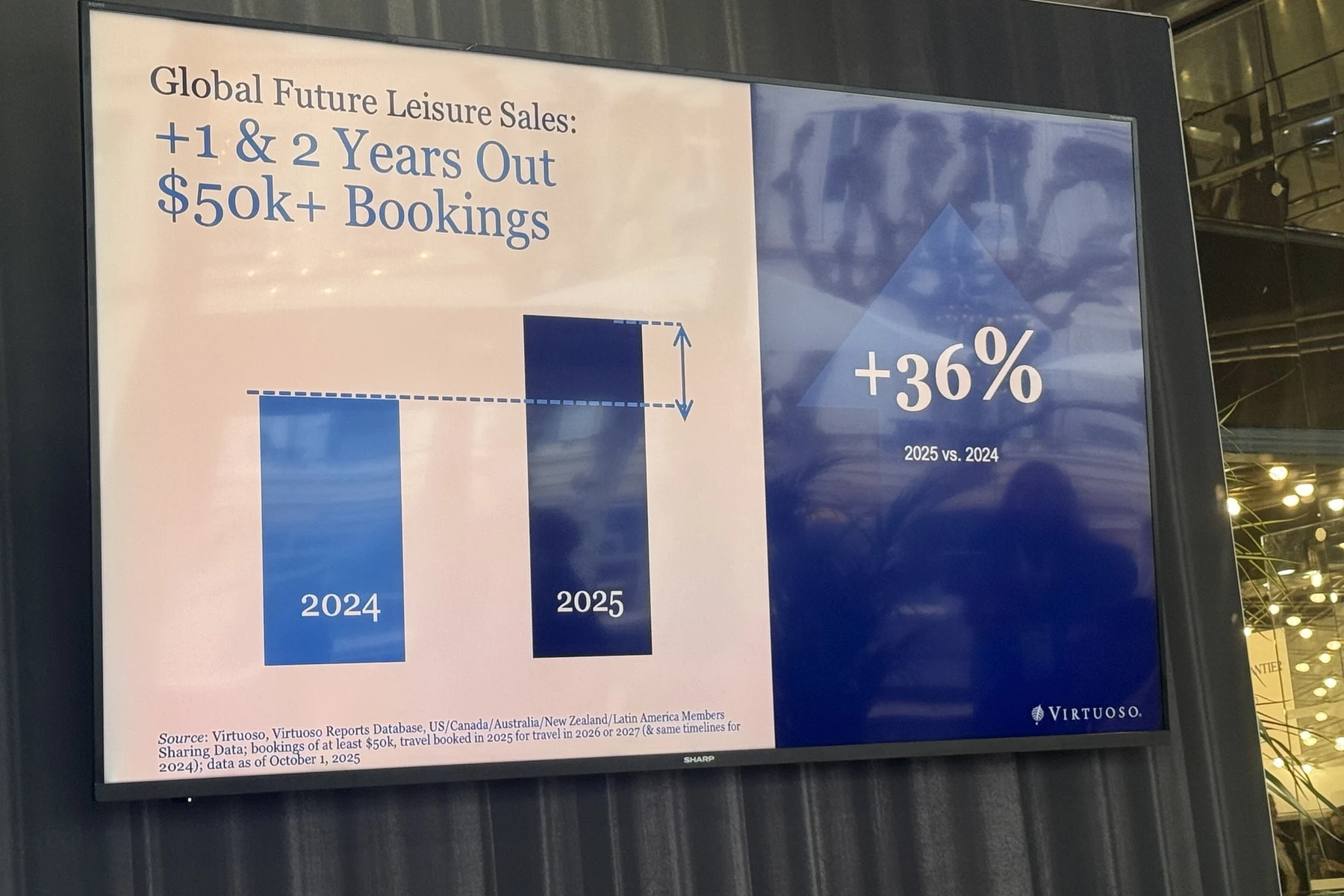
That luxury clients commit their money very early and very high. Sales booked one and two years out are up 24 %, and 36 % of those bookings exceed fifty thousand dollars.
Virtuoso has stopped measuring its business by the year, because the year no longer says anything meaningful about this trade.
A luxury advisor now works mainly on departures twelve months out or more. The network therefore measures its sales over a one to two year horizon. Over that horizon, growth reaches 24 %.
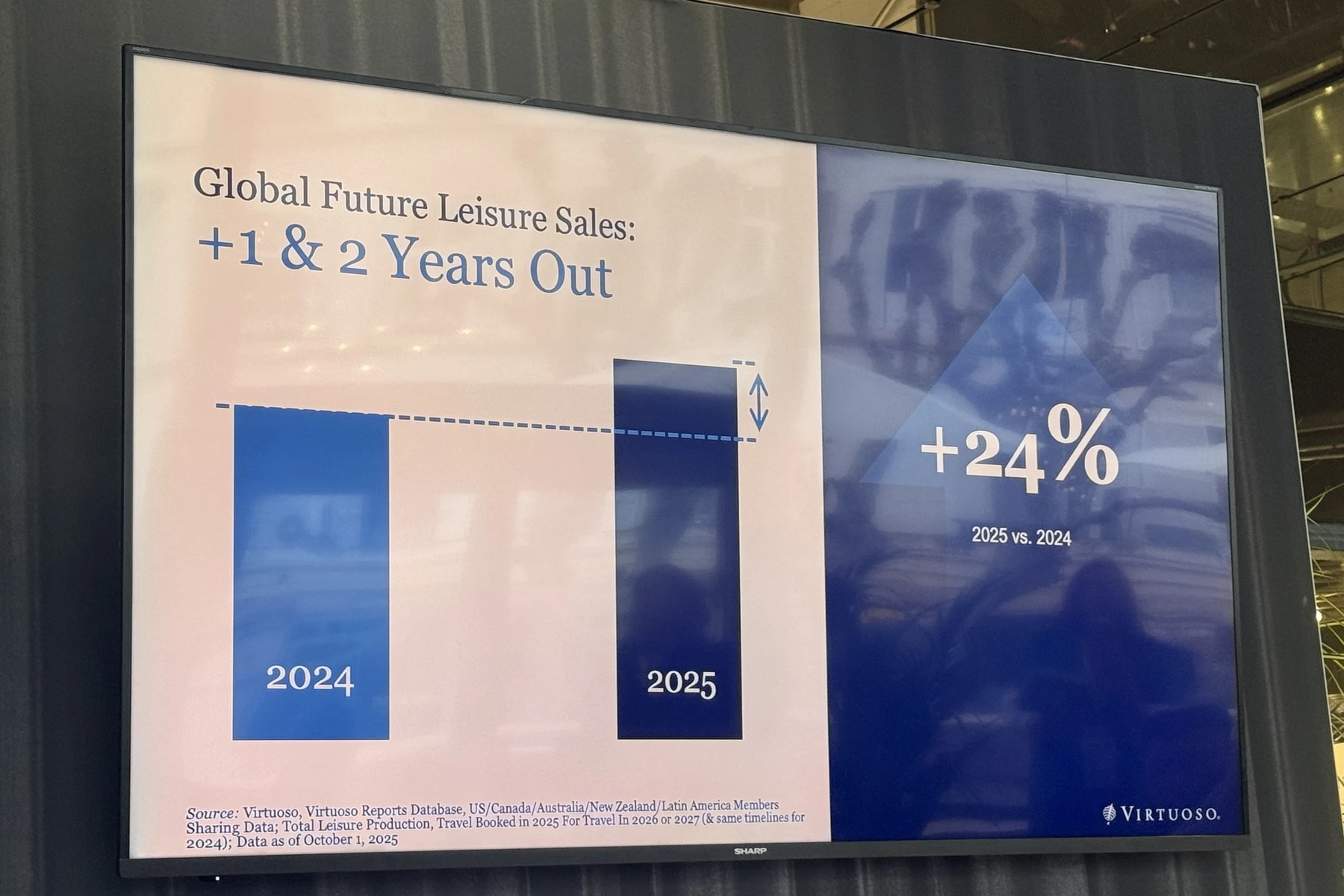
The second figure speaks louder still. Thirty-six percent of those distant bookings exceed fifty thousand dollars. This is not a client's annual spend. It is a single booking.
The festive season confirms the trend and reveals its mechanics. Production is up 29 %, made up of 18 % additional bookings and a 10 % rise in average price. Demand is climbing, and prices are following without breaking that demand.
Three forces explain this health, and Matthew Upchurch lists them without lyricism. The first is demographic, and frankly astonishing. Never in human history have six generations travelled at the same time. He adds a statistic that puts hotel projects back in their place: 66 % of all human beings who have ever reached the age of sixty-five are alive today. Sixty-five year olds have always existed, simply never in such numbers.
The second force is the now settled preference for experience over object. The third is wealth creation outside the historic markets, what he calls the rise of the rest.
Which trends are advisors forecasting for 2026?
Escaping the crowds, slow immersion, privatisation and wellness. Virtuoso's annual report, built on 2,485 advisors across more than fifty countries, forecasts rising demand for 67 % of them and higher spend per trip for 66 %.
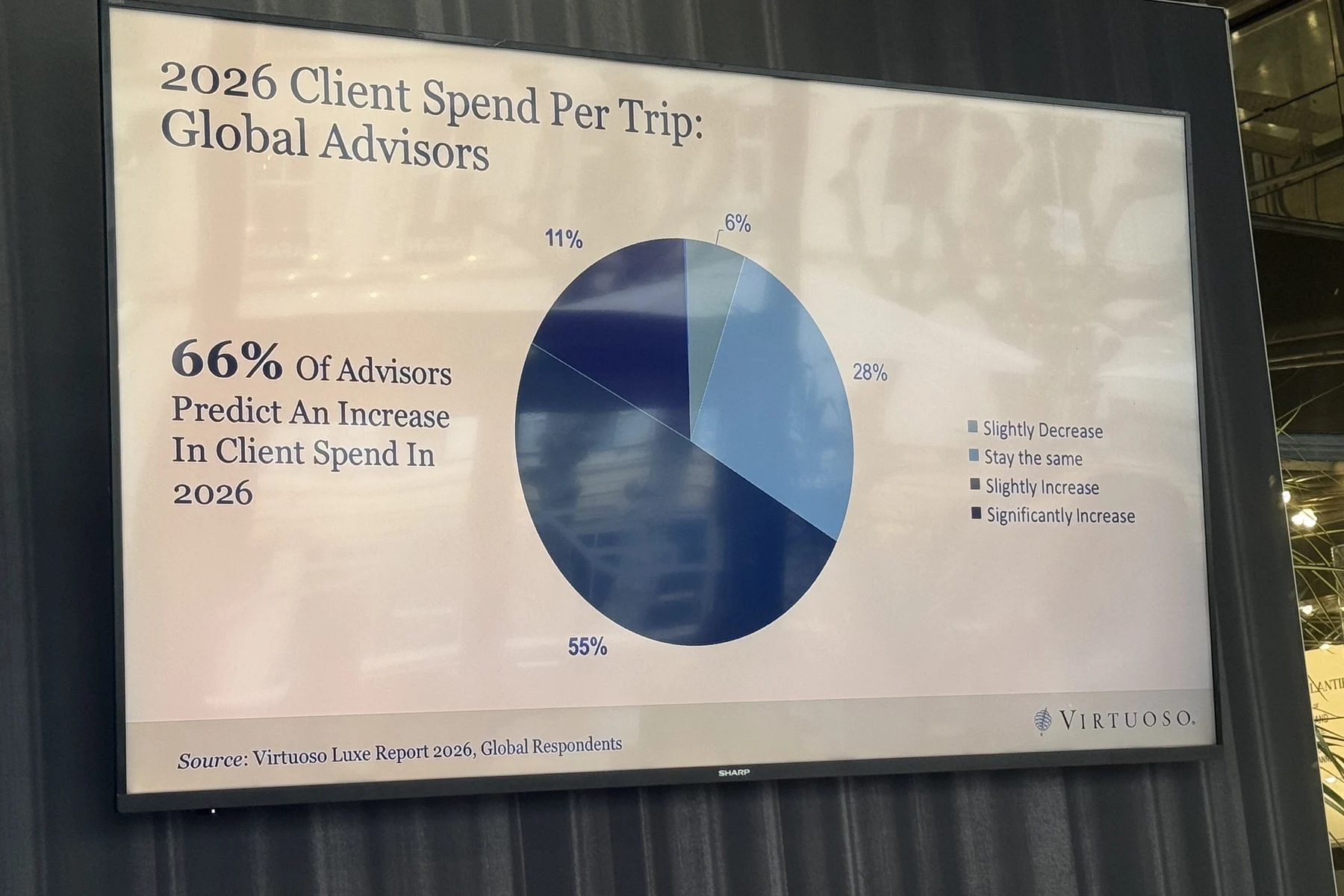
Five trends shape the year, and each translates into operating decisions.
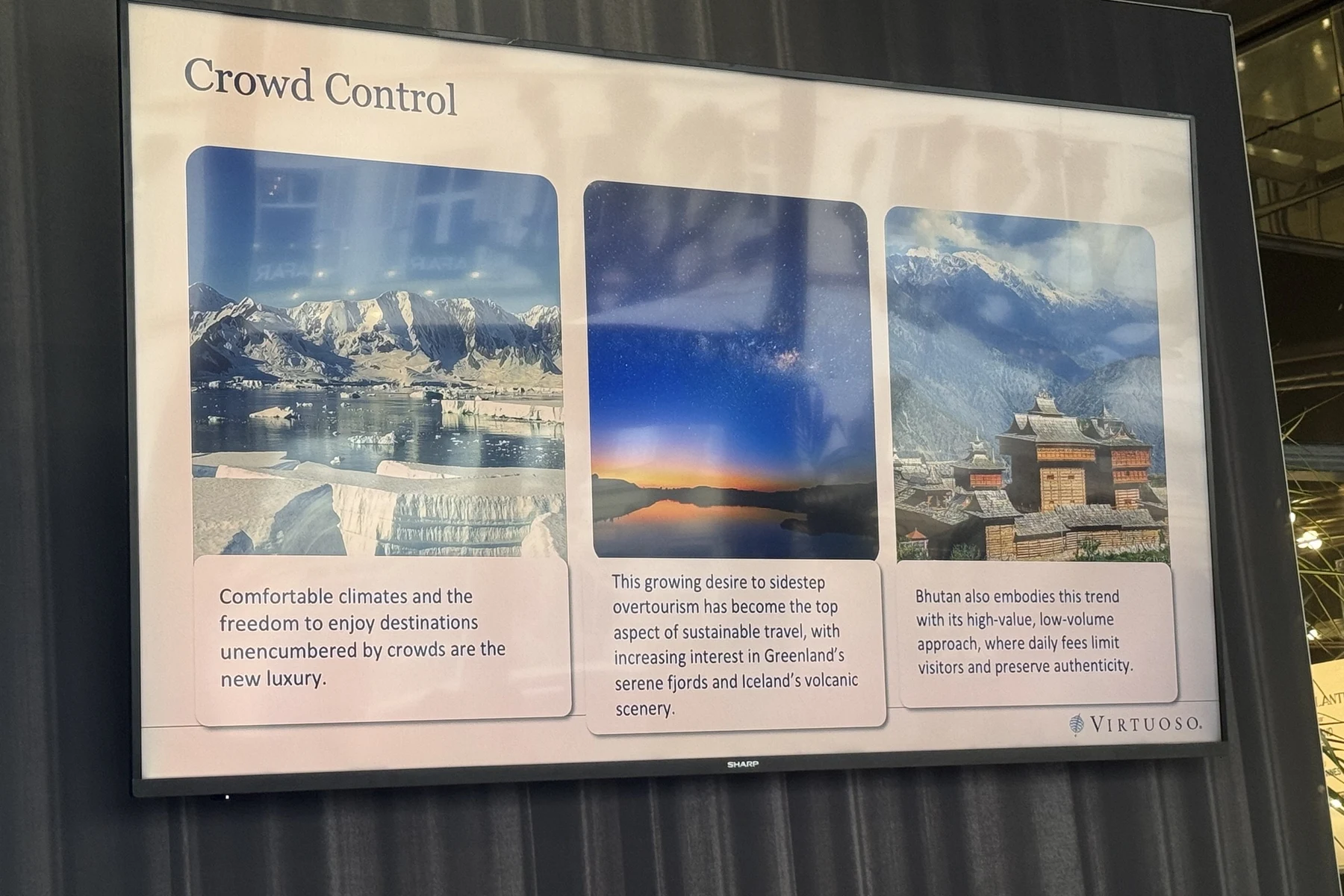
Crowd management comes first. Clients are seeking temperate climates and places where they can move freely. In Europe, September and October have already replaced July and August as the wealthy traveller's reference months. Some advisors no longer say low season. They say the season when the locals are happy. The line is funny, and it is serious: it describes a client who refuses to be a problem for the city he is visiting.
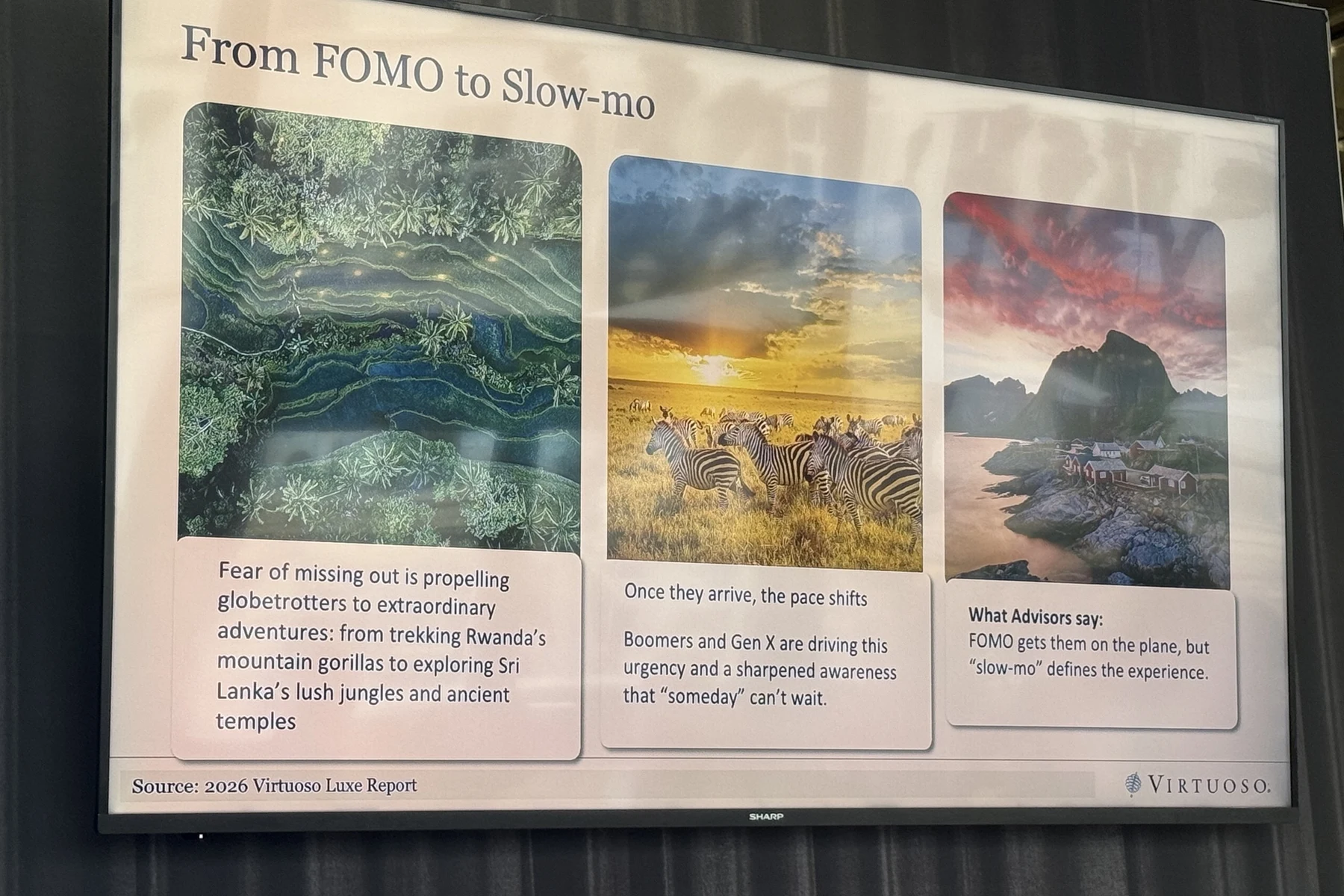
Slow immersion follows. The fear of missing out still drives departures, particularly towards destinations that the climate threatens to transform. But once on the ground, behaviour has reversed. The client no longer wants to skim. He wants to understand, and he stays considerably longer than before.
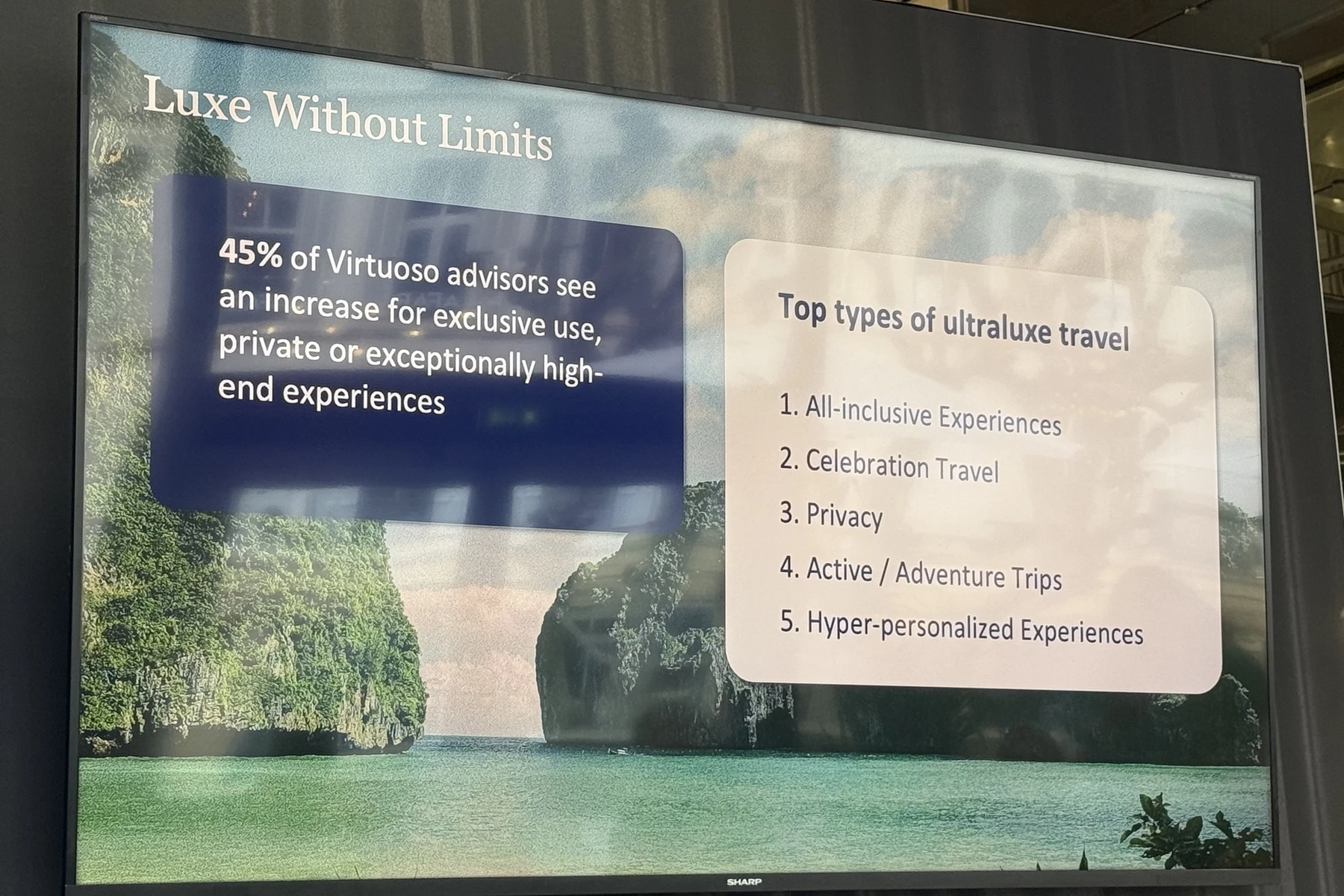
Privatisation is settling in for good. Nearly one advisor in two reports growth in exclusive and private use. Restricted access, intimacy, celebrating a life moment, guided adventure, wellness and hyper-personalisation now form the heart of the top-end offer.
Merged travel completes the picture, and it is the most useful insight of all for a secondary destination. Matthew Upchurch describes what he calls the luxury traveller's creative tension: the desire to return to the places he loves and the desire to discover new ones, simultaneously. The answer is to combine the two. His example: a client who loves Venice and learns that a two-hour train will take him to Ljubljana.
Any city sitting two hours from a saturated destination should read that sentence carefully.
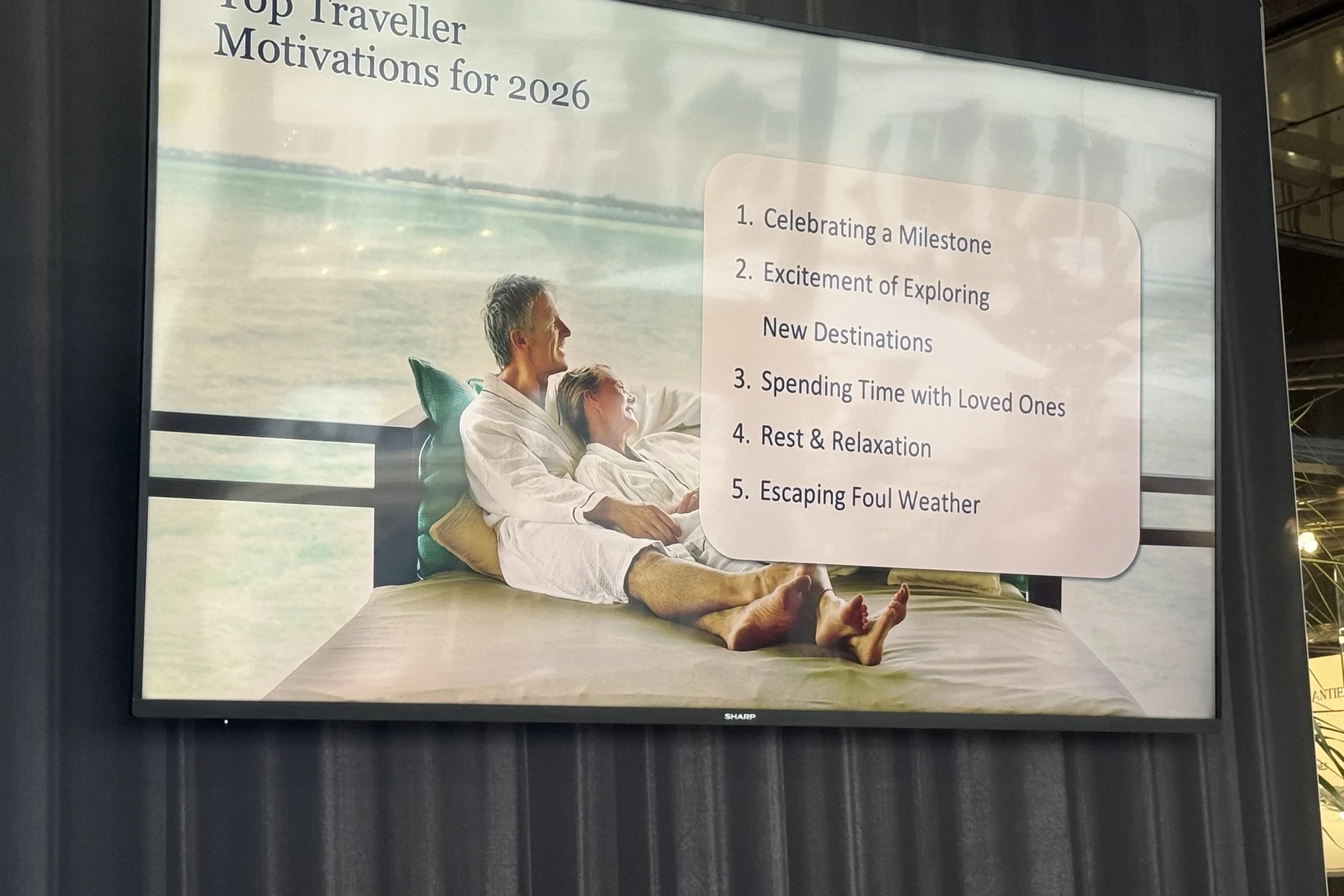
Finally, the primary motivation for travel is not discovery. It is the celebration of a life milestone. Then come exploration, time with loved ones, rest, and escaping bad weather. A hotel that does not know it is hosting a birthday, a wedding anniversary or a family reconciliation deprives itself of the only piece of information that matters.
What still protects a margin in 2026?
The feeling left with the guest. Matthew Upchurch names it as the last defence against commoditisation, and he borrows from Will Guidara the sharpest distinction between service and hospitality.
This was the passage that silenced the room.
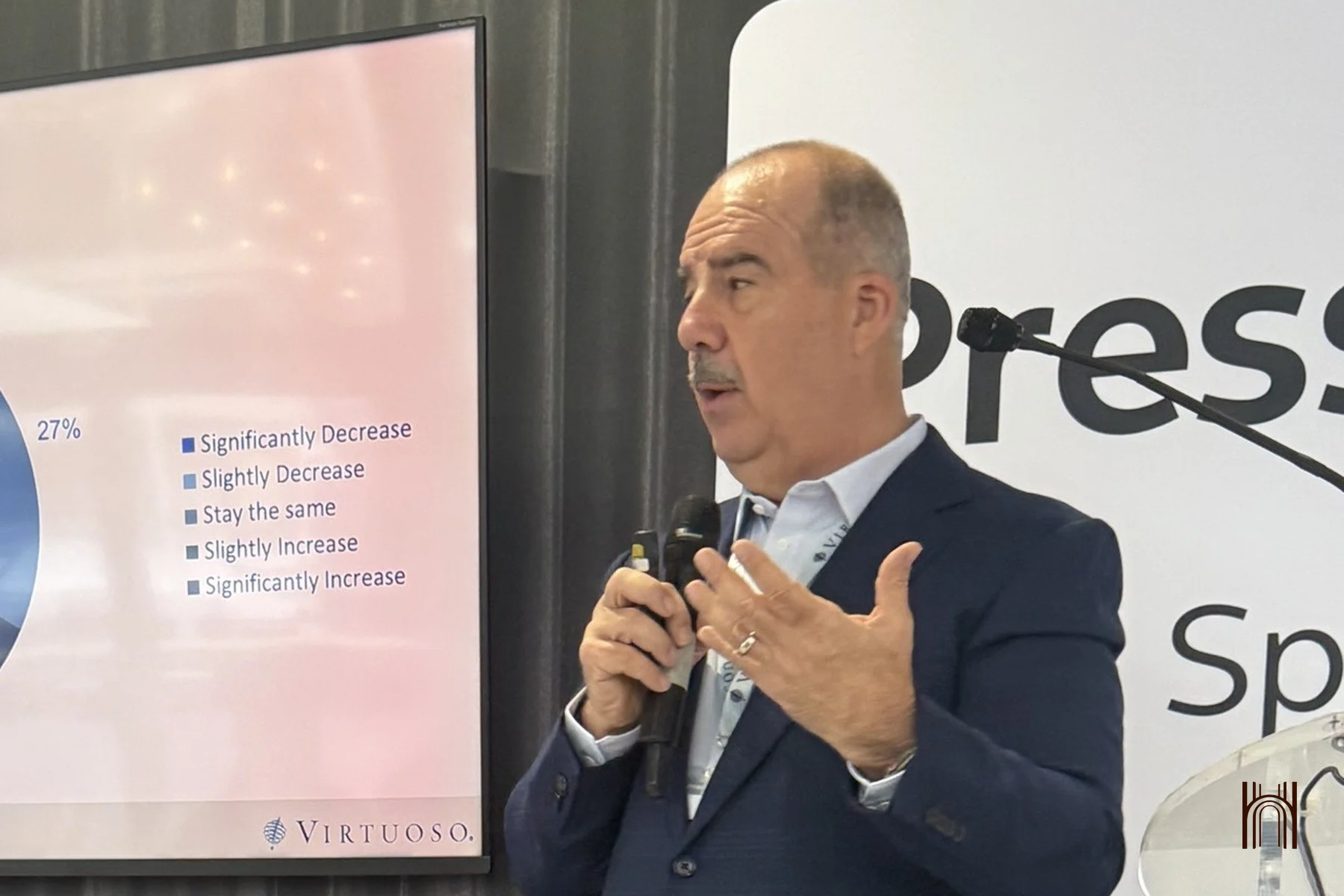
Drawing on the author of "Unreasonable Hospitality", Matthew Upchurch frames the difference in two moves. Service is the thing you do. Hospitality is how you make the guest feel while you are doing it.
The distinction sounds simple. It is financial. In a world that standardises everything, where every service ends up compared line by line, the one question whose answer cannot be copied is this: how did you make me feel?
Matthew Upchurch adds a warning I would like to see posted in boardrooms. Today's guest is informed. He immediately tells apart a property that recites the words from a property where he genuinely feels the difference.
Words, today, are free. Every house speaks of authenticity, attention and bespoke service. The vocabulary has become so common that it proves nothing any more. The proof has moved from discourse to sensation, and sensation is manufactured through internal culture, the quality of the teams and the relationship with the territory. Matthew Upchurch says it plainly: the organisations that will succeed are those that invest in their people's culture and in their ties to their community.
Asked which single word he would keep to define luxury after forty years in the trade, he chose neither excellence, nor rarity, nor exclusivity. He chose diverse. The diversity of ages, passions, cultures and expectations among wealthy clients has, he says, never been greater.
That word condemns a still widespread practice: the single persona. Designing a property for one archetypal guest, described on a single page and pinned up in the marketing department, today means disappointing five clienteles out of six.
Laurent Delporte's reading of it
A conference like this one is only worth what is made of it afterwards. Here is what I make of it, concretely, when I walk into a property.
I always begin with the same exercise, and it surprises people. I do not list what the house offers. I list everything it still imposes on its guest. A queue on arrival, a form, a choice he did not want to make, a signature, a bill presented at the wrong moment, a request he has to repeat twice. Each of these gestures is a friction, and every friction is a share of the value the guest stops perceiving. Matthew Upchurch's line, "I could do it myself, I do not want to", is precisely the measure of what your property charges for.
I then look at the distance between the discourse and the sensation. Every house I work with has a charter, a manifesto, a vocabulary. Almost none can tell me through which precise gesture, at which minute of the journey, that vocabulary becomes perceptible to the guest. That is where my work sits: turning an intention into an observable sequence, then checking that it holds when the team changes and when the hotel is full.
Finally, I work with the teams, because sensation cannot be decreed. A team member who does not understand the purpose of his role in the journey will never produce the attentiveness we are discussing here. Internal culture is not a finishing touch. It is the production tool of the margin.
And I systematically ask management three questions. How exactly do you welcome your guests, gesture by gesture? What has changed in that welcome over the past five years? What would you do differently if your clientele were fifteen years older, or fifteen years younger, than the one you picture?
Those three questions look like nothing. They almost always open the real subject.
The rest belongs to method: observing what the guest is actually buying, measuring where the journey loses value, and rebuilding. That is what I do in my hospitality strategy consulting assignments, in my guest experience audits and in the training I lead with teams. If I travel to ILTM and MIPIM in Cannes, to EquipHotel in Paris and to the Luxury Hospitality Conference in Milan, it is precisely to bring back this kind of figure before it becomes conventional wisdom.
Two thousand dollars a night does not pay for a room. It pays for the absence of effort and the quality of a feeling. Everything else is furniture.
Key takeaways
Virtuoso brings together 553 member properties, more than twenty thousand advisors and thirty-five billion dollars in sales, across fifty-eight source markets.
Since the pandemic, global leisure travel has grown by 128 %. The Virtuoso network has grown by 277 %.
The average nightly rate across preferred partners has reached a record two thousand dollars.
For an equivalent trip, a client guided by a network advisor spends three times more than the client of an outside advisor, and four times more than an independent traveller.
Sales booked one and two years out are up 24 %, and 36 % of those bookings exceed fifty thousand dollars.
The annual report, built on 2,485 advisors across more than fifty countries, forecasts rising demand for 67 % of them and higher spend per trip for 66 %.
Never have six generations travelled at the same time, and 66 % of all human beings who have ever reached sixty-five are alive today.
In Europe, September and October have replaced July and August as the wealthy traveller's reference months.
The primary motivation for luxury travel is the celebration of a life milestone, ahead of exploration and rest.
Service is the thing you do. Hospitality is how you make the guest feel while you are doing it. It is the only thing that cannot be copied.
Share this article with a colleague, a client or a partner.
That is often how an idea enters a house, and then its habits.
What you say about it matters more than what I say.
A keynote, a mission, an article in the magazine: if my work has been useful to you, a few lines on Google are worth more than any argument.
Leave a review on Google →