Toward a Civic-Minded Approach
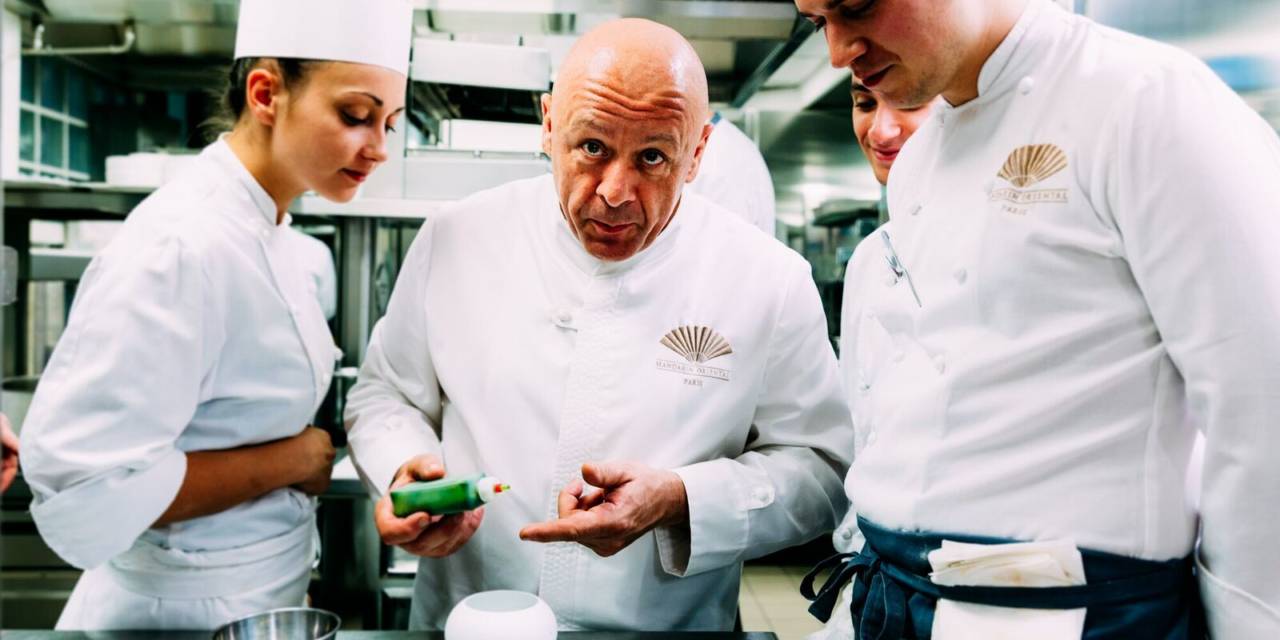
Thierry Marx, executive chef and director of food and beverage at the Mandarin Oriental, Paris, is also an engaged citizen. He is actively working to shape the hospitality industry of tomorrow, balancing a return to fundamentals with innovation.
As patron of EquipHotel, he champions a necessary awakening, decodes the shifts underway in the industry, and offers the keys to reform by adapting to new patterns of consumption.
What Changes Do You Foresee in the Hospitality of Tomorrow?
The hotel industry took a real blow with Airbnb, whether we are talking about luxury hospitality or mid-range and budget hotels. Everyone came up against new ways of sharing and consuming. Airbnb sent us a strong message: we need to understand it and adapt our offering.
Is a concierge service even useful anymore? Guests arrive with a concierge in their pocket. Wouldn’t it make more sense to create a lifestyle manager role, one that could rethink the concierge profession and offer on-site experiences, rather than selling services outside the hotel?
By looking ahead, we can anticipate these shifts. We need to rely on young people, who have already embraced these new patterns of consumption, and understand how they envision the hospitality of tomorrow.
Hospitality is moving toward personalization. Guests want to live an experience. Yet in our industry, that experience is extremely fleeting. The whole challenge of our profession, then, is to make it memorable. And that comes through experiences that carry social and environmental impact.
Today, it is not the latest technology that guests are looking for, the iPads and flat screens: they already have better at home. What matters most, on the contrary, is the quality of human contact.
But for this mechanism to work well, it depends on our workforce. Without it, there can be no successful guest experience. So the real stakes are training and information.
Given the Changes in the Hotel and Restaurant Industry, How Should Training Evolve?
Hospitality schools as they were designed in the twentieth century no longer offer a relevant solution. Today’s students learn faster and are steeped in digital culture. They need training that is quicker and more effective. We have to give them the chance to grow faster so they can flourish more quickly in our professions.
Training needs to come back to building skills on the job. The longer we stretch out the length of a diploma, the further we move from the real solution. Today, business schools are creating hospitality master’s programs: students complete barely a year of training and go on to become general managers instead of graduates from hospitality schools. The professions in our industry are changing, and we need to try to understand these shifts and adapt to them.
That is exactly the work we are doing today with “Cuisine Mode d’Emploi” and “Boulangerie Mode d’Emploi,” training people for our professions in twelve weeks.
This approach has become necessary because of high turnover and the loss of skilled workers.
How Do You Give Employees a Sense of Purpose to Motivate Them?
One word: “project.” I only ask my team members one question: “Where do you see yourself in two years?” Nothing else interests me. They help me reach my goals, and I help them build their career path. It is a relationship built on trust. With an employee, it is not simply an employment relationship. A salary is what we pay for a skill set, but that skill set needs to keep evolving, otherwise we create frustration.
Hoteliers and restaurateurs have a social responsibility.
At the Mandarin Oriental and in my job integration schools, for example, I created an English-language theater school so that employees who never had the chance to learn the language could get an introduction to it.
Hoteliers need to understand that we are the ones who will create tomorrow’s workforce.
The Time Has Come for Environmental Awareness
More and more chefs, for example, are growing their own vegetable gardens. Is this the approach you are part of, notably through your commitment to HQE (High Environmental Quality) standards?
I have identified 350 hectares of organic farmland between Chartres and Orléans. I work with partners who have an environmental impact, but also a social one.
We need to clearly distinguish civic-minded initiatives from marketing initiatives. Putting a garden on your hotel roof does not make a hotelier an engaged citizen. Ten tomato plants on a rooftop mean nothing in terms of actual production. That garden needs to be put to good use, for instance by turning it into an educational garden.
Today, hoteliers and restaurateurs must be engaged citizens. Social and environmental impact are now part of the guest experience.
Share this article with a colleague, a client or a partner.
That is often how an idea enters a house, and then its habits.
What you say about it matters more than what I say.
A keynote, a mission, an article in the magazine: if my work has been useful to you, a few lines on Google are worth more than any argument.
Leave a review on Google →