Since its opening in 2019, Fairmont Rio de Janeiro Copacabana has not only become a prestigious address on Avenida Atlântica; it is part of a deeper dynamic, that of a hotel renaissance that goes beyond a simple move upmarket to question the very way a place is inhabited.
In 2026, the hotel celebrates its seventh anniversary and, in the words of its General Manager Netto Moreira: "What we are most proud of is having become a place in Rio not only for travelers, but for the city itself."
Through an architecture that pays tribute to Brazilian design, an immersion through sport and culture, and an exclusivity embodied by the Fairmont Gold concept, the hotel redefines international luxury by placing it at the service of local identity.
Understanding a hotel through the intimacy of the room
I spent one night at Fairmont Rio de Janeiro Copacabana with a very specific intention: to observe how an international hotel can translate the carioca spirit of the city of Rio de Janeiro. This way of being, unique to Rio, cannot be reduced to a postcard image. It lies in something more elusive: a lightness in the relationship to time, a warmth that is not familiarity, a way of letting the city in without ever being overwhelmed by it.
In my work, the room always constitutes a central point of observation. It is the guest’s first territory, the place where the hotel can no longer hide behind an overall staging. Everything becomes immediately legible: preparation, coherence, quality of attention and the ability to create a relationship.
At Fairmont Rio de Janeiro Copacabana, this question arises with particular intensity. How can an international brand offer an experience faithful to its standards while allowing space for a strong local identity? How is this balance expressed concretely in a space as codified as a hotel room?
This article proposes to decode this promise through a precise angle: the room, its composition, its preparation and the way it becomes a true tool of hospitality.
A design born from transformation: between heritage and repositioning
Fairmont Rio de Janeiro Copacabana is not a building designed ex nihilo. It is part of the transformation of the former Sofitel Copacabana, entirely rethought during its repositioning under the Fairmont brand. This evolution partly explains the current structuring of spaces, particularly the suites, which retain an existing architectural base while integrating a new reading of luxury.
The property offers around 375 rooms and suites, including between sixty and seventy suites located on the upper floors, featuring Fairmont Gold categories with open views over Copacabana Bay and Sugarloaf Mountain. Sizes vary depending on typology, but suites generally range from 70 to more than 120 square meters, with layouts that prioritize the separation of uses. This scale makes it possible to move beyond the logic of an enlarged room to offer a true living space.
The renovation project was designed to align the hotel with the standards of Fairmont Hotels & Resorts while integrating a strong Brazilian identity. Under the direction of architect Patricia Anastassiadis, a designer of Greek origin trained between Paris and São Paulo, whose sensibility moves between European rigor and tropical exuberance, the Fairmont Rio was conceived as a celebration of the city’s golden age.
The choice of furniture follows this logic: it incorporates pieces by internationally recognized Brazilian designers, in the lineage of a tradition initiated by figures such as Sergio Rodrigues or Zanine Caldas, whose works laid the foundations of a distinctly Brazilian formal vocabulary, creating an atmosphere closer to a "collector’s home" than a hotel lobby.
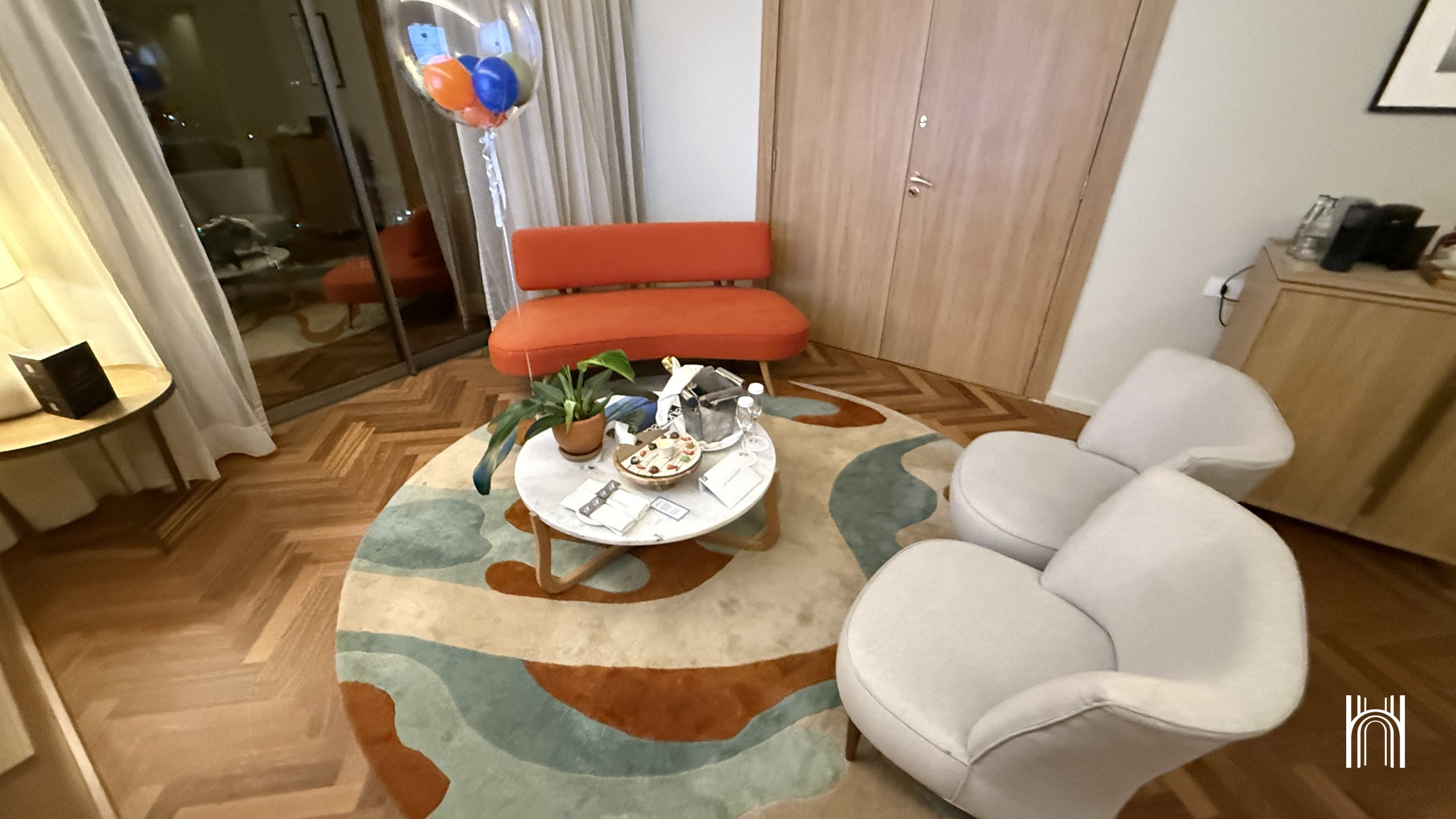
This approach is felt in the suite. The space does not seek to impress through a spectacular architectural rupture. It is part of a continuity, with a desire to bring fluidity, clarity and a constant relationship with the outside.
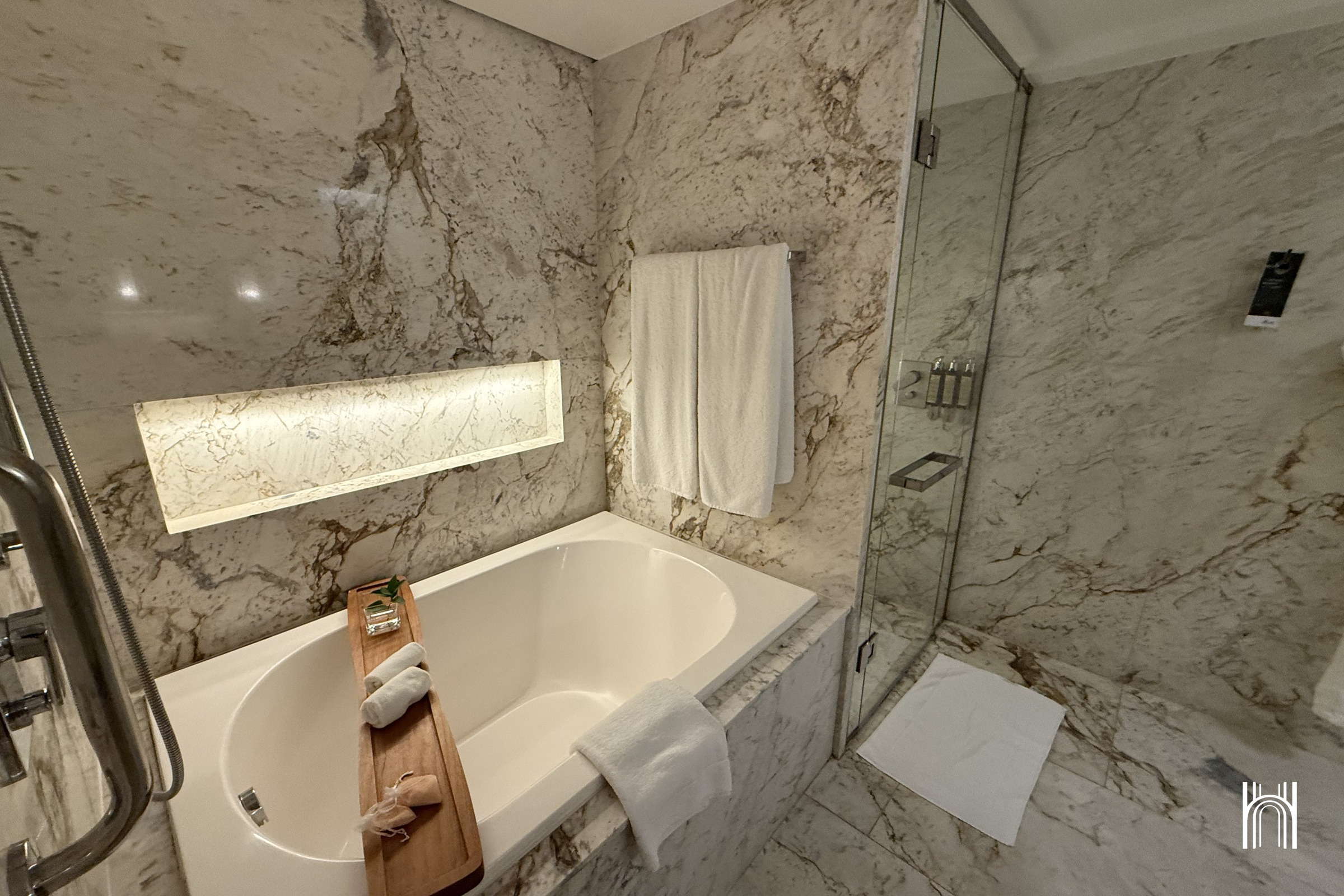
Materials play a decisive role in this perception. Marble structures the bathroom and brings a sense of solidity and freshness, suited to the climate. Warm woods, textured fabrics, natural tones and furniture inspired by Brazilian design create an atmosphere that is more residential than demonstrative. The objective is not to accumulate signs of luxury, but to build a sensory coherence: touch, light, acoustics. This interior writing dialogues with the outside without trying to reproduce it, which avoids a decorative effect.
The view constitutes the other pillar of the experience. The blue of the ocean, omnipresent thanks to large openings, enters the space and dialogues with decorative elements that recall local culture. The gaze embraces the Atlantic Ocean in its full width, the perfect curve of Copacabana beach, and at the end of this line, the Dois Irmãos, the two granite peaks that close the horizon like a signature of Rio. On clear days, Sugarloaf Mountain appears in the distance, instantly recognizable.
At the other end, Forte Duque de Caxias, set on Morro do Leme, punctuates the panorama with its military silhouette and, on certain mornings, its bugle resonates up to the suite, a discreet signal that Rio has its own life, its own rhythm, its own memory. The suite, through the grace of its openings, lets all this in without filter. It becomes an observation post: appreciating the sunrise that accompanies waking up, feeling the city without dissolving into it, being connected without being exposed.
A staging of arrival that reveals generous hospitality
The experience of the suite does not stop at its design. It takes on its full dimension at the moment of arrival. It is at this precise moment that the intention of the hotel becomes visible, tangible, almost immediate.
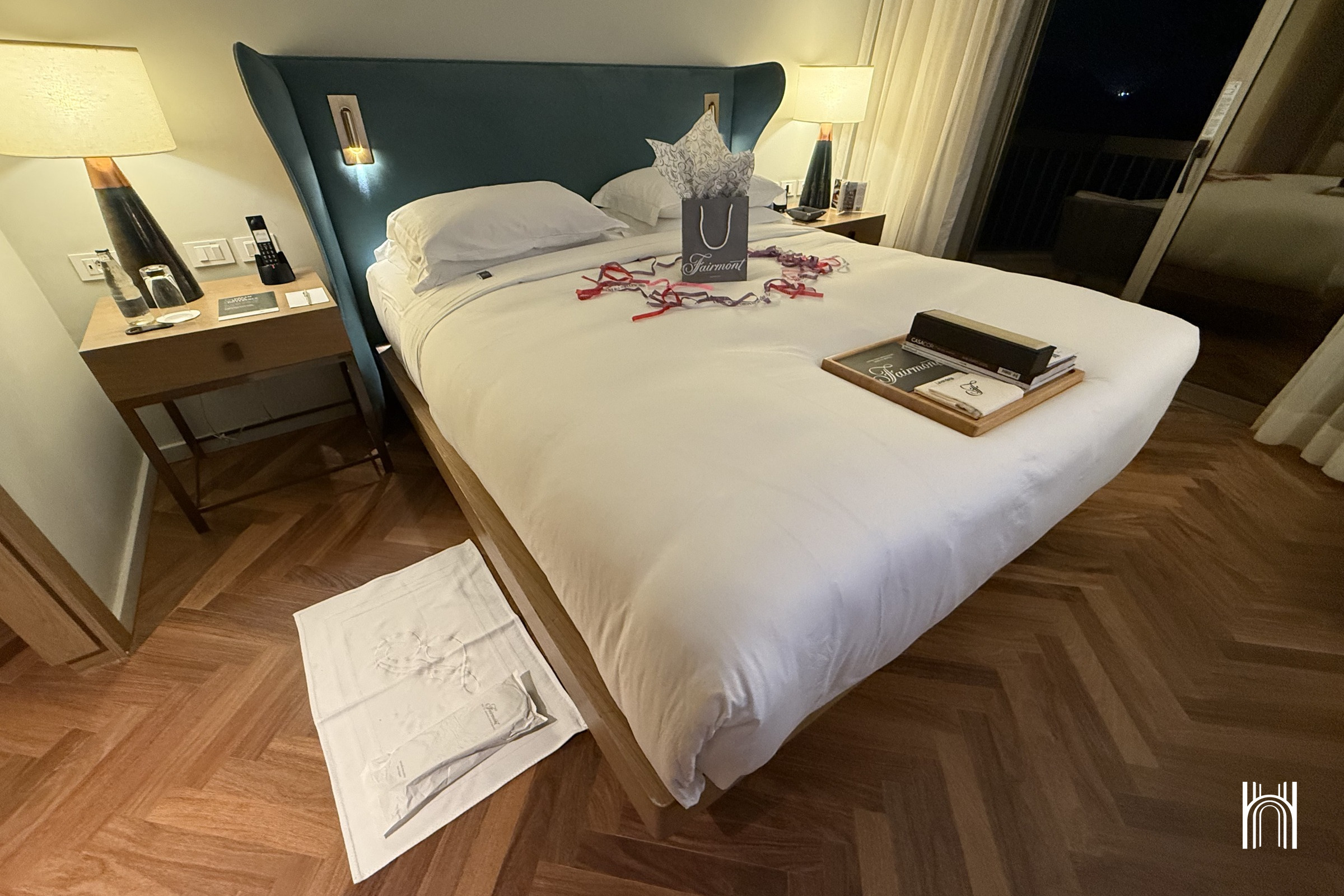
Upon entering the suite at the end of the day, a particularly refined welcome appears. The space is not simply ready. It is staged. Personalized helium balloons, arranged throughout the room, create an unexpected first impression. A form of warmth settles immediately, accompanied by an almost playful feeling that breaks with the neutrality sometimes observed in luxury hospitality.
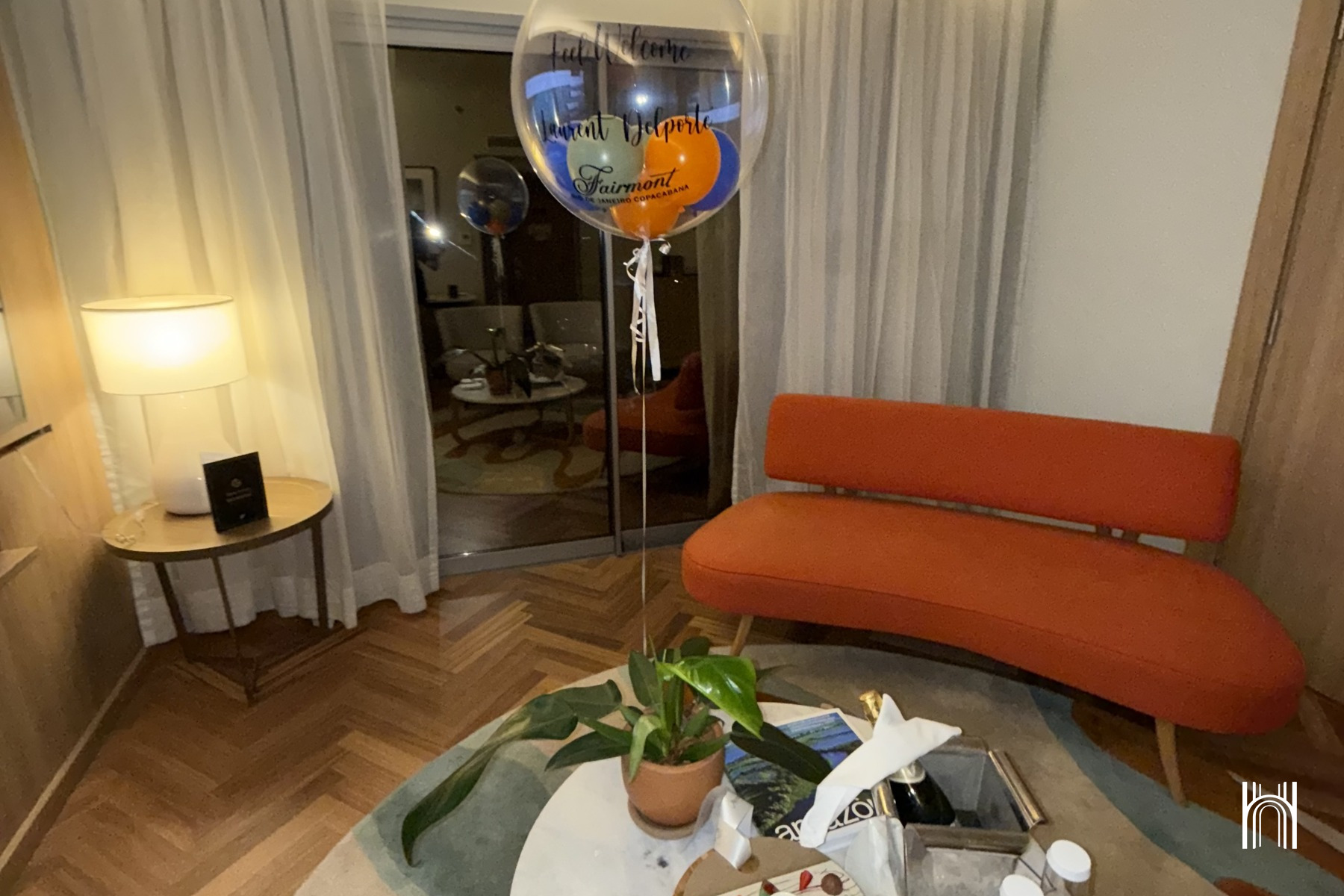
This first surprise modifies the relationship to the place. The suite is no longer a standardized space. It becomes a living space. This nuance is essential. It marks the beginning of a more personal experience.
The attentions unfold with coherence: a bottle of champagne, fruits, gourmet products, a welcome message. The whole creates an impression of controlled generosity, without any sense of accumulation. What particularly stands out is the precision of each intention. One element perfectly illustrates this: a chocolate entitled "palette du peintre," presented like a miniature artwork, playing with the dominant colors of the suite (ochre, deep blue, off white), as if someone had taken the time to understand not only who I was, but how I perceive things. This type of attention goes beyond service. It reveals a relational intention.
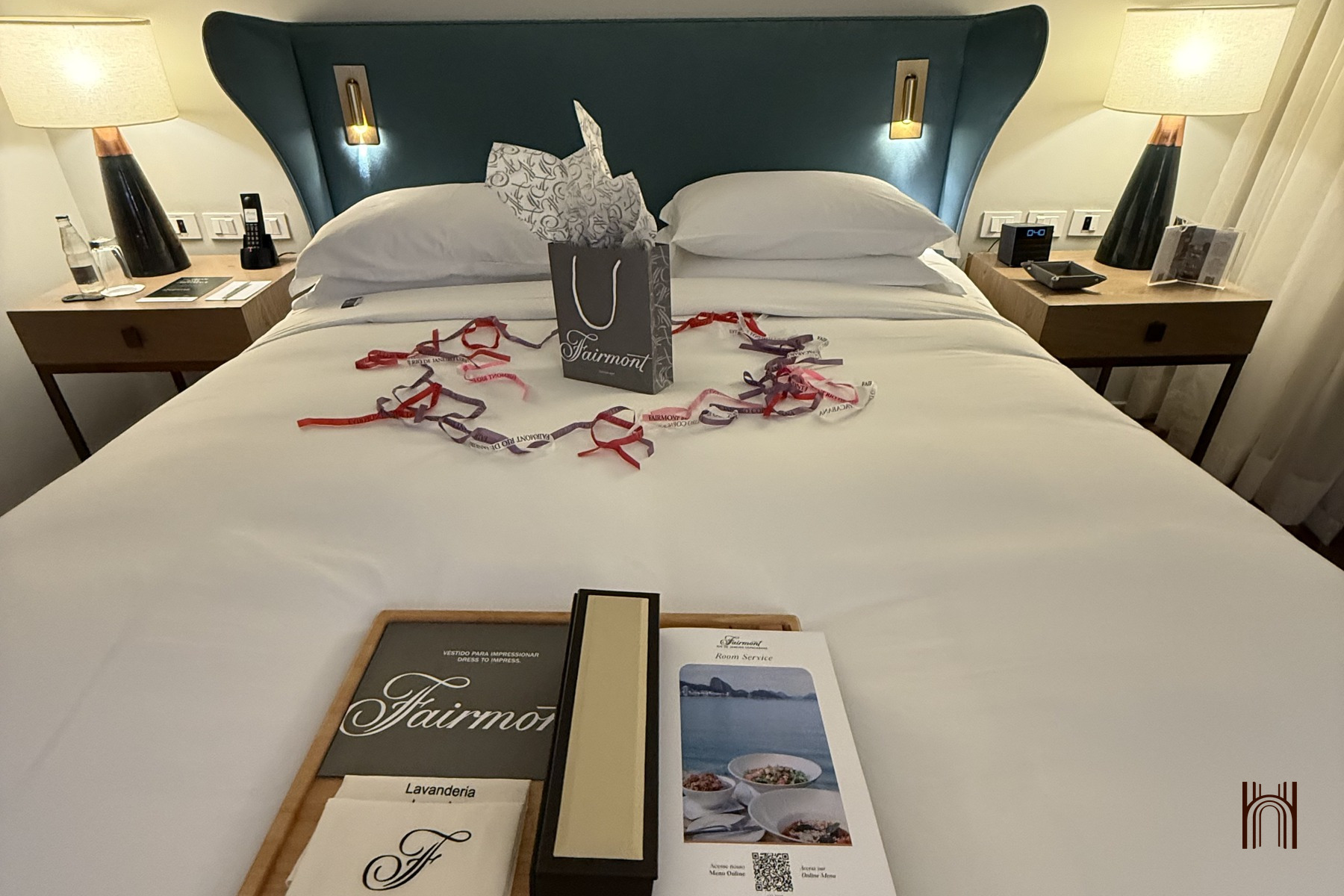
Later in the evening, upon returning to the suite, the space has evolved. The evening service has prepared everything with precision: the bed, adjusted lighting, elements repositioned to accompany the transition into the night. This continuity in attention plays an essential role. The welcome is not limited to a single moment. It is part of a temporality, accompanying the different moments of the stay. Welcoming does not consist only in responding to an expectation. It consists in anticipating, adjusting and creating a relationship that evolves.
A fragrance offered upon returning from breakfast and before leaving the hotel extends this logic beyond the stay itself. With notes of sandalwood, tiare flower and a subtle iodized touch, it does not attempt to recreate conventional exoticism. It evokes something more intimate: an open window onto the Atlantic, skin warmed by the late afternoon sun. A trace of the place remains, even after departure.
Through this staging, Fairmont Rio de Janeiro Copacabana does not seek to impress. A more refined intention emerges: to create a precise emotion, without excess, but with accuracy. It is an expression of generous hospitality.
An experience of well-being between immersion and retreat
The experience is not limited to the suite. It structures all rooms, designed according to the same logic of balance between openness to the city and the capacity for retreat.
In the morning, the light gradually enters. The sea is there, the beach comes alive, Rio begins its day before your eyes. This constant relationship with the outside is not endured, it is designed. Volumes, openings, the orientation of spaces are conceived so that the city is present without ever imposing itself. The guest chooses their degree of immersion.
This is where the intelligence of these spaces lies. Once the curtains are drawn, the environment becomes silent, cocoon-like. The suite amplifies this possibility thanks to the separation of living and resting areas, while the room offers a more compact but equally coherent version.
In addition, for Fairmont Gold guests, a dimension fundamentally changes the relationship to the stay: access to a dedicated butler, available twenty-four hours a day. This is not just another service. It is a presence. Knowing that a trusted person can respond to any request, a last-minute reservation, advice about the city, an unexpected need in the middle of the night, creates a particular sense of serenity.
There is no longer a need to search or question. The stay can be fully experienced. This constant availability transforms Rio, an intense city that can sometimes be disorienting for an international traveler, into a familiar territory. The butler becomes, in a way, the thread of the stay, the one who connects each moment and ensures that nothing disrupts the experience.
Well-being is also extended through the hotel spa. Spread over 400 square meters, the space offers five treatment rooms including a couple suite, a sauna and a beauty salon. The approach to treatments is directly inspired by Amazonian biodiversity, the ingredients, rituals and textures speak of Brazil. This is not the logic of a generic hotel spa. It is a coherent extension of what the room has initiated: an immersion that does not stop at the view or the design, but engages the body itself.
Well-being does not rely on a spectacular element. It is born from this balance: energy and calm, stimulation and soothing, discovery and comfort. And sometimes, it simply lies in knowing that someone is looking after everything.
What must be remembered
The rooms and suites at Fairmont Rio de Janeiro Copacabana illustrate a contemporary approach to hospitality, in which space becomes an active component of the experience. Design, quality of materials, staging of the welcome, the spa and the relationship to place come together to create something coherent and rare: an international hotel that does not resemble all the others, because it has chosen to belong to its territory rather than simply be placed within it.
On a personal level, this night spent in the suite allowed me to fully experience this intention. The balance between immersion in Rio and the capacity for retreat creates a fluid and particularly pleasant experience.
The following morning, before leaving the suite, I paused for a few moments in front of the bay window. The beach was already coming to life. A jogger, a few fishermen, the soft morning light over the Atlantic. The bugle of Forte Duque de Caxias sounded in the distance, punctual, almost ceremonial.
It was at that moment that I understood what the hotel had achieved. Not offering me a room with a view over Rio. But giving me the feeling, for the time of one night, of belonging there, even just a little.
Fairmont Rio de Janeiro Copacabana thus offers a relevant reading of contemporary hospitality, capable of integrating a strong local identity while meeting the expectations of an international clientele.
Share this article with a colleague, a client or a partner.
That is often how an idea enters a house, and then its habits.
What you say about it matters more than what I say.
A keynote, a mission, an article in the magazine: if my work has been useful to you, a few lines on Google are worth more than any argument.
Leave a review on Google →