Renovating a palace hotel is never just an aesthetic transformation. It questions, in depth, the way a place welcomes, serves and creates emotion.
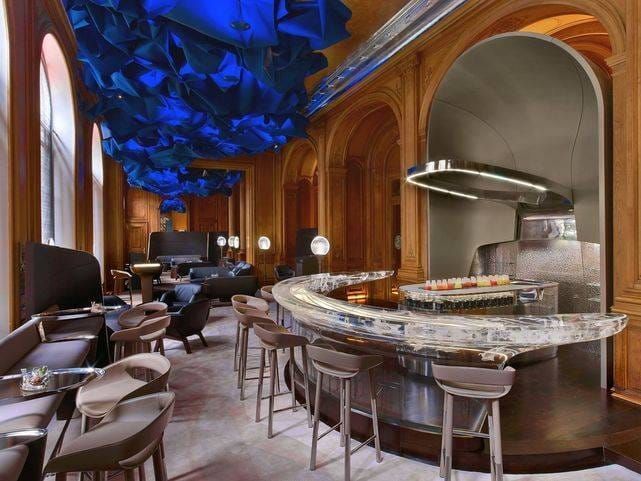
At the Hôtel Plaza Athénée, the renovation of the bar led by Patrick Jouin and Sanjit Manku perfectly illustrates this shift: moving from a decor to a genuine experience.
Through this conversation held in 2014, a reflection emerges that still feels relevant today, on how architecture, teams and the intention of service can turn a space into a living place.
Renovating a hotel: an experience project before an architecture project
A hotel renovation is prepared long in advance. It is important to involve staff in order to properly understand their needs and to work with them on how to improve their working conditions. You also need to step back and surround yourself with an expert who will bring knowledge and ideas. That expert can then prepare a brief to hand over to the architect. The architect will then have all the information needed to prepare a preliminary project, to be discussed among the teams, the investor, the hotel director and the expert. At every stage, the hotel director and the investor must remain the decision-makers.
A renovation is a wonderful opportunity to reinterpret your service offering, to renew yourself. Unfortunately, hoteliers too often simply redo the same thing, without changing anything. That is a shame. This is what happened at the Ritz Paris, which chose to renovate as before. If I take the example of the Plaza Athénée bar, Patrick Jouin and Sanjit Manku completely rethought the space. Bottles of spirits are no longer on display, the back office is better equipped to carry out preparations that are then finished in the bar, in front of guests. It is a real revolution in hospitality.
Patrick Jouin and Sanjit Manku explain how they worked with the Plaza Athénée bar team: "We worked together on the wishes and operational needs of the bar team. They thought a great deal, with their own team, about how to improve the bar. We listened closely and offered ideas. This is not a bar like any other. It is a stripped-back bar, not a temple to bottles of spirits from every major brand in the world. It is a place for preparing cocktails.
Our duty is to create a project that is coherent with the spirit of the bar the head bartender wants to build. The furniture is there to be comfortable and to put you in the best conditions to enjoy a drink and live a beautiful emotional experience. We are here to elevate the cocktails and the other drinks served in the bar."
The Plaza Athénée bar: a break from the codes of luxury hospitality
How did you work with the Plaza Athénée? What defines your work on the bar? How do you embody the "Plaza spirit" in your work?
Our work at the Plaza Athénée is always very particular. We do not work across the whole hotel, only in certain areas (the bar and the restaurant). Our work becomes part of the spirit of the Plaza.
The bar is an incredible space, with beautiful proportions. It is very warm, with wood present throughout. But it is a beautiful room from another era: it lacks a bit of our era, our spirit.
With every renovation, we ask ourselves what we can add to this space, respectfully, in order to shift the energy of the room. It is always small things, and it is in the details that we transform the atmosphere of a room. You need to find something very modern to add to this historic room, without creating a contrast that would make guests uncomfortable. Quite the opposite, we look for a link to history and a bridge toward the future. It was a real risk for the Plaza to add contrast to the bar, and proof of its boldness.
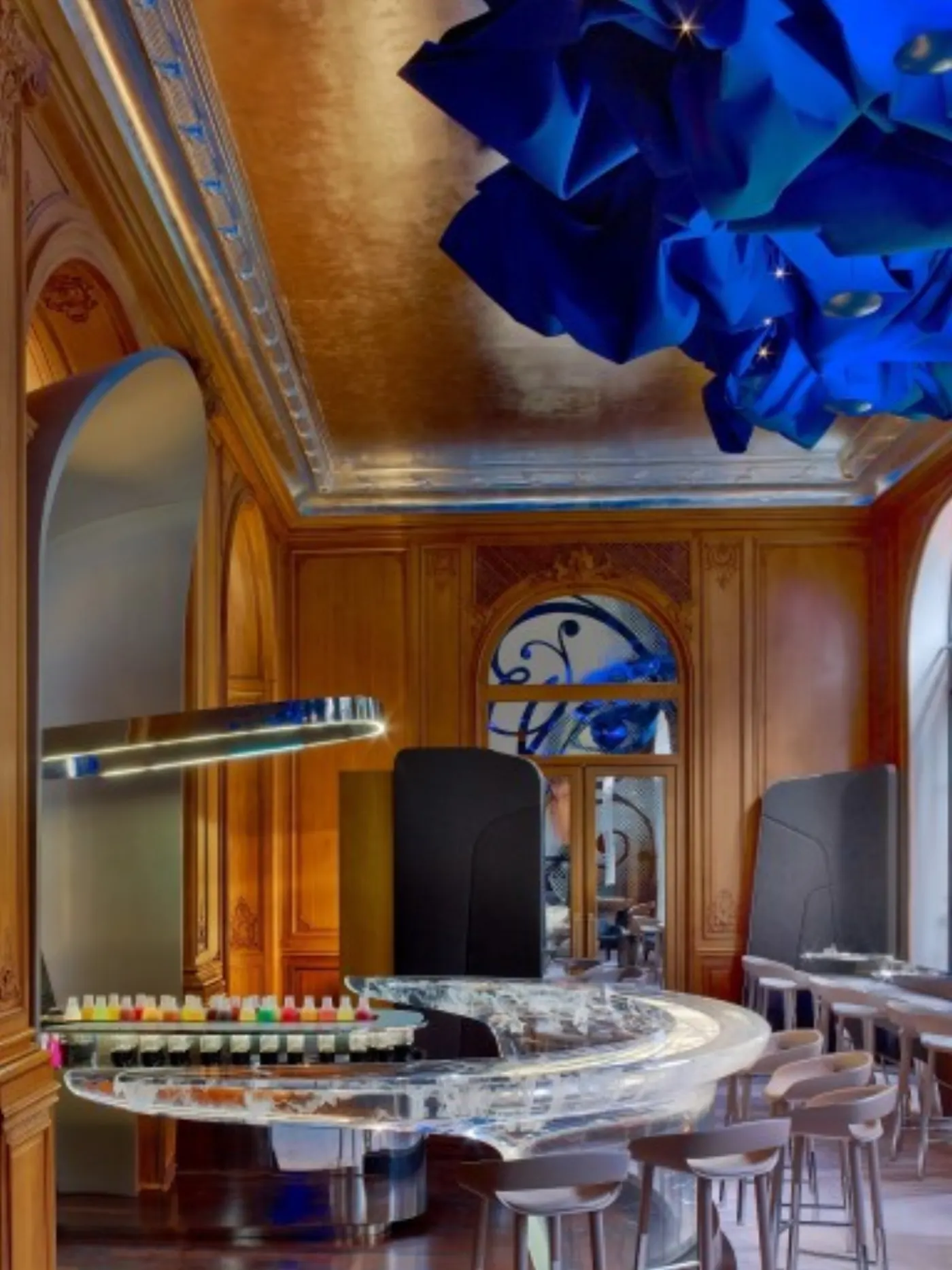
We wanted to make as strong a statement as we did in 2000, during the previous renovation, and to create an even bigger gap between the last renovation and this new one. On our first visit together, we look at the room for the first half hour without saying anything, then we share everything that inspires us. We try to spark surprise and magic. We map out the stages of the guest's gaze. They will first look for the bar with a touch of magic, then the room, through the furniture, the ceiling, the floor and everything else. From there, our work begins.
We wanted to bring colour up on the ceiling, and a more sober colour, almost monotone and even dark, on the floor. The idea was to better see people's faces throughout the bar. The furniture is there purely to bring comfort and "private" spaces around screens and large, generous armchairs. They evoke the furniture of certain cars, with armrests. We wanted to create small cells within this bar, as well as an area with high tables, to match the plural expectations of the clientele. The blue drapery on the ceiling is a source of inspiration: we looked for a suspended work, to add lightness to the proportions of the room.
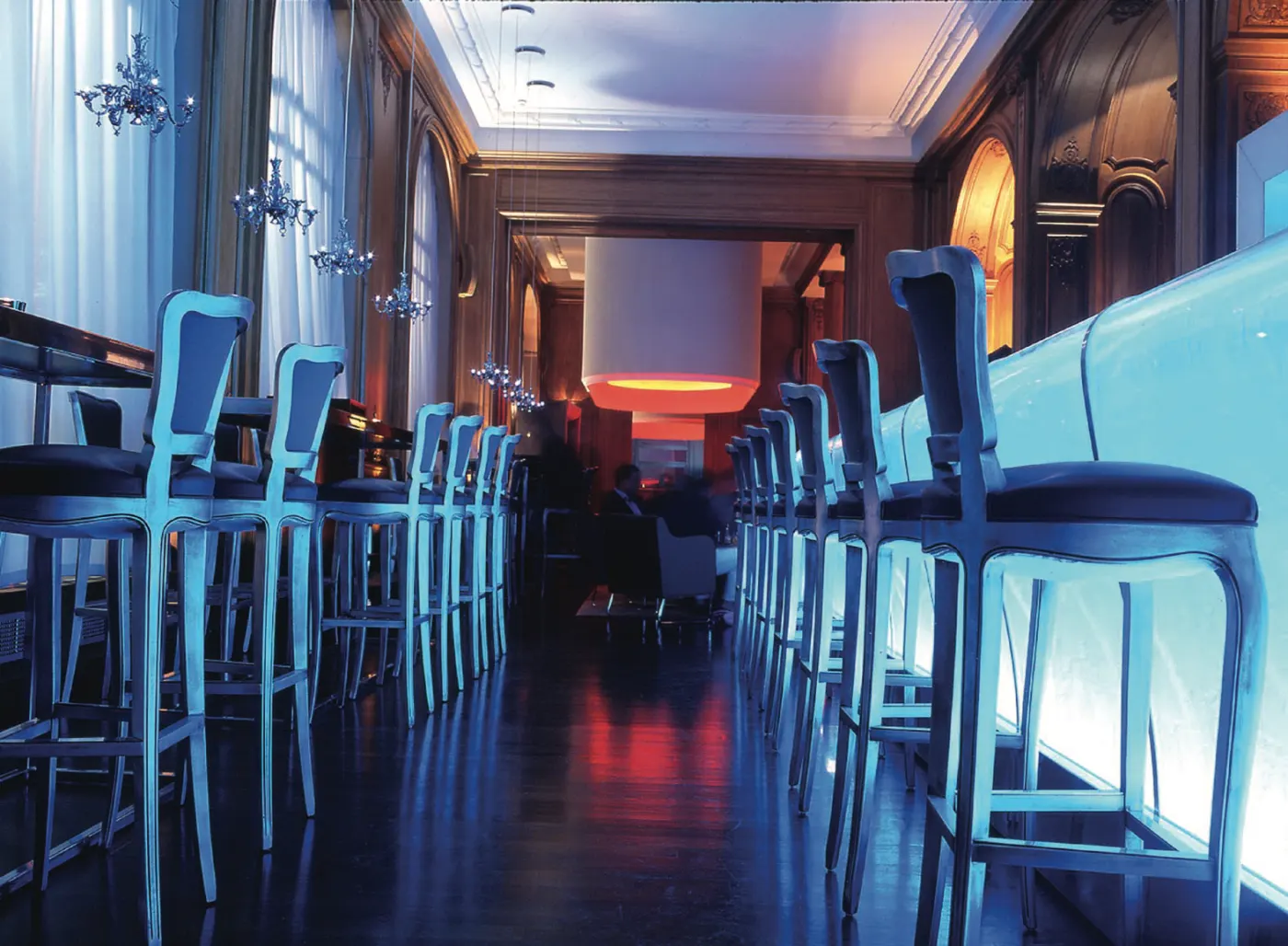
Before the renovation
French hospitality as a way of building spaces to welcome guests. How did you reinterpret this art?
For us, French hospitality is the feeling of truly being at home, of feeling good in a space in order to feel its energy. The space must be very comfortable, and guests must feel truly welcomed. That is the essence of French hospitality.
What matters most in the bar is that it is not just a space, it is home. The team welcomes you with great pleasure, just like at home. You feel welcomed as a guest among friends. The same is true in the restaurant, around Denis Courtiade, who brings an extra soul to the place.
On an architectural level, French hospitality also means bringing life back to a place. It is not about destroying it to rebuild it, but about bringing modernity and novelty while keeping part of its past. Since our first project with the Plaza, we have appreciated the history of the place, but we asked ourselves: "What is a 21st-century palace?" So we wanted to bring boldness, to leave a remarkable memory. We looked for something surprising and daring, and pushed the limits of what can be done today, in terms of colours, materials and craftsmanship. The idea is not to recreate a museum. We would then have added nothing to the room. A museum is something you visit from time to time. A hotel is the opposite: it is a living place, one that must keep being given life. How do you add a soul.
What to remember
The renovation of the Plaza Athénée bar raises an essential question: should a hotel be preserved or reinvented?
By choosing measured boldness, the Plaza Athénée shows that a place can evolve without losing its soul.
This is precisely where the notion of generous hospitality lives: a hospitality that is not limited to welcoming, but that seeks to create connection, emotional comfort and a genuine human experience.
Seen this way, renovation becomes a strategic lever, not to follow a trend, but to redefine the very way we welcome people.
![Plaza_Athenee_-_Bar_-_HR_(c)_Eric_Laignel_2[1]](/images/mag/patrick-jouin-sanjit-manku-bar-plaza-athenee/body-3.webp)
Share this article with a colleague, a client or a partner.
That is often how an idea enters a house, and then its habits.
What you say about it matters more than what I say.
A keynote, a mission, an article in the magazine: if my work has been useful to you, a few lines on Google are worth more than any argument.
Leave a review on Google →