Reinventing hospitality on board: when airlines become cultural ambassadors
Hospitality in the air is more than just a smile or a well-presented meal tray. It is a subtle art, a true human choreography serving a memorable experience. Unlike the world of hotels or restaurants, that of air transport is characterized by a strong discontinuity in the customer journey: before, during and after the flight, passengers circulate in multiple spaces - airport, plane, stopover - the management of which often escapes the company. However, it is the latter that will find itself evaluated at the end of the trip.
With DELPORTE HOSPITALITY, I had the opportunity to support the teams of an airline wishing to evolve their approach to hospitality. The objective was not to add a few ready-made formulas, but to transmit a culture of sincere, living, embodied hospitality - inspired by the hotel industry. An approach that takes root well before boarding, and which continues well beyond landing.
When does airline hospitality actually start?
Some consider hospitality to begin at check-in or boarding. In reality, it comes to life as soon as the passenger arrives at the airport. In an often stressful, impersonal and fast-paced environment, every gesture is important. Poorly designed signage, indifferent staff, unanticipated waiting... and the experience can quickly deteriorate, before it even begins.
Even though the airport is not under the direct responsibility of the company, it represents a major point of friction. The passenger does not distinguish institutional boundaries. The real challenge therefore consists of creating emotional continuity within a fragmented journey. This requires specific training for teams at each point of contact.
During my interventions with employees on the ground, I systematically remind people of this simple idea: the first and last impressions of the trip are born in the airport. Anyone wearing a badge, whether a cleaner, waiter, salesperson or security guard, becomes a potential hospitality player. Answering a question, directing a passenger, offering a kind look: so many gestures that give meaning to the collective mission.
Attention to the child, reflection of a true culture of welcome
In one of the companies supported, remarkable work has been undertaken around considerate language. The teams learned to adapt their speech not only to adult passengers, but also to children. Rather than launching a generic “hello children”, each member of the staff addresses them individually: “Hello young man”, “Hello miss”, putting themselves at their level, with an authentic look and intention.
These details, far from being insignificant, reveal a demanding vision of hospitality. Too often, certain young passengers are ignored: no words, no smiles, no attention. This lack of consideration says a lot about the host culture - or lack thereof.
Learn vocabulary, yes, and the importance is to transmit a state of mind.
Training in hospitality is not just about learning a few formulas. It’s about getting each employee to adopt a sincere and aligned welcoming posture. A sentence, no matter how well it is written, rings false if it is not carried by a correct intention. In a closed and constrained space like that of an airplane, this authenticity becomes essential.
At DELPORTE HOSPITALITY, this dimension is at the heart of our training: it is not enough to use kind language - you must be fully inhabited by it. The right expression is born from a true presence to the other. It’s not about playing a role, but about making what is said resonate with who we are. It is this inner coherence that makes the difference between a service perceived as mechanical and a truly touching welcome.
On board: embodying your country through hospitality
An often underestimated - but very inspiring - dimension lies in the cultural dimension of air hospitality. An airline is much more than a simple transport operator: it becomes an ambassador of a country, of an imagination, of traditions, of an art of living.
Flying with Air France already means feeling a certain French refinement. The attention to detail, the discreet elegance, the care of language. Flying with TAP means rediscovering a scent of Portugal: the singing accent, the human warmth, the local products, the quality and elegance of the uniforms. Each company thus embodies its own personality, perceptible through its service.
Meal trays are never trivial. Scents, textures, recipes tell the story of a culture. But beyond the dishes, there are rituals, gestures, attitudes which reflect a national identity. Hospitality then becomes the aerial expression of cultural roots.
Create a coherent hospitality journey, from departure to arrival
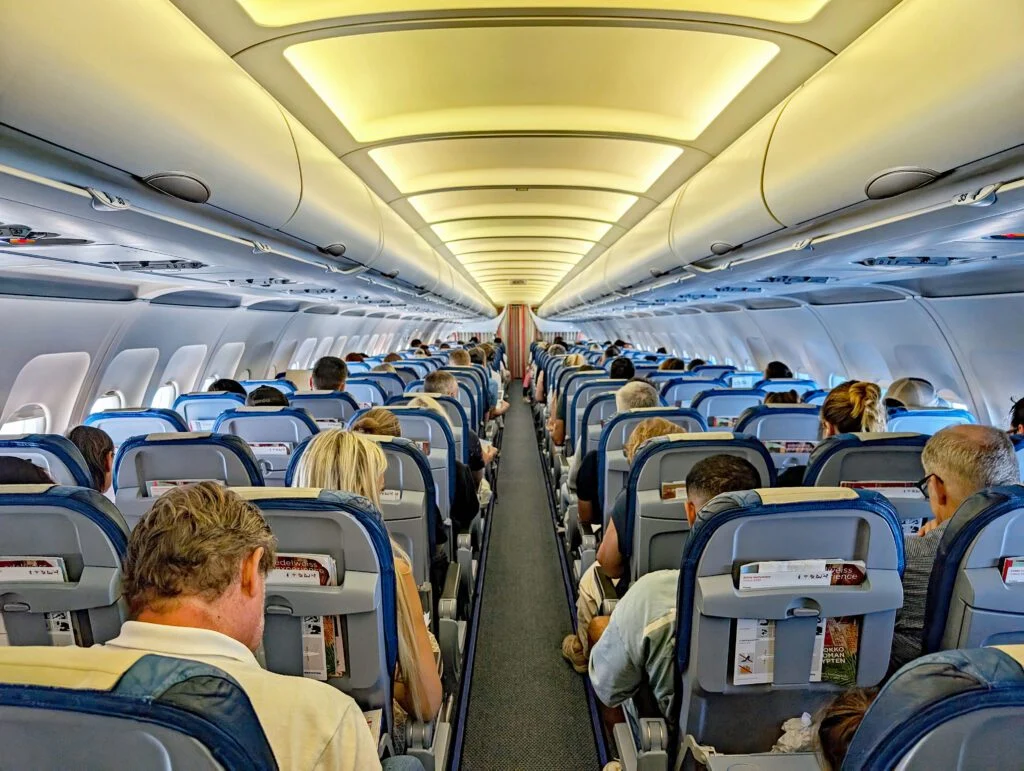
On board, maintaining a constant quality of attention despite constraints (small spaces, fatigue, unforeseen events) constitutes a major challenge. It is precisely in these demanding contexts that hospitality can express all its power.
Some companies have established strong rituals, particularly at the end of the flight. When staff stand at the door of the plane to say a personalized word, offer a sincere smile or express a thank you, a bond is created. The passenger feels recognized, greeted, valued.
However, once disembarked, this link suddenly breaks. The return to airport reality is often abrupt and impersonal. There remains fertile ground for exploration here: how to extend hospitality beyond theft? How can we smooth this transition? Post-flight remains a blind spot in the customer journey.
DELPORTE HOSPITALITY: training differently to transform the experience
With DELPORTE HOSPITALITY, I had the privilege of supporting an airline wishing to anchor hospitality in everyday reality, far from marketing discourse. This company wants hospitality to be experienced - both by passengers and by their teams.
Our approach is not based on rigid protocols, but on lasting awareness. We work on postures, emotions, self-understanding. Because it is illusory to offer a sincere welcome without first meeting oneself. This is the entire educational base that we have built: a human, sensitive, aligned approach.
We help companies identify their cultural assets, promote them through hospitality, create meaningful rituals, and embody their brand in each interaction.
In an ultra-competitive world, where the price offer is becoming commonplace and where devices are similar, hospitality is becoming a major strategic lever. It makes it possible to create a lasting preference, to establish emotional loyalty, to offer what technology will never replace: the human connection.
But to achieve this, a paradigm shift is necessary. It is no longer enough to train the right actions: we must also train hearts. We must reconnect the teams with their core mission: to offer each passenger a travel experience that leaves a mark.
What if hospitality became the true luxury of travel?
Tomorrow, it may be neither larger screens nor more sophisticated menus that will make the difference. It will be the ability of a company to welcome with sincerity, to create bonds, to take care. It will be the attention paid to each look, each child, each thank you. This will be the way to embody a country through a smile.
Hospitality should no longer be seen as an extra service. She is its very soul.
📣 Does this message speak to you? So do not hesitate to share it with those around you, to your colleagues, to your clients, to young people looking for a vocation, or to anyone who could be inspired by these issues of transmission and excellence. Together, we can circulate these ideas, restore meaning to manual and hospitality professions, and create real vocations.
💡 If you have ideas, needs, or if you want to go further, I am here to listen to you. I offer hospitality audits, hospitality strategies, inspiring conferences, tailor-made training, as well as coaching for leaders and teams in the hospitality, luxury and exceptional venues sectors.
📬 To not miss anything, you can subscribe to my newsletter and receive each month reflections, resources and concrete initiatives around generous hospitality® and French know-how.
Share this article with a colleague, a client or a partner.
That is often how an idea enters a house, and then its habits.
What you say about it matters more than what I say.
A keynote, a mission, an article in the magazine: if my work has been useful to you, a few lines on Google are worth more than any argument.
Leave a review on Google →