Discovering the Oetker Collection
I had the pleasure of visiting the wonderful and legendary town of Baden-Baden, in Germany, in 2017. This town is rich in history, tradition and nature. It is a resort town and a spa town, set deep in the Black Forest. Baden means “baths,” a reference to the Roman thermal baths that gave rise to the town.
The town developed in the 19th century thanks to its casino, its racecourse, its theatre and its hotels.
One of the most beautiful hotels in Germany has managed to evolve over the years. It is the legendary Brenners Park-Hotel & Spa. It was on my list of hotels I still had to discover. It was in this hotel that French President Charles de Gaulle and German Chancellor Konrad Adenauer met on 15 February 1962, to launch the European project.
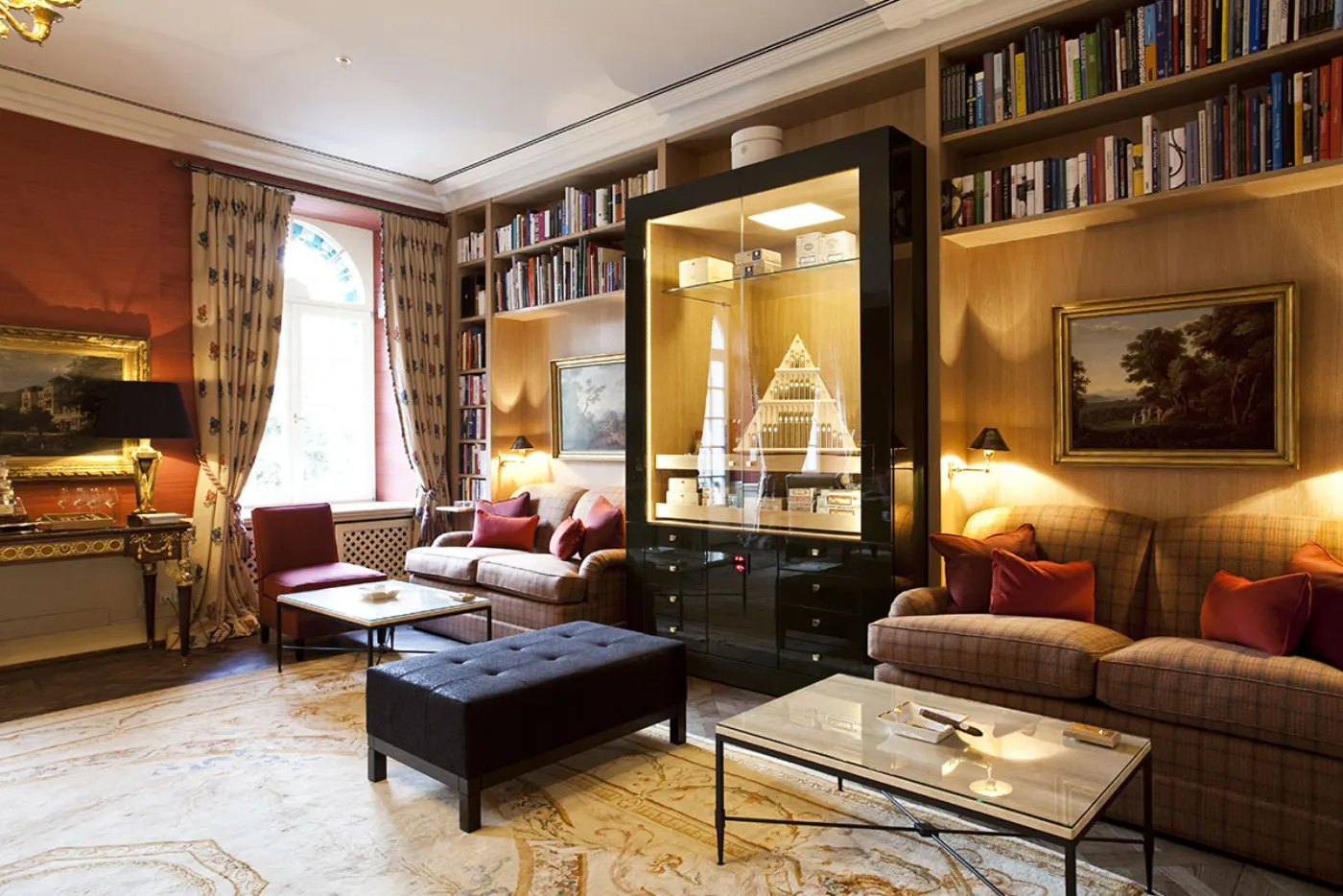
It is a truly essential grand hotel. It has more than 140 years of history, during which each generation of staff has passed on its know-how and its way of being to the next, in service of its guests. It is a genuine art of welcoming that is transmitted in this way.
The Cigar Lounge at Brenners Park-Hotel & Spa.
This hotel belongs to Oetker Collection, whose international headquarters is also located here. It was on this occasion, in 2017, that I met Frank Marrenbach, CEO of Oetker Collection. We talked about our passions and about his vision of luxury hospitality. He has since left the group, but his words remain relevant today.
What is your vision for luxury hotels in 10 or 15 years, and how is Oetker Collection preparing for it?
The quality of service matters more and more. It is about finding staff who have both the capability and the talent to work in such institutions. Oetker Collection would like to position itself as a company that attracts this kind of talent.
While remaining a relatively small company in size, we pursue a global strategy to conquer new markets and export our art of welcoming.
We also need to remain careful in terms of marketing strategy and positioning. We operate in the five star luxury market, and metropolises are extremely important to us. We would like to balance our portfolio a little more with cities such as Berlin, Rome, Tokyo and Singapore. These cities are attracting more and more people and talent. We need a presence in these major cities to keep our company thriving and to help it shine across the world. That is why New York, for example, matters to us: everyone goes there. Choosing major cities means acting both for the client and for our staff.
You have to be careful about the opportunities that arise: every pearl on a necklace has a particular value, just as every hotel must have a particular added value, beyond the purely financial side.
How do you support the evolution of new technologies for your current and future guests? How is luxury evolving?
First of all, it is a permanent journey. Our hotels are constantly evolving. We make sure to introduce these technologies. It is not just about targeting younger guests, but everyone. Technology can seem complex, but we need to find a way to present it simply. Indeed, a guest only stays a few days in their room, and does not necessarily want to take the time to learn how to use a new technology just to turn on the light, for example.
On the other hand, younger guests have new expectations. For them, luxury has to be much more relaxed. Take the tie, for example: it is a symbol, but when I travel, or when I spend a few days with my family, I never wear one (even though I love my tie). In the same way, table service has changed completely: dishes are no longer announced as formally as before. Our younger staff have a new vision of luxury and hospitality. For instance, banning beards is now simply impossible, at the risk of losing staff.
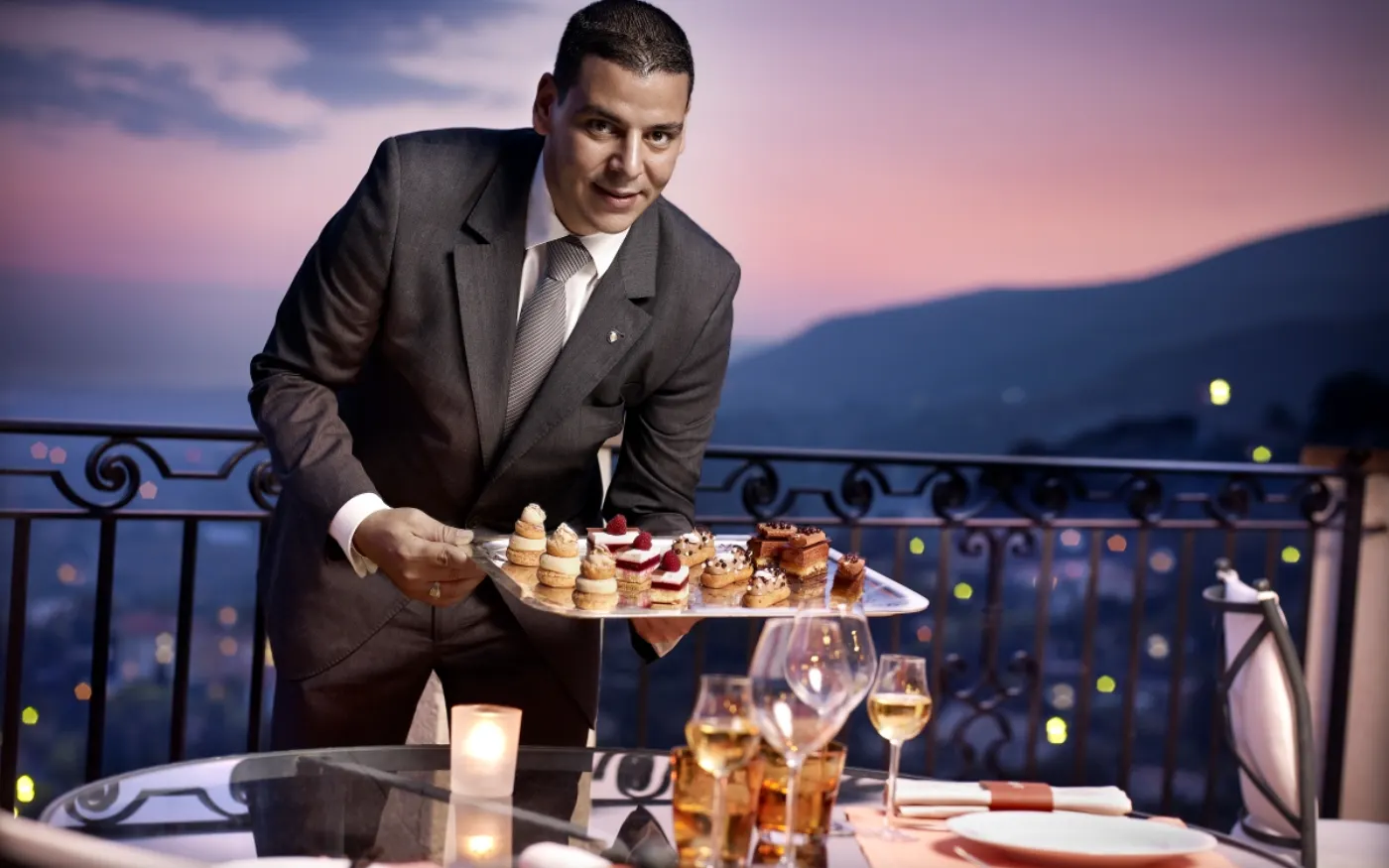
We also need to be able to create spaces where you feel good, even with technology present. In some of our hotels, for example, it is possible to switch off the wifi. It is not to stop people working, it is simply to help them sleep better. Our guests are often so overwhelmed with work that we have to find ways to help them find calm for a few days.
Service at Château Saint-Martin & Spa.
To come back to your question, the world is changing, and has always been changing. We are well prepared for these changes, and I am not worried about them. The changes happening right now are centred around service. As an example, a few years ago, no one would have believed that Airbnb could compete with luxury hotels. A hundred square metres in an Airbnb near the Trocadéro in Paris costs two to three times less than a hotel room of equivalent size at a hotel like Le Bristol. As a result, we need to create spaces where people want to meet: a café, a restaurant, a bar, events, security. Service is therefore what allows us to stand apart. For example, our head concierge knows our guests and their needs. Speed is a key element of service, but not the only one, there is a great deal of humanity in service too. So we must never lose sight of the very heart of our business: serving our guests.
Share this article with a colleague, a client or a partner.
That is often how an idea enters a house, and then its habits.
What you say about it matters more than what I say.
A keynote, a mission, an article in the magazine: if my work has been useful to you, a few lines on Google are worth more than any argument.
Leave a review on Google →