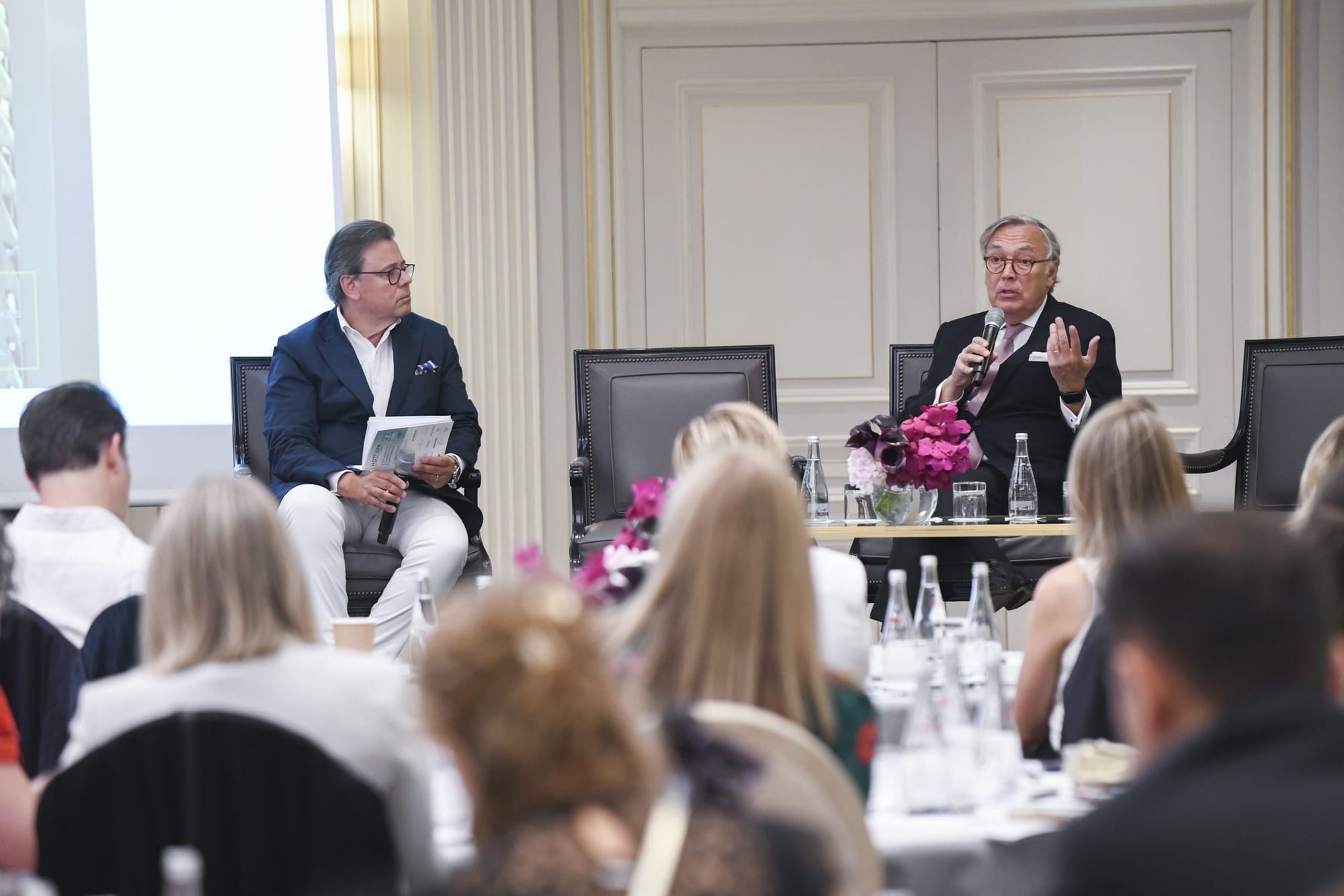
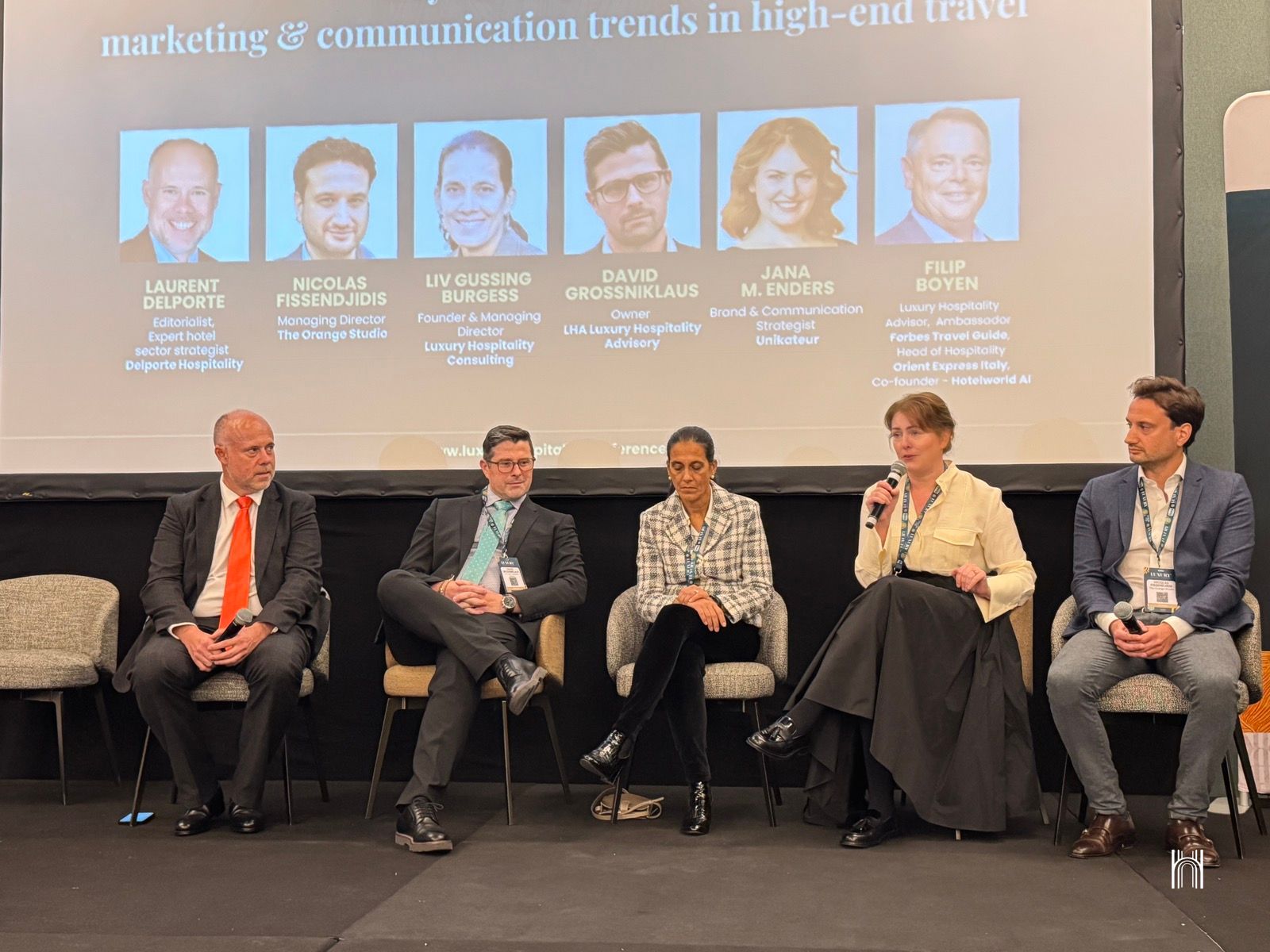
Every autumn, the Luxury Hospitality Conference brings together in Milan the leaders and professionals who shape luxury hospitality in Europe. The organisers invited me to speak on a panel devoted to marketing and communication in high-end travel. Filip Boyen, former CEO of Small Luxury Hotels of the World and later of Forbes Travel Guide, put the questions to us, and each speaker answered in turn. The first concerned the balance between artificial intelligence and the human gesture. My answer came down to a single boundary: the machine must give time back to the teams, never think in their place.
I regularly lead keynotes and workshops, in France and abroad. I never come to deliver a lesson. I come to share what the field has taught me and to test it against the reading of professionals who build hospitality differently. Milan is one of those gatherings where that exchange is most useful, because the room is demanding.
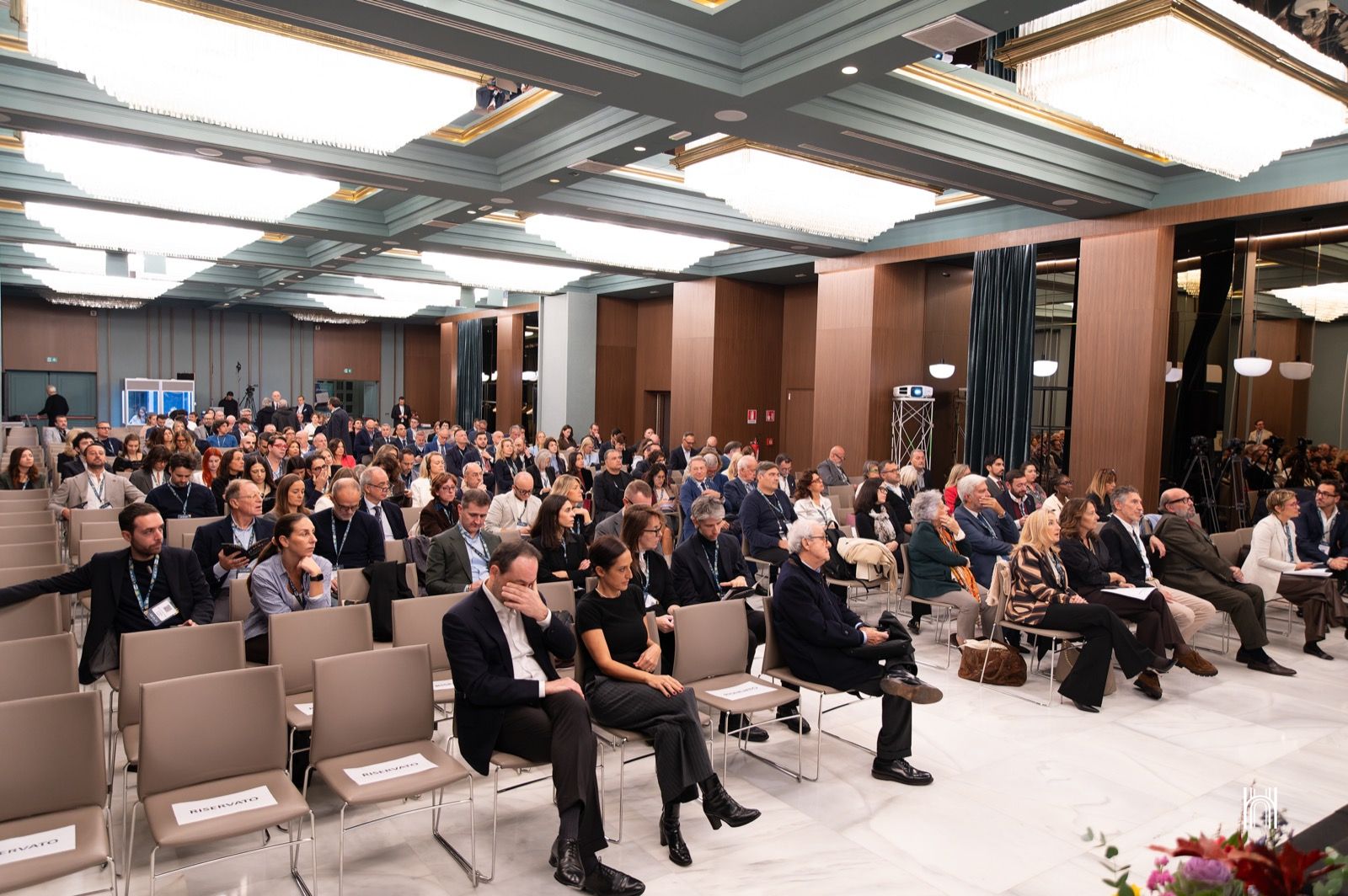
Here is what I argued there, and why I believe our profession is debating the wrong question.
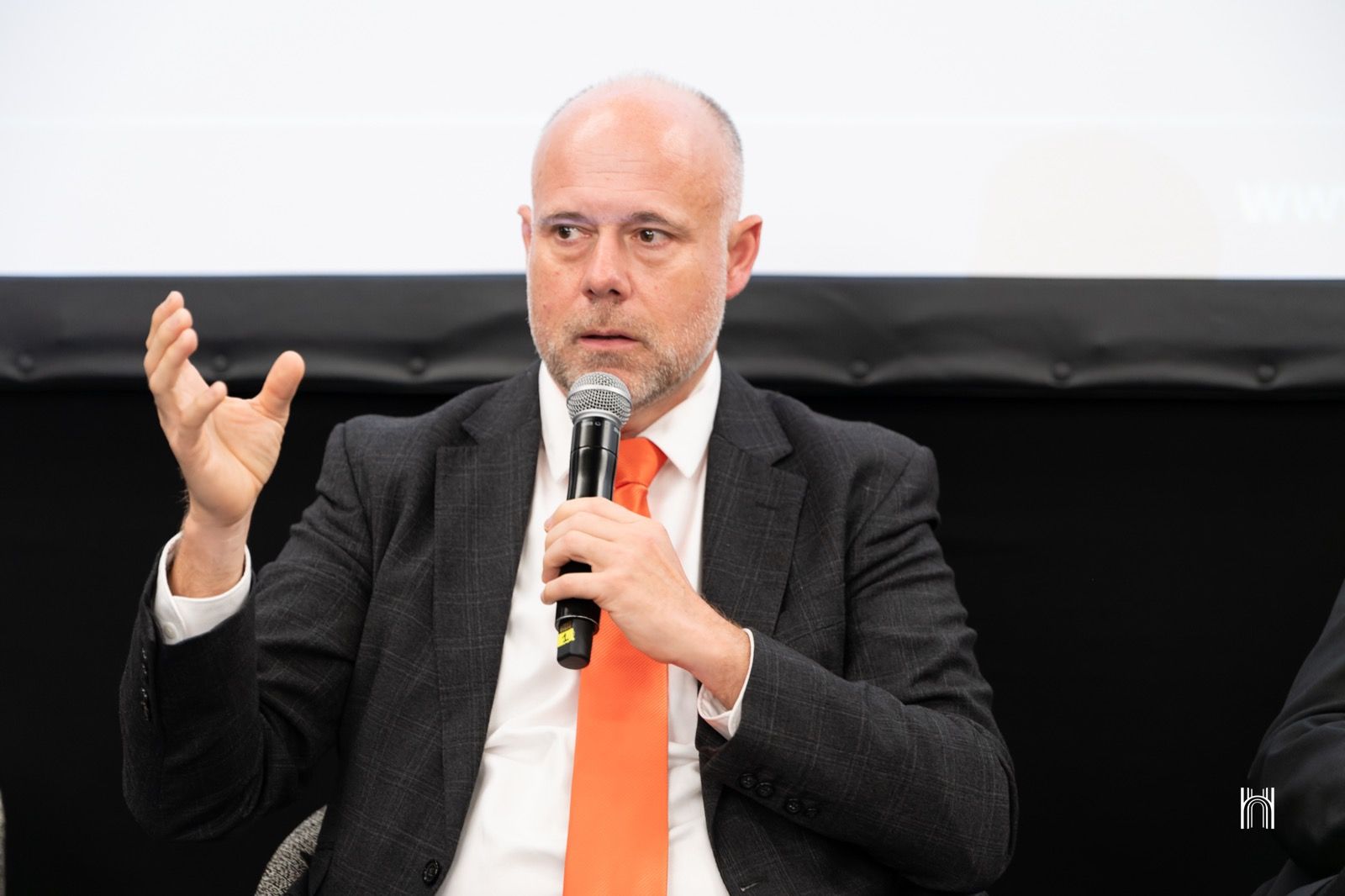
Why should a bar robot worry a management team?
Because of a sentence the industry repeats without thinking: "it's only a robot". It captures the sector's blind spot exactly.
The scene now repeats itself at trade shows and openings. A robot serves the drinks at a cocktail reception, and its owner offers cheerful reassurance: it's only a robot, it pours the drinks, nothing more.
That is true today. It will not be true for long. Tomorrow this machine will have a camera. A glass will fall and it will go and clean up on its own. It will spot an incident on the floor and head back to the kitchen. It will know how many kilos it is carrying and how far. It will no longer be a mechanical arm, it will be a silent employee that observes and decides.
Yet that gaze, that constant reading of what is happening in a room, has until now been a human profession. A director, a head waiter, a manager who crosses the bar and sees, in three seconds, that a table is bored, that a guest is hesitating, that a server is overwhelmed.
Go to Singapore and you will see what this looks like at scale. Robots, automation, everywhere. It is no longer a projection.
The question is therefore not whether the robot serves well. It will serve well. The question is what remains of the profession of the person who used to serve, and whether the house has bothered to answer that before switching the machine on.
What should be entrusted to artificial intelligence, and what should be refused to it?
Artificial intelligence must give time back to the team. It must never think in its place.
That sentence sums up my position, and I repeat it in every training session. It draws a simple line that many management teams have never set down in writing.
On the right side of the line: everything that wastes time without producing relationship. Re-entering information already given, searching for availability, compiling a history, preparing a guest profile, chasing an invoice. Every minute recovered there is a minute returned to presence.
On the wrong side: interpretation. Deciding what this guest needs tonight. Choosing the tone of a reply. Sensing that a family arrives exhausted and that check-in should be cut short. These gestures cannot be programmed, because they require perceiving a state, not processing a data point.
We try to automate everything, and that is very bad in hospitality, and worse still in luxury hospitality. What we lose along the way is emotion and emotional intelligence, which is precisely what the guest is paying for.
A management team that confuses the two columns invests in a tool hoping it will produce a human quality no software manufactures. And it leaves its teams with the feeling of having been bypassed.
Does time given back make a team available?
No. Artificial intelligence solves the question of time, not the question of presence. Availability is not a slot in a schedule, it is a state.
Giving thirty minutes back to a housekeeping manager or a front office manager creates no additional attention if those thirty minutes are immediately filled with something else, or if the person who receives them arrives exhausted, upset, or simply absent from themselves.
A team member can stand in front of a guest, look at them, say the exact words the procedure requires, and be nowhere at all. The guest feels it immediately. They will not be able to name it, but they will feel it, and that sensation is what decides their memory of the stay.
Making a team genuinely available therefore starts with the team. To truly welcome another person, you must first have learned to welcome yourself. A team member who cannot recognise their own tiredness, tension or irritation will not see it in a guest either. They will apply the procedure, correctly, and miss the point.
This is the central idea of my training sessions, and the one that produces the most silence in a room.
What happens when a team no longer understands its role?
It applies the procedure without being present, and the guest feels it immediately, without ever being able to name it.
This is the point I wanted to make in Milan, and it bears directly on the employee experience.
A team member who does not understand the purpose of their role in the guest journey will never produce the attentiveness in question here. They can be faultless on procedure and absent in the relationship. Two guests arriving at the same hour, in the same hotel, under the same service charter, will experience radically different arrivals depending on who stands in front of them.
The arrival of automation makes this risk worse, because it sends an implicit message to the team: what you were doing could be done by a machine. If nobody redefines what the machine will never do, that message stands, and it demotivates.
This is why artificial intelligence is first a management question and second a technology question. In that order, and not the other way round.
What is the real question to put to a board?
Not what the tool will save us, but what meaning it leaves in the work of those who remain.
I ended my intervention in Milan with a piece of news everyone in the room had in mind. Amazon had just announced fifteen thousand job cuts.
I put three questions to the audience, and I put them here to any management team preparing its investment plan.
What is the meaning of your life?
What is the meaning of the life of your team member?
Where do you want to go with artificial intelligence?
These three questions look like nothing. They nevertheless decide everything that follows. A house that deploys a tool without answering them will gain productivity and lose engagement. A house that answers them first gains both.
Take care of all this, and build meaning.
How I approach this subject in the houses I work with
I always begin with the same exercise, and it takes people by surprise. I do not ask which tools management is considering. I ask each team member to tell me what their role is for in the guest experience. The answers immediately reveal where meaning has been lost, and it is almost never where management imagined.
I then look at the distance between the discourse and the sensation. Every house has a charter, a vocabulary, a manifesto. Almost none can tell me through which precise gesture, at which minute of the journey, that vocabulary becomes perceptible to the guest. That is where my work sits: turning an intention into an observable sequence, then checking that it holds when the team changes and when the hotel is full.
I work in three formats depending on the need: a keynote to plant the idea in front of a room, a workshop to let teams experience it, and longer-term support to check that it survives staff turnover. In French or in English, in France or abroad.
None of these formats is off-the-shelf content. Each is built with the house that welcomes me, from its guests, its teams and what it is trying to become.
This question reaches far beyond hotels. Every organisation that automates puts it to its teams, in a clinic as much as in a branch office, in a contact centre as much as in an airport lounge. Everywhere, the answer sits in the same place: what the house decides to keep human. That is the heart of generous hospitality®, the method I pass on through consulting, training and keynotes.
If the three questions asked in Milan crossed your mind as you read these lines, they deserve better than solitary reflection. A keynote for your teams, a workshop with your managers, or simply a conversation to check whether this is the right subject: my office answers, and the first exchange costs nothing but twenty minutes.
Key takeaways
Automation does not threaten the guest experience first. It threatens the meaning of the work of the teams who produce it.
A robot that observes and decides takes the place of a human profession. The question is not whether it serves well, but what remains of the profession of the person who used to serve.
Artificial intelligence must give time back to the team, never think in its place. Everything involving interpretation stays human.
A team member who does not understand their role applies the procedure without being present. The guest perceives it without being able to name it.
Three questions before any investment project: what meaning for you, what meaning for your team member, where do you want to go with this tool.
Time given back does not produce availability. A team member physically present and inwardly absent creates no perceptible value.
Share this article with a colleague, a client or a partner.
That is often how an idea enters a house, and then its habits.
What you say about it matters more than what I say.
A keynote, a mission, an article in the magazine: if my work has been useful to you, a few lines on Google are worth more than any argument.
Leave a review on Google →