
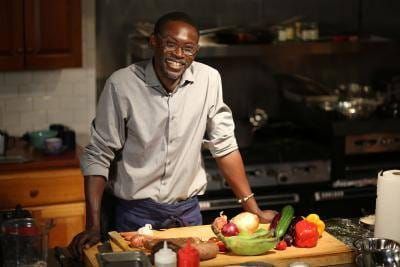
According to Pierre Thiam, Senegalese chef based in New York
In the restaurant industry, the art of welcoming must be reflected at all levels, from the moment the guest arrives and even slightly before, at the time of reservation.
The welcome, the atmosphere, the decor, the comfort, the floral touch, the choice of cutlery, the lighting, the acoustics, the aesthetics of the plate, the quality of the products served, and the attention paid to the smallest details all contribute to offering an enjoyable experience to guests.
I met Chef Pierre Thiam in 2015 in Saint-Louis, Senegal, during a symposium on the Art of Welcoming in Senegal. The meeting with Pierre was fascinating. He has lived and worked in New York for over 20 years. He trained in culinary arts in several restaurants. Talented, he opened his first restaurant, "Yolélé", in 2000. The second restaurant, "Le Grand-Dakar Restaurant", opened four years later. He wrote the book "Yolélé" in 2008 to promote African cuisine, featuring Senegalese recipes. He was a finalist for the Julia Child Award in 2009 and won the Gourmand World Cookbook Special Jury Prize in Paris in 2010.
He creates a contemporary cuisine inspired by African products. He seeks a balance between authentic taste and the nutritional qualities of the ingredients. The whole experience is presented in a setting that integrates Africa's own values of hospitality and aesthetics. Pierre is an ambassador of the African art of welcoming. For him, the art of welcoming is "one of the cardinal values of Africa in general and Senegal in particular (Teranga). With us, the stranger is king. When the entire restaurant team makes this their maxim, the guest's meal is transformed into an authentic and unforgettable experience."
Pierre Thiam, you are a Senegalese Chef based in New York. You have written books on Senegalese cuisine and received various awards for your work. Drawing on your culture and your travels, you define your cuisine as "a high-quality contemporary cuisine, inspired by African products." You reinterpret your expertise through travel while keeping your roots, which you constantly enrich.
How does territory shape a country's restaurant industry, thereby determining its art of welcoming? How is dining a source for transmitting values?
It is clear that the territory is its essence, as a country's cuisine is primarily influenced by its environment. A country's dining, drawing inspiration from the products of its terroir, is therefore logically shaped by the territory. Beyond products, this dining reflects a set of values unique to that environment, including its art of welcoming.
How do you reinterpret traditional Senegalese cuisine? What is your cuisine? What are the different ways of dining?
When I revisit traditional Senegalese cuisine, my personal experience naturally plays a role. Sometimes, ideas from elsewhere creep in subtly. Other times, ingredients from my home country are used as the basis for a recipe from abroad. A kind of dialogue takes place, and the plate becomes a "meeting point of giving and receiving". In doing so, I do not try to change tradition, which remains the foundation of my inspiration. I wish to remain faithful to its essence and its flavors. My cuisine is rather a way of paying tribute to this tradition, which will always remain at the heart of the dialogue.
As for the different ways of eating, where I come from, there is only one: we eat together, with family, with friends... eating is always a kind of communion.
How do you define the Senegalese art of welcoming? And can you shed light on the art of welcoming in New York?
In Senegal, the guest is king. The stranger is always welcome to share the same meal around the same bowl. The word Teranga is the expression that best symbolizes this Art of Welcoming in Senegal. In New York, there is also an Art of Welcoming, although it is different from Senegal's. The pace is different. Here, you must first be introduced or invited. It is a much more individualistic and material society. The sense of community is therefore inevitably less developed than in Senegal.
How is the art of welcoming an experience for the guest? How can the African art of welcoming be translated into a restaurant? From the cuisine to the service and the decor...
The art of welcoming makes the guest feel special. Dining is not just a transaction where the guest gives money and is served a plate. It is through this art of welcoming that the guest experience becomes enjoyable. It is because they feel welcome that they return. The restaurant's objective is the guest's well-being, from the moment they walk through the doors, from the reception hostess to the moment they receive their bill. This begins with the quality of service, attention to the smallest details, atmosphere, decor, and lighting: nothing should be overlooked to ensure the guest's comfort.
For an African restaurant, the objective remains the same: to offer the guest an enjoyable experience. However, it should not be a mimicry of what other restaurants from different cultures do. Let us remember that a country's dining is inspired by its terroir: its products as well as its values. An African restaurant that integrates this offers a much more complete experience to the guest. This integration must, of course, adapt to the context and the times. While avoiding overdone clichés, the decor, the atmosphere, the choice of colors or lighting should allow the guest to travel to Africa.
For example, when I design a menu, I think of the guest and their well-being. I take into account both the nutritional aspect and the aesthetics of the dish, which must always be appetizing. As a chef serving a cuisine that is meant to be African, I also wish to offer, as much as possible, the experience of eating together, which is one of our fundamental values. This can be expressed in different ways: either through a tapas-style concept where the table is encouraged to share several small dishes, or by serving the meal on a platter allowing everyone to serve themselves directly onto their plate, or even eating directly around a bowl as is done in our homes. It all depends on the restaurant's ambition. If the goal is to win Michelin stars, the approach will, of course, be revised.
Share this article with a colleague, a client or a partner.
That is often how an idea enters a house, and then its habits.
What you say about it matters more than what I say.
A keynote, a mission, an article in the magazine: if my work has been useful to you, a few lines on Google are worth more than any argument.
Leave a review on Google →