
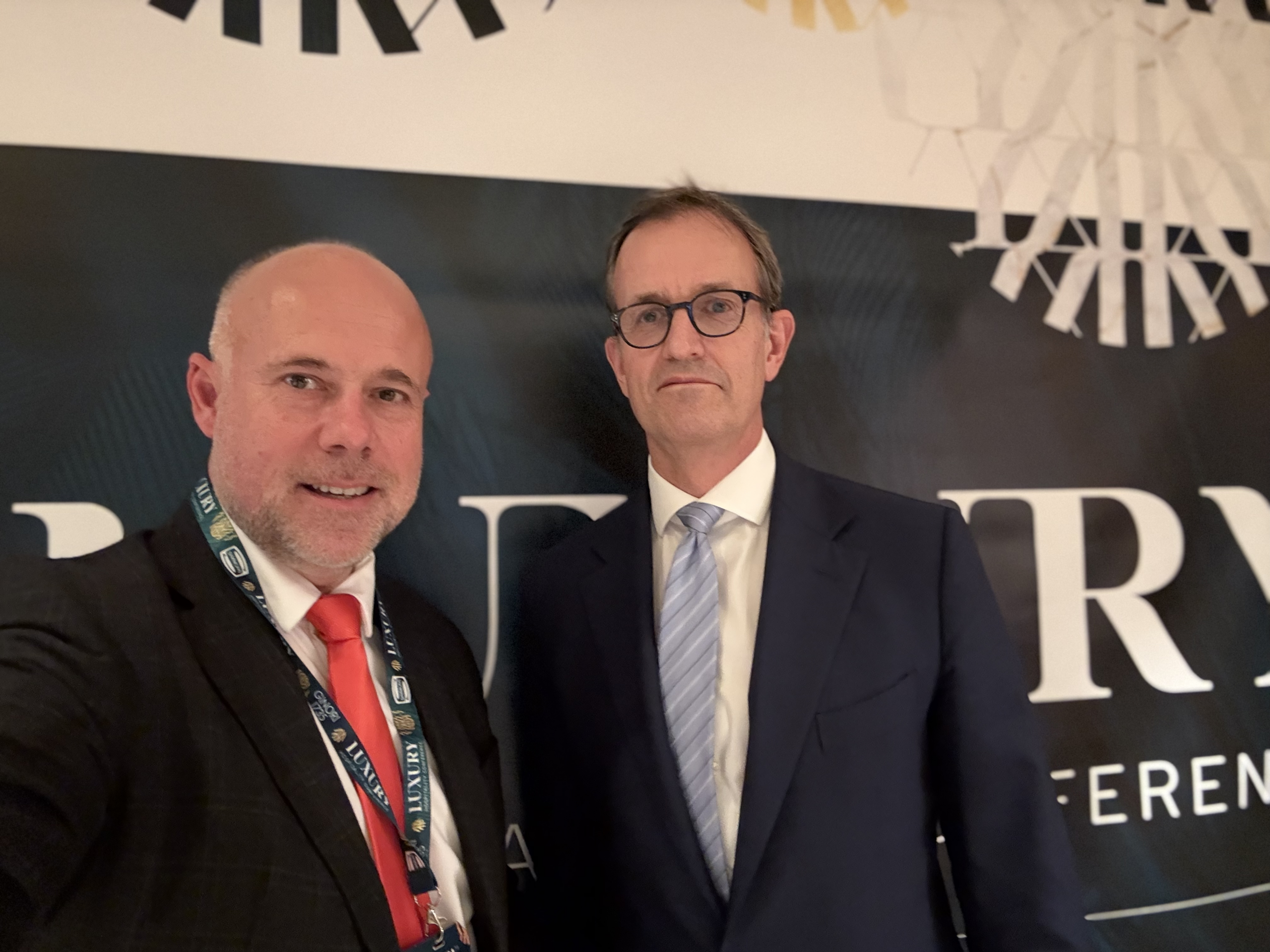
At the Luxury Hospitality Conference in Milan, an international event that brings together professionals, managers and hoteliers every year, I had the opportunity to listen to and talk at length with Markus Venzin, Managing Director ofEHL. These discussions with Markus have profoundly enriched my thinking on an essential issue: how can human capital become the main lever of excellence for tomorrow’s hotel industry?
This international event, which each year brings together hotel executives, investors, operators and luxury experts, is often a good barometer of the real state of the sector. I took part as a speaker, and as an attentive observer of an industry that is searching, transforming and, sometimes, contradicting itself.
Excellence cannot be decreed, it has to be built. It’s built through pathways, encounters, training and coaching, and above all by leaders capable of transmitting an embodied vision. It’s also passed down from generation to generation. It is and will remain human.
The question then arises: how can we build excellence in a deeply human industry, when investment in human capital is still too often of secondary importance?
Hospitality, a human industry struggling to make the most of its talents
The hotel industry likes to remember that it is an industry of people serving people. In reality, however, this assertion comes up against a more complex reality. Markus Venzin says it sincerely: while human resources are universally recognized as essential, the sector has historically had difficulty in sustainably developing individual talent.
After Covid, this fragility became even more pronounced. In addition to the well-known structural difficulties of demanding working conditions, staggered working hours and operational pressure, there are new generational expectations and increased competition from other, more attractive sectors. The result is visible: persistent tension on the job market and a relative disaffection of certain profiles for operational jobs in the hotel industry.
This malaise is not just a question of wages or constraints. It also depends on the sector’s ability to explain the meaning of these professions, to tell the story of what they enable people to experience, learn and become. Many talented young people leave hospitality not because they reject service, but because they don’t see themselves in it.
This lack of projection also points to another, deeper reality: the need to give meaning while respecting individual life choices. For a long time, hospitality was part of a culture of service, in which it was above all necessary to perform a role, sometimes without questioning the framework or personal equilibrium. Serving often meant stepping aside, applying rather than thinking. But the world has changed profoundly. New generations are no longer just looking for a job, but a form of participation, recognition and dialogue. They want to understand why things are done the way they are, how they can evolve, and how professional life can be intelligently articulated with personal life. Excellence can no longer be built against these aspirations; it must be built with them.
This conviction guided certain operational decisions from the outset. When I was Director of Lodging at a 600-room hotel in Paris with a staff of almost 350, one decision seemed obvious to me: to give every young person working at reception and in the reception services the chance to enjoy a real weekend at least once a month, from Friday evening to Monday morning. In 2005, this organization was not self-evident: teams simply didn’t have weekends, except for the oldest ones. My decision was not a matter of granting an advantage, but of sending a clear signal. It reflected a simple idea: it’s possible to have a deep love of the hotel business, to commit oneself to it with high standards and passion, while still having the right to live, recharge one’s batteries and preserve a personal balance. It was also a step towards building long-term commitment and excellence.
Training for the hotel industry… and for the world
Founded in Lausanne in 1893, EHL is recognized as the world’s leading hotel school. It trains students from all over the world for careers in hotel management, with programs ranging from Bachelor’s to Master’s degrees, as well as executive and specialized courses. . EHL has been ranked No. 1 in the QS world hospitality management rankings for 7 consecutive years.
With this in mind, Markus Venzin has repositioned the school not only as a top-level academic institution, but also as a place for educational innovation, with close links to the industry. His conviction – “we need hoteliers who are entrepreneurs” – reflects a broader ambition: to make hospitality a skill applicable to all trades and sectors, while retaining its human heart.
At EHL, fewer and fewer graduates are joining hotels directly. The majority go into the luxury goods industry, retail, finance, consulting or brand management.
For Markus Venzin, this openness is essential: if talents trained in hospitality move into a variety of industries, it’s not a betrayal of the profession, but proof of the power of the human skills developed. But this raises a strategic question for hoteliers: if talent has a choice, why would it stay? Excellence can no longer be an implicit promise. It must be lived, transmitted and embodied. Training is no longer just about passing on technical know-how. The aim is to train people to understand their role, their impact and their possible trajectory.
Once again, when I was in the field as Director of Lodging and Hospitality, one point always struck me as essential: welcoming employees deserves as much attention as welcoming customers. At the time, my deputies and I set up a structured integration program, with precise follow-up times: one week, three weeks, three months, six months, nine months. Not to control, but to listen, adjust, explain and give meaning.
This logic applied equally to trainees and apprentices. The challenge was not just to teach them a trade, but to show them why this trade made sense, what it enabled them to learn about themselves, others and the world. Without this transmission, hospitality loses one of its major strengths: its ability to reveal vocations.
Hospitality thus becomes a management discipline, just like finance or strategy, but with a major difference: people are both the means and the end.
Internship and integration: where it all really begins
Markus Venzin’s speech highlighted the experience of trainees and young talent. He sums it up almost as a matter of course: today’s trainees are tomorrow’s employees. Yet too many organizations still treat this stage as a secondary variable.
Some establishments provide support, explain things and take their time. Others simply assign tasks, sometimes in low-value functions, without ever making their meaning explicit. Markus Venzin then poses a simple, almost brutal question: who would want to work in a back office on a long-term basis if nobody explained the real usefulness of this role in the overall experience?
This need for coherence is even more pressing when it comes to internships, especially at the end of the curriculum. I ran a master’s degree in hospitality in France at a business school, and I was always very clear with the students: a final-year internship must be a time of real learning, not just the provision of skills. In recent years, however, certain practices have raised questions. Luxury hotels promote their image, multiply the seductive speeches, but in reality use students with 5 years of higher education as an operational workforce, without managerial content or transmission. An internship presented as an opportunity to immerse oneself alongside a restaurant manager – to understand schedules, cost sheets, team organization or outlet strategy – sometimes turns out, after just a few days, to be a succession of room services with no learning perspective. An internship without a real training dimension becomes counter-productive: it discourages, damages confidence and turns young talent away from the sector for good. I then asked the student to terminate the internship, after a conversation with the hotel manager, and accompanied him in the search for a more formative alternative.
In hospitality, the internship cannot simply be for the use of students; it must remain an act of transmission.
Leadership and culture: the central role of the General Manager
A luxury hotel often represents an investment of 50 to 70 million euros, sometimes much more. But one question is rarely asked head-on: how much is really invested in the managerial development of the person running the plant?
Markus Venzin sums it up with a formula that hits the nail on the head: many General Managers are excellent representatives, capable of embodying ceremonial, but not always true managers. But leadership is not a symbolic posture. It conditions culture, the way talents are developed, recognized and passed on.
For my part, I still see too many Hotel Managers who don’t feel the need to train, go back to school or follow executive courses. In my opinion, this is a strategic error. No one is born a leader. Leadership is built, adjusted and evolves with time, contexts and teams.
Leadership is not just a symbolic posture. It conditions :
- plant culture,
- how talent is recruited, trained, supported and retained,
- and, above all, the team’s ability to pass on this culture to others.
Coaching can support the development of managerial and leadership skills, and it’s a good idea not to do so. This requires a capacity for openness, continuous learning and constant questioning. The Managing Director is the first role model, capable of embodying what he asks his managers to do. What’s more, a well-trained manager will become the director of tomorrow. Conversely, poor management experience is likely to produce – almost mechanically – careers marked by the same lack of exemplarity.
The role of the leader is therefore not just to organize, but to transmit a philosophy, consistency and exemplarity on a daily basis. This vision of leadership, with the human being at the center, is the cement of sustainable excellence.
Key points to remember: excellence as a human responsibility
The Milan conference reminded us of a fundamental truth: hospitality will remain an industry of people at the service of other people. Technology will optimize operations. Digital tools will facilitate training and organization. But excellence can never be programmed.
It will be built on the quality of career paths, the attention paid to talent, managerial courage and the ability of leaders to learn, again and again. It will be played out in the way organizations welcome their teams, give them meaning and transmit a living culture.
One point is often absent from strategic discussions, even though it is central to the hospitality business: self-knowledge. Welcoming others implies an ability to understand one’s own reactions, limits, biases and limiting thoughts.
it’s difficult to be fully available to others without having learned to welcome ourselves. This introspective dimension is neither abstract nor theoretical. It determines the quality of the relationship, the managerial attitude and, ultimately, the customer experience.
At a time when artificial intelligence is transforming processes, automating certain tasks and aiding decision-making, this human dimension is becoming even more precious. Empathy, creativity, emotional intelligence and intercultural understanding remain impossible to automate.
Markus Venzin is right to point out that the future of the hotel industry will depend not only on its concepts and brands, but also on its ability to invest sincerely in its human capital. It’s at this price that excellence will cease to be a word and become a lived experience.
