

Six Senses and the Art of Emotional Hospitality: A 2017 Interview with Neil Jacobs
Some interviews gain depth over time. Not because they become outdated, but because they allow us to measure how ideas evolve and, in some cases, how visionary certain approaches already were.
The conversation you are about to read was conducted in 2017 with Neil Jacobs, who was at the time the CEO of Six Senses Hotels Resorts Spas. Since then, leadership has evolved, the brand has continued to grow, and the hospitality landscape has undergone significant transformation. Yet, the principles discussed in this interview remain strikingly relevant today.
At a time when the notion of “guest experience” was still emerging as a central topic in luxury hospitality, Six Senses was already shaping a distinctive approach one rooted in emotional connection, intuitive service, and a deep respect for the environment. Their philosophy anticipated many of the expectations that define the industry today: personalization, wellness, authenticity, and a strong sense of place.
Revisiting this interview offers valuable insight into how these ideas were articulated early on. It also resonates strongly with what I define as “generous hospitality”: an approach that aligns three essential dimensions the sense of place, the human connection embodied by teams, and the personal well-being of the guest.
You are also invited to watch the video associated with this interview, recorded at the time, which brings this philosophy to life and offers a more immersive understanding of the Six Senses experience.
Neil Jacobs, CEO at Six Senses: The Art of Welcoming
It is my pleasure to share with you my interview with Neil Jacobs, the Chief Executive Officer at Six Senses, about the art of hospitality and the Six Senses brand.
Neil Jacobs is the CEO at Six Senses Hotels Resorts Spas. With over three decades of experience in the operation, development and transactional side of hotels and spas, Neil is passionate about wellness, sustainability, inventive design, food and experiential travel.
Prior to joining Six Senses, Neil spent five years at Starwood Capital Group as president of global hotel operations where he was responsible for the development of two innovative new brands, Baccarat Hotels and 1 Hotels, both debuting in 2014.
Neil spent 14 years with Four Seasons Hotels and Resorts most recently serving as senior vice president operations for Asia Pacific since 2003. Based in Singapore, he was responsible for the operation of 16 hotels throughout the Asia Pacific region with 10 additional properties under development in China, India, Vietnam and the Indian Ocean. In this role, he managed four regional vice presidents and was responsible for the human resources, finance and sales and marketing disciplines in the region.
His career prior to Four Seasons included key leadership roles with New Europe Hotels NV, IDG Resorts, Grand Champions Resort Corporation and Venture Inns of America. He began his hospitality career in Food & Beverage with Trusthouse Forte and his spirit of adventure has taken him to exciting postings around the world including London, Rome, Sardinia, Paris, Sri Lanka, Bali, Barbados and Los Angeles.
Neil attended Westminster Hotel School in London and received a diploma in French Civilization from La Sorbonne in Paris, France. He is fluent in English, French, Spanish, Italian and Bahasa Indonesia.

Six Senses Zighy Bay – Mountain Picnic
What is your business approach of French art of welcoming? Do you think that French art of welcoming is a differentiating factor for luxury hotels?
The traditional French art of hosting and service, art of welcoming, is ingrained in the way we prepare for and welcome guests, but Six Senses is less concerned about formality and strict rules and more focused on the individual needs and wishes of our guests.
One of our six core values is called Emotional Hospitality. This approach to service begins with empathy and a desire to understand the guest’s needs and wants, both spoken and unspoken. We understand that people are driven by emotions and our intuitive approach to service means that every guest receives a richer and more personal experience.
Two examples to further illustrate how we approach the guest welcome is how we make someone feel like they are being welcomed into our home.
On arrival at one of our resorts, we invite guests to remove their shoes. They are placed in a cotton bag and guests can select not to wear shoes until they are ready to depart. We want guests to relax and walk freely through the sand, if that is their desire. Shoes do not have to be worn in restaurants. Our guests still select to dress well and look stylish, but in a casual, relaxed way.
We have experienced sommeliers at all resorts who share their knowledge of wines and encourage our guests to samples various vintages before deciding on which bottle best complements their meal. We take away the formality of selecting and serving wine and make lunch or dinner a relaxed celebration.
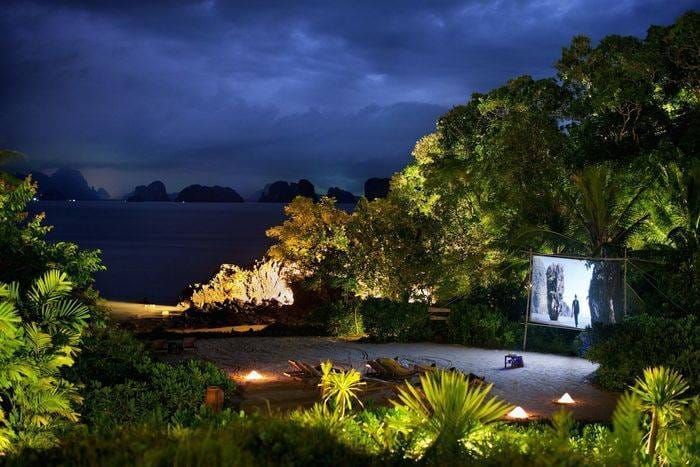 Six Senses Yao Noi – Cinema Paradiso by the beach
Discover my Interview with Neil Jacobs, CEO at Six Senses
What is your vision around the art of welcoming at Six Senses hotels? What is Six Senses’ guarantee in terms of service, and how does the group differentiate itself from competition ? How is each hotel different?
New employees, or hosts as they are called at Six Senses, go through a rigorous hiring process. Not only do potential hosts interview with human resources and the relevant department head, the property general manager also meets, interviews and approves all new hires. Six Senses looks for people who are passionate about pleasing guests and show an innate ability to go beyond the basics of service to make a guest visit ‘out of the ordinary’.
With increasing work hours and growing stress levels, people find it hard to gain perspective, to focus on what really matters in life. To sustain guests we strive to create memories. To be lasting they must be unique – not just a perfect martini, but a perfect moment. The most powerful memories are built from a shared moment of discovery or a shared moment of change. Using our intuition and applying it in the form of emotional hospitality removes these everyday barriers and leaves us open to bonding once again with the world, nature, others and ourselves.
In terms of what makes each property special, all of our resorts and spas are rooted in the local culture. Our architecture and building practices follow indigenous designs and utilize local architects and artisans. Our food comes from local farmers and fishermen. Our knowledge of the best fishing holes, diving spots, underground and pop-up clubs, happenings and restaurants is founded on our local relationships. And we could not hope to care for our guests if we did not first care for our people and the communities we are part of.
I should add that another of our values is: Fun & Quirky. This is not something you would ordinarily associate with the hospitality and wellness industry. Our curiosity and desire to explore and deliver unique experiences, allow us and our guests to discover unexpected ways to reconnect every single day. Six Senses is not stuffy and uptight. We are all about having fun, being out of the ordinary and comfortable with who we are and who are guests are.

From Emotional Hospitality to Generous Hospitality: Lessons for the Future of Luxury Hotels
Looking back, this interview captures a pivotal moment in the evolution of luxury hospitality. What appeared in 2017 as a distinctive approach encouraging guests to remove their shoes, reducing formality, and focusing on emotional connection has since become a defining expectation across the industry.
However, beyond these practices, it is the underlying philosophy that truly stands out. The concept of “emotional hospitality,” as described by Neil Jacobs, reflects a shift from delivering service to creating meaningful human experiences. It acknowledges that excellence is no longer defined solely by precision and standards, but by the ability to understand, anticipate, and connect with guests on a deeper level.
This perspective aligns closely with today’s most pressing hospitality challenges. Guests are no longer simply looking for luxury amenities; they seek coherence, authenticity, and experiences that resonate with their personal values and emotions. They expect to feel recognized, understood, and genuinely welcomed.
In this context, the notion of sense of place becomes essential. At Six Senses, it is expressed through immersion in nature, local culture, and a deliberate effort to create environments where guests can reconnect with themselves and with their surroundings. But beyond design, it shapes the entire guest journey, from arrival to departure.
In my view, this coherence lies at the heart of what I call generous hospitality. It requires a holistic approach that considers the place, the people, and the guest as a unified system. It demands attention to detail, but also the confidence to simplify, to remove unnecessary formality, and to create space for genuine human interaction.
Ultimately, this interview reminds us that the future of hospitality will not be driven by an accumulation of standards, but by a deeper understanding of human needs. The ability to create emotion, to offer meaningful experiences, and to build lasting memories will continue to define the most inspiring brands in luxury hospitality.