
The Carlyle, A Rosewood Hotel – New York
The elevator opens onto a silent corridor. The dark wood-panelled walls, the subdued lighting, the floor covered with a soft, geometrically patterned carpet – everything here speaks of another era, without ever seeming outdated. We’re at the Carlyle, A Rosewood Hotel, on the corner of Madison Avenue and 76th Street, on Manhattan’s Upper East Side. A palace with 190 rooms and suites, opened in 1930, which will celebrate its centenary next year with the serenity of those who know they have lived through history unscathed.
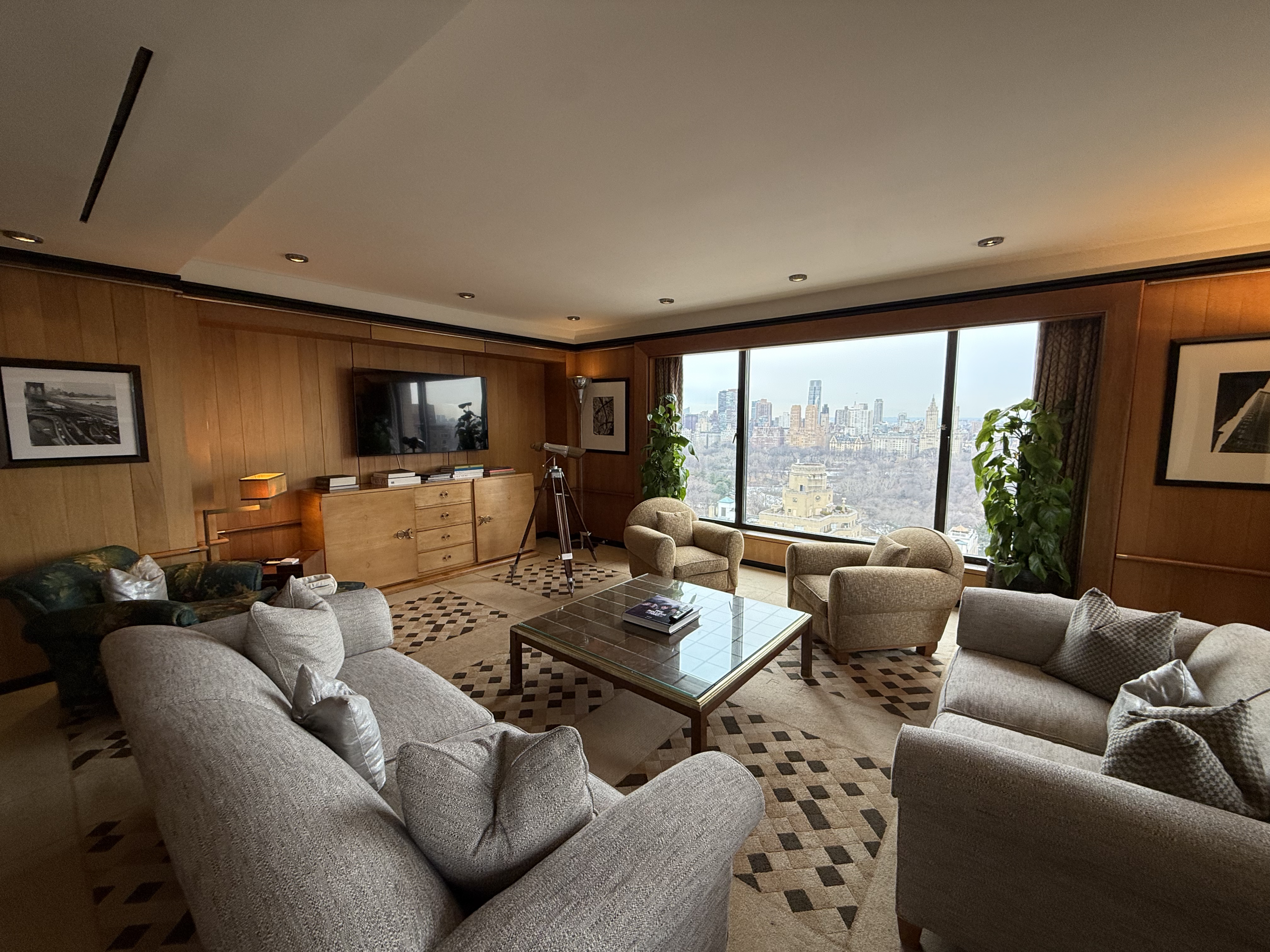
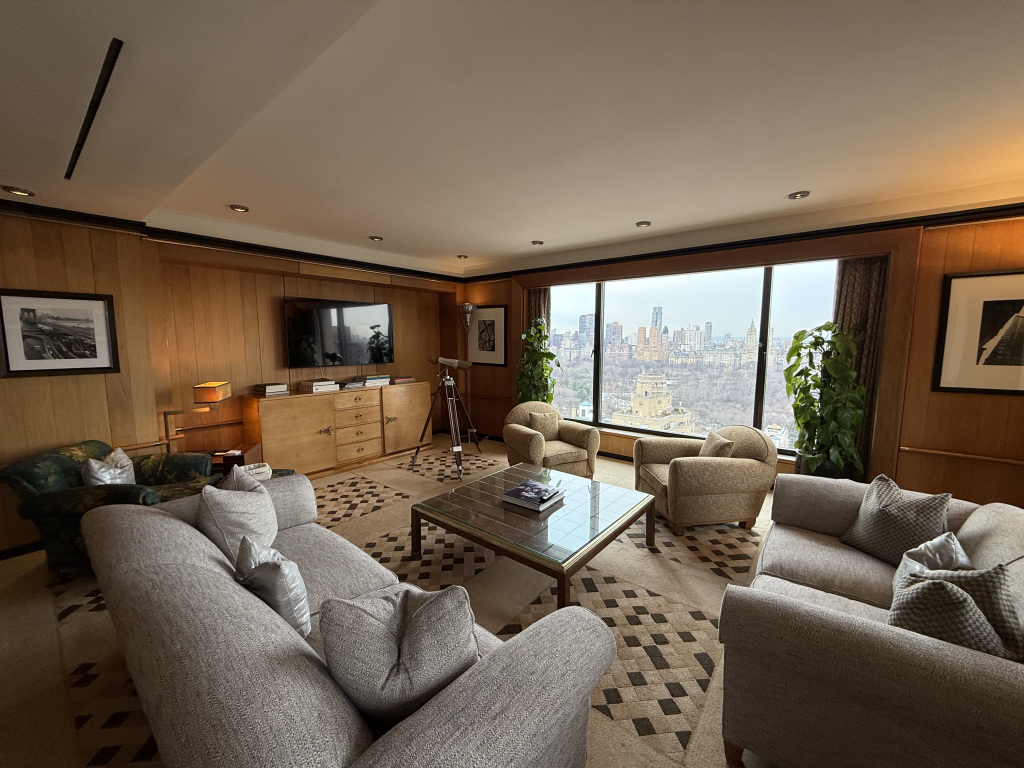
It was in one of the hotel’s most beautiful suites that I met Marlene Poynder, Managing Director of the Carlyle for the past three and a half years. The view from the top of the Art Deco tower is breathtaking: Central Park stretches into the distance, the rooftops of Manhattan are silhouetted against the morning light, and it’s immediately clear why presidents, artists and royalty have chosen this address as their refuge. The suite itself – voluminous, luminous, furnished with the attention to detail that characterizes great houses – embodies the Carlyle’s promise: to make every guest feel as if they are staying in a private apartment of the highest quality.
Upper East Side, not in a hotel.
Australian by birth, New Yorker by adoption for the past ten years, Marlene Poynder is the first woman to head this institution in its 95-year history. She talks about her hotel with the precision of a manager and the passion of a local.
Read the customer before he even arrives
Marlene Poynder’s vision of hospitality begins long before the customer walks through the doors of the Carlyle. It begins in the hours, sometimes days, before his arrival. And it’s based on a simple principle: know, anticipate, personalize.
“In New York, we like to understand the customer first, learning as much as possible about them before they arrive. We try to find out as much information as possible beforehand, so that we can organize appropriate welcome attentions, whether they drink or not, for example.”
The famous Carlyle cookies, the carefully selected New York culinary specialties, the attentions placed in the room before arrival: nothing is left to chance, but nothing is mechanical either. It’s a personalization that Marlene Poynder clearly distinguishes from the standardized pre-arrival practice you find in most palaces.
“Most luxury hotels practice pre-arrival. But for us, it’s much more specific. Do they like bathtubs? Do they want to be able to cook? Do they travel with a lot of luggage? Do they need lots of storage space? These are essential details.”
This granularity of customer knowledge is not a superfluous luxury; it is the very foundation of the Carlyle experience. With its 55% of suites, many of which were once private apartments bought up over the years, the hotel offers a rare diversity of configurations: full kitchens, kitchenettes, large bathrooms with separate bath and shower, and generous storage space. All these options can only be mobilized if we know exactly what the customer is looking for.
“Rather than making the customer change once they’re on site, we gather as much information as possible beforehand.”
A sense of place: living in an Upper East Side apartment
What strikes you right away at the Carlyle is the atmosphere. Not a conventional palace with its imposing lobby and codified geography. More like an upscale residential building, lived-in, warm and full of life. An impression that Marlene Poynder fully assumes.
“There’s clearly a sense of place here. We’re in an Upper East Side residential apartment in many of our rooms or in the corner suites.”
This is precisely what Rosewood has understood and preserved. Unlike many renovations, which standardize in order to reassure, the Group has maintained the heterogeneity of the spaces, with each room and suite having its own identity, the result of the work of different designers over the decades.
“Not all the rooms are the same. Different designers have worked on the rooms over the years. Rosewood has given us that sense of place. When you come here, you have the choice of which style of room or apartment you want to stay in.”
The Empire Suite, by designer Terry Despont, is the most emblematic example. Even during refurbishments, Marlene Poynder ensures that the spirit of the designer is scrupulously respected. “We’re keeping it in the spirit of Terry Despont because it received so much recognition during its previous renovation.”
When the Cheng family took over ownership in 2011, they recognized and perpetuated this eclectic identity. A choice of heritage as much as of hotel, which says a lot about the philosophy of the house.
A 95-year-old building: between heritage and relevance
Managing a 95-year-old heritage building in the heart of one of the world’s most demanding cities is a constant challenge. Marlene Poynder makes no bones about it.
“Having a heritage building is a wonderful thing. But older buildings require a lot of work and a lot of maintenance. It would be easy to gut the building completely and modernize all the rooms. But we’d lose a lot if we did that.”
The Carlyle is one of a very small circle of historic luxury hotels in New York that Marlene Poynder can count on the fingers of one hand. This scarcity is a responsibility. And it calls for a clear stance: to pay homage to the heritage without locking it up in sterile museification.
The challenge is also to attract younger customers, without betraying long-standing loyalists. On this point, Marlene Poynder is pleased to note that Art Deco is back in vogue. “Young visitors discovering the Empire Suite particularly appreciate its art deco heritage.”
Added to this is the renaissance of the Upper East Side itself. The neighborhood is now attracting a new generation of New Yorkers, spurned by rents in Tribeca or the West Village. New cafés and restaurants are emerging. Luxury boutiques run north up Madison Avenue to 76th and 80th Streets. “As the buildings are smaller in this area, the atmosphere remains that of a local village and less overcrowded,” observes Marlene Poynder. The Financial Times in London even reported on it. A transformation that gives Carlyle a renewed territorial anchorage.
Bemelmans Bar: when the soul of a place goes viral
It’s hard to mention the Carlyle without mentioning the Bemelmans Bar. With murals by
Ludwig Bemelmans; the illustrator of the famous children’s book *Madeline*, who was commissioned for six months and ended up spending eighteen months at the hotel with his family. The bar has become one of Manhattan’s hottest spots. What’s the recipe for success?
The recipe, in fact, grew out of a strategic decision taken after COVID, when New York was looking to reinvent itself. The Carlyle team decided to open the bar without any restrictions on opening hours or days. Noon to midnight, seven days a week, 365 days a year, with live music every day.
“The town had been badly hit. When the bar reopened, it reopened completely. Young people knew they could come every day. TikTok and Instagram made it viral, which led to queues.”
Visitors come first for the frescoes, then return for the music and cocktails. This virtuous circle says something essential about the hotel’s philosophy: luxury is not consumed in a closed room. It is experienced in collective spaces, in encounters, in the care given to each interaction.
A team like a family: hospitality handed down from generation to generation
Behind the elegance of the premises and the precision of the service, there are men and women, many of whom have made the Carlyle the center of their professional and often personal lives.
“Many of our team members have been working here for a very long time. Some people have been here for 20, 30 or 40 years. One member of the housekeeping department has just retired after 44 years in the same position.”
Many are immigrants. They grew up together in the hotel, raised their families in the same neighborhood, shared the same decades. A close-knit, almost family-like community. What struck Marlene Poynder on her arrival was that this intimacy doesn’t exclude, it welcomes.
“Even though they’re a close-knit family, they’re extremely welcoming, like New York in general. They are proud of the hotel’s heritage and their role in its success. We encourage them to tell guests their stories and be themselves.”
This authenticity is undoubtedly the most difficult ingredient to reproduce in contemporary luxury hotels. You can’t buy it, you can’t script it. It is cultivated over decades, by management who understand that team loyalty is the foundation on which any lasting customer experience rests.
“Artistry”, a word that says it all
When I ask her to sum up the Carlyle in a single word, Marlene Poynder doesn’t hesitate for a second. “Artistry. That’s how I define it.”
A word that says it all: the artisanal mastery of service, the attention to detail, the beauty of the spaces, the precision of the welcome, the emotion that the hotel seeks to evoke at every moment. Hotels as an art of living, not as a lodging industry.
For this is the deep conviction that runs through his every word: a hotel like the Carlyle can’t be understood from a bedroom. It can be experienced in its entirety sitting in the Gallery, at Dowling’s watching the captain prepare a steak, or leaning back at Bemelmans chatting to a bartender in a red jacket.
“If guests don’t enjoy everything that goes on in the hotel, I don’t think they leave the Carlyle really understanding what we’re about.”
Before leaving, I take one last look at Manhattan from the heights of the suite. 95 years of history, 190 rooms and suites, and the quiet certainty that the rarest luxury is that which makes every guest feel that they are, here, exactly where they were meant to be.
—
*The Carlyle, A Rosewood Hotel – 35 East 76th Street, New York, NY 10021 – rosewoodhotels.com*
