
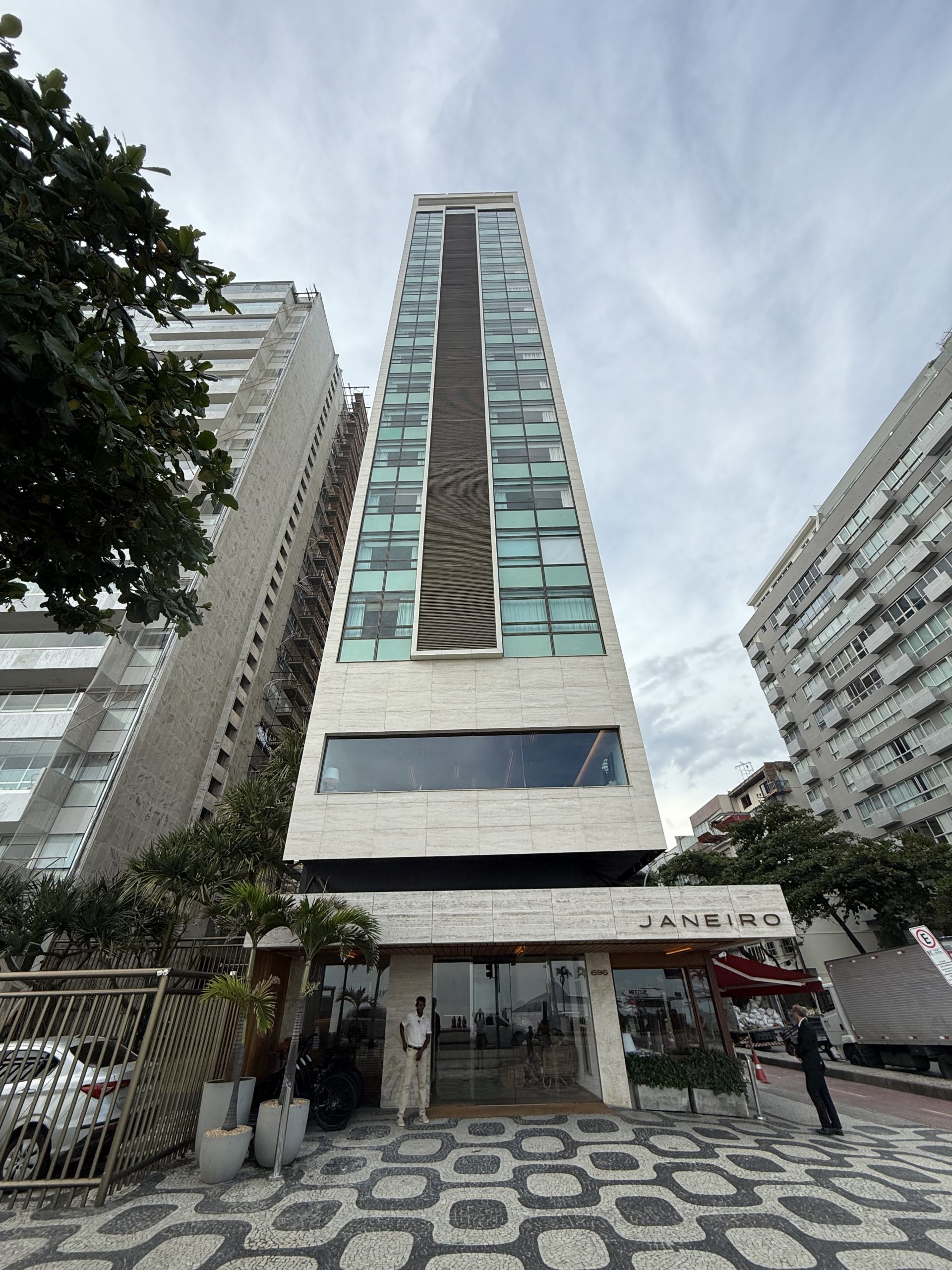
I had the pleasure of staying for two nights at the JANEIRO Hotel, facing the Atlantic Ocean on Leblon Beach in Rio de Janeiro.
Opened in 2018, this intimate property of 51 rooms and suites, all oriented toward the sea, is set within an elegant residential neighborhood, deeply rooted in local life.
From the moment of arrival, the experience feels fluid, natural, and effortless. Hospitality here is not declared, it is felt. What stood out most was the simplicity and sincerity of the relationship with the teams, their attentive presence, their way of being. There is an immediate sense of being welcomed into a home open to both the city and the ocean. The Janeiro Hotel is a living place, warm and deeply human, where every detail seems designed to create connection.
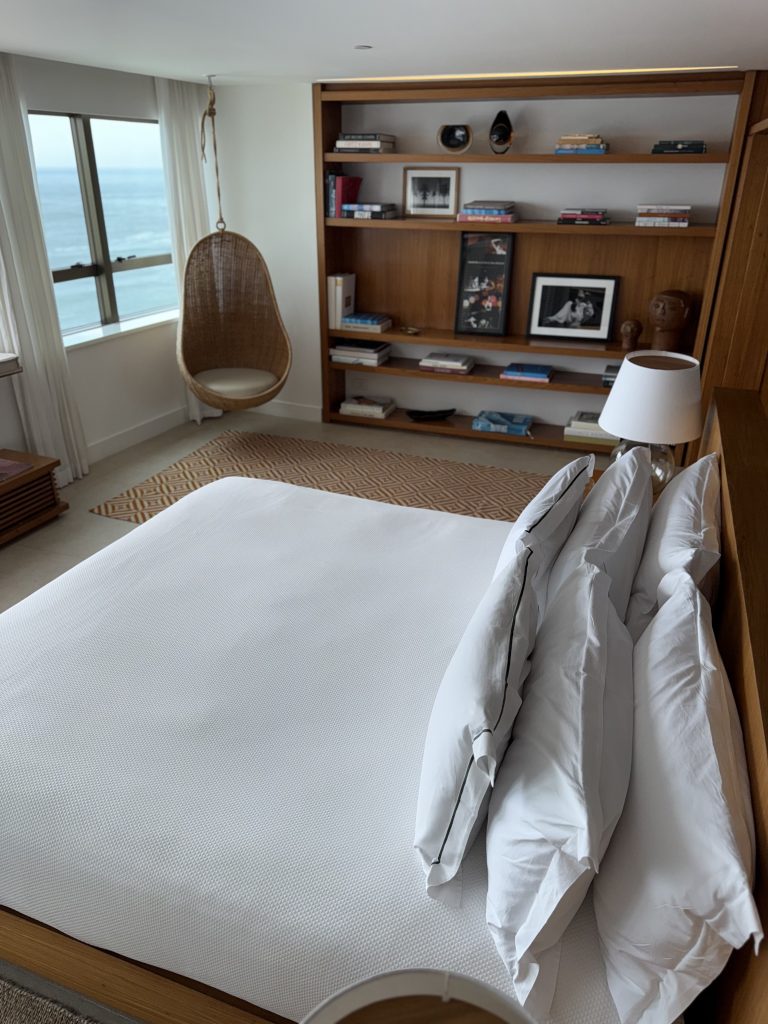
The architecture, designed by Lia Siqueira, is built around the idea of a contemporary Carioca residence, punctuated with subtle modernist touches. Wood is omnipresent throughout the structure, furniture, and décor, in dialogue with travertine marble, sandy tones, and natural light. Materials such as wood, straw, and linen extend this sense of softness and lightness into the rooms, all opening onto Leblon Beach.
The artistic curation is led by Oskar Metsavaht, creator, photographer, founder of the Osklen brand, and owner of the hotel. Through artworks, objects, and personal archives, art becomes an intimate and living presence, deeply connected to the Carioca lifestyle, to nature, and to an engaged vision of sustainability.
He also operates an art gallery facing the Botanical Garden, which I had the opportunity to visit.
At the helm of the Janeiro Hotel, Paola Tonini Moura embodies this vision of sincere and fluid hospitality. As General Manager, she places human connection, care for teams, and authenticity at the heart of her approach. Her leadership reflects the spirit of the place: a free, warm hospitality deeply anchored in the life of Rio.
It was with her that I discussed the art of hospitality, luxury, Carioca culture, and how the Janeiro Hotel translates these values into daily experience.
What is your vision of hospitality in Brazil, and more specifically in Rio de Janeiro?
For me, hospitality begins with the very meaning of the word. It comes from the word “hospital,” a place where people care for others. To welcome someone is, first and foremost, to care.
This requires empathy. It means understanding where people come from, why they travel, and in what emotional state they arrive. Some come to celebrate, others to rest, and others during more fragile moments. Hospitality lies in the ability to sense this and to adapt the welcome accordingly.
The more I understand someone, the more sincerely I can care for them. This applies equally to our guests and to our teams. It is impossible to be fully present for others without first taking care of oneself.
In Brazil, and particularly in Rio, hospitality is inseparable from lifestyle. It is natural, fluid, and sincere. The goal is not to impress through rigid luxury, but to create a relationship, a sense of home, a feeling of belonging. The welcome is warm, alive, and embodied. Guests enter an energy, a way of being in the world.
How does the Janeiro Hotel embody this vision through its architecture, artistic identity, and Carioca spirit?
The Janeiro Hotel was conceived as a contemporary Carioca home, not as a traditional hotel. Located on Leblon Beach, near Ipanema but with a very different identity. The neighborhood is more residential, more family-oriented, with its own distinct energy. Beyond its location, the Janeiro Hotel is designed as a way of living the city. The décor, atmosphere, and interior design are not meant to impress, but to tell a story.
The architecture by Lia Siqueira highlights natural materials, with wood at its core, combined with stone, natural fibers, and light. The intention was never to impose a design, but to create continuity with the environment, without boundaries between interior and exterior.
This philosophy extends into the rooms. Spacious, bright, and open to Leblon Beach. They feature natural straw, linen, and wood, creating a soft, warm, almost domestic atmosphere. Everything invites guests to slow down, breathe, and observe the ocean.
The artistic curation by Oskar Metsavaht plays a fundamental role. he artworks, photographs, and objects tell a personal, familial, and cultural story. Art is never decorative; it becomes a living expression that gives the place its soul.
The Carioca spirit runs throughout the project. Being Carioca is not just a place of birth, it is a way of life. It is a relationship to the sea, to light, to movement, to nature. Life in Rio unfolds largely outdoors: people wake early, run along the beach, surf, practice sports, and move through the city by bicycle.
This energy is reflected in the guest experience: all rooms face the ocean, bicycles are available, and spaces are dedicated to well-being, such as yoga and meditation. The objective remains constant: to offer a genuine immersion into Carioca life as it is truly lived.
What role do teams play in this experience and in your definition of luxury?
Hospitality cannot exist without teams.
Everything begins with internal culture. Team members live the same lifestyle that is offered to guests. Many are Cariocas, making this transmission natural.
Luxury, as I see it, is neither rigid nor ostentatious. It is based on human connection, quality of service, and the freedom to be oneself. This is reflected even in the uniforms, deliberately light and comfortable, designed by our creative team. Employees feel freer, more natural, and closer to guests.
When teams feel well, welcomed, and heard, it is immediately perceptible. When they feel at home, guests feel the same. This shared sense of home creates a deep and lasting difference.
Caring for guests begins with caring for teams. This responsibility is central. Regular moments of exchange are organised through weekly briefings and an internal programme called Coffee with Ideas.
These gatherings allow employees to freely share ideas, feedback, and proposals. Suggestions are listened to, considered, and implemented when possible. When teams see their ideas come to life, they feel valued, engaged, and involved.
This trust naturally translates into guest relationships, into presence, and into attention to detail.
What place does sustainability hold in your vision of hospitality?
Sustainability is one of the fundamental pillars of the Janeiro Hotel. It is not a discourse, but a daily practice. The commitment of Oskar Metsavaht, through the Instituto-E and his environmental and community initiatives, deeply influences the philosophy of the place.
This translates into concrete actions: reducing plastic, installing water filtration systems, limiting single-use products, working with local producers, and composting organic waste. Even small details tell a story, such as laundry bags made from recycled fishing nets collected on beaches. Même les détails racontent une histoire, comme les sacs à linge fabriqués à partir de filets de pêche récupérés sur les plages.
Rio de Janeiro is a city where nature and urban life coexist in a unique way. Between the ocean, the mountains, and the urban forest, the balance is both fragile and precious. The Janeiro Hotel expresses this Carioca spirit: a deep connection between hospitality, nature, art, and responsibility.
Laurent Delporte’s Perspective:
What feels particularly accurate in the positioning of the Janeiro Hotel is its ability to fully embrace a strong, situated, almost committed identity. In Rio de Janeiro, neighborhoods are not merely geographic zones; they are distinct worlds, each with its own rhythm, culture, and energy. Leblon bears no resemblance to Ipanema, Copacabana, or Santa Teresa. To translate this residential, elegant, and deeply local identity into a hotel is a true challenge. Here, it is clear that the hotel does not seek to please everyone, but to embody a specific place, a way of living Rio. This ability to make guests immediately feel where they are is, in my view, one of the Janeiro Hotel’s greatest achievements.
Art and culture also play a structuring role. The curation by Oskar Metsavaht extends far beyond the artworks or selected objects; it permeates the entire property, even the team uniforms, designed by him. This detail is far from anecdotal. It contributes to an atmosphere that is contemporary, relaxed, elegant, and deeply Carioca. It deliberately challenges traditional hospitality codes in favor of a freer, more living, more embodied form of hospitality.
This cultural approach becomes a true lever of hospitality: it creates proximity, curiosity, and above all, connection.
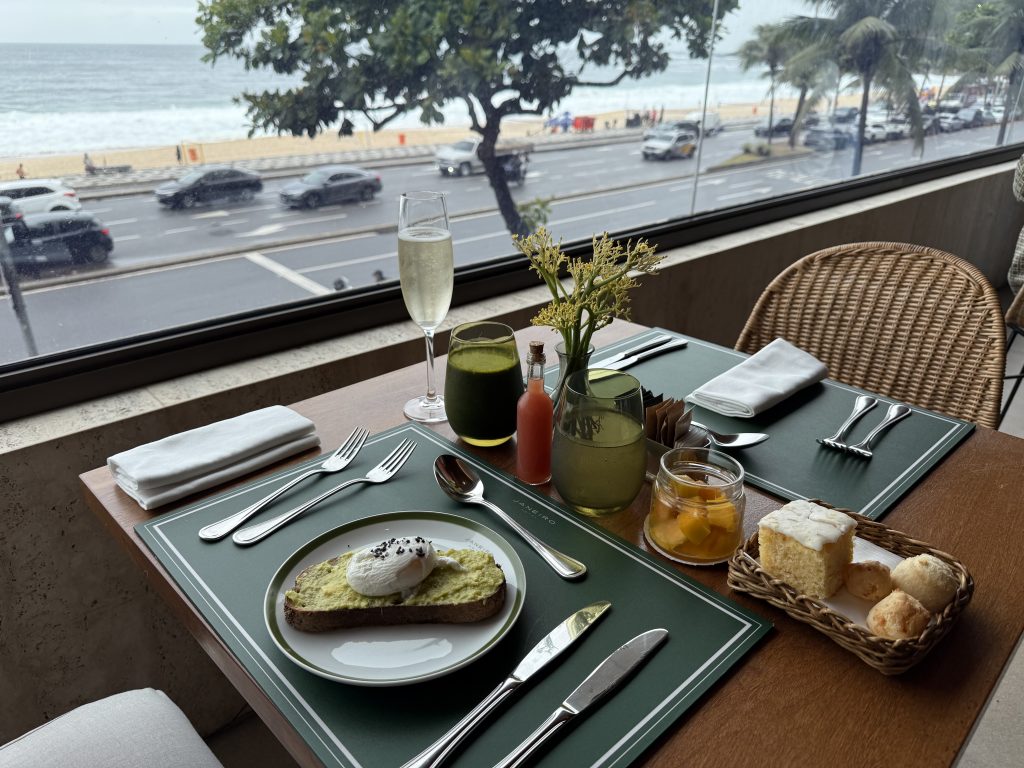
Finally, the experience extends seamlessly into the spaces dedicated to dining and conviviality. I particularly appreciated the à la carte breakfast, which breaks away from standardized formats and invites guests to take their time facing the ocean. Two dining concepts coexist, with a strong focus on products, daily rhythms, and lived experience. The rooftop bar and terrace, with its pool, offer a spectacular 360-degree view: the ocean, the mountains, the city, and the Christ the Redeemer rising in the sky. It is a place apart, ideal for a cocktail, for observing the changing light, and for fully absorbing the energy of Rio. Once again, the sea, the landscape, and the architecture become active elements of hospitality, reinforcing this immersion into a Carioca atmosphere that is modern, warm, and deeply alive.
