

This interview with Alain Ducasse was conducted around 2015, at a time when the transformation of the French art of welcoming was already underway within luxury hospitality. Revisiting this exchange today offers a particularly insightful perspective. It reflects a vision that has not only endured but continues to influence how hotels and restaurants approach guest experience, design, and service culture.
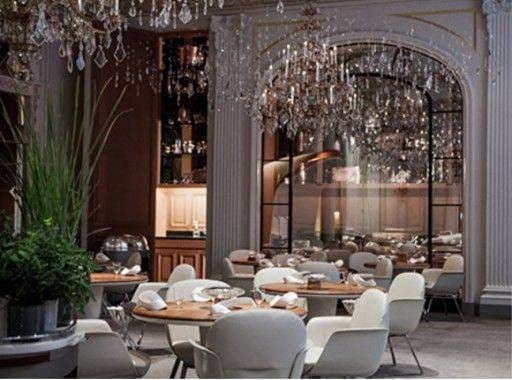
At the time, Alain Ducasse had just reimagined his restaurant at the Plaza Athénée, introducing a bold reinterpretation of fine dining rooted in what he defined as “naturality.” Beyond cuisine, this transformation embodied a broader shift in hospitality strategy: moving away from rigid formalism toward a more sincere, human, and experience-driven approach.
This philosophy resonates strongly with today’s key challenges in luxury hospitality: how to design experiences that are both meaningful and differentiated, how to align tableware, space, and service with a coherent narrative, and how to create emotional connections that go beyond traditional standards. These are not only questions of gastronomy but also of hotel conception, interior design, and operational strategy.
Within DELPORTE HOSPITALITY MAG, the editorial approach has always been to produce timeless content. Interviews such as this one are intentionally preserved and revisited because they continue to provide strategic insight years later. They reflect a deeper understanding of hospitality one that transcends trends and focuses on what truly creates value: attention, coherence, and the human dimension of service.
How do you envision the French art of welcoming? In what ways have you revisited it? What are the keys to success today in guaranteeing that the client enjoys an exclusive experience?
The French art of welcoming has been shaped by a very long tradition. This is an advantage, but, over time, it has also become a problem. The codes by which the art of the table operates have begun to be perceived as very formal and restrictive. Newer clients found them excessive and intimidating. We ended up losing sight of what actually constitutes the essence of the art of welcoming: being sincerely attentive to guests and allowing them to penetrate the bubble of perfection and generosity.
When we re-opened my restaurant at the Plaza Athénée, I figured that I would have to restore this authenticity of attention and reinvent the rituals of welcoming. This is the meaning behind the drink that’s offered to clients as soon as they take their place: beetroot water infused with hibiscus. This drink is accompanied by a tuile of grains and several fine slices of rice-bread, along with some lightly salted butter. The message is clear: we are truly going to take care of you. This is in some ways a return to the core value: at its heart, the art of welcoming consists of exhibiting the pleasure that we take in receiving guests.
Alain Ducasse and His Art of the Table
How have you arrived at reinterpreting tableware in your new restaurant? How have you moved past pre-existing codes? And could you also give us a few words about the cabinet of curiosities and the glassware you’ve set on your table?
Tableware, or the art of the table, corresponds with the art of welcoming, and the two are obviously inspired by the cuisine that is served at the Plaza Athénée. That’s where it all starts: my conception of a cuisine of ‘naturality.’ It’s a cuisine that expresses, somewhat radically, the following conviction: before the chef, there was nature. It’s nature that dictates the menus, and the talent of the chef consists in a form of self-effacement in order to exalt the true taste of what nature intended to give us. The tableware thus reflects this philosophy. For example, the tables are constructed from an absolutely superb oak. I thus decided not to hide this splendor of nature under tablecloths. This move breaks the traditional codes of haute-cuisine restaurants, but it conveys a very strong meaning.
The cabinet of curiosities serves in homage to artisans who have dedicated their expertise to the service of the art of fine dining. We have a few pieces on loan from the Christofle Museum and several crystal pieces by Saint-Louis—these represent two of the most prestigious French artisan houses. And I’ve also added a few copper pieces from my personal collection. But I didn’t want the cabinet to serve a strictly decorative function: it renders a service that is put to efficient use by the service staff. It thus completely enters as part of the dining experience.
As for the glassware, they’ve been designed by Pierre Tachon and produced by MD Crystal. These are mouth-blown glasses with hollow, tapering stems, such that the wine takes on the form of a diamond. I wanted the champagne glasses to be of the same model to underscore that champagne is, at the end of the day, a wine at heart.
The water glasses from the Austrian house Lobmeyr are also remarkable pieces. Mouth-blown, these are objects of arachnid finesse, light as a bubble, such as only an artisan—an artist, shall we say—would be capable of executing.
Several of the pieces—such as the glasses, carafes, cups, etc.—from Lalique and other artisans were personally sourced by Alain Ducasse, who is said to be an indefatigable treasure hunter. This is the case, for instance, for a full service set that he’s procured from Baccarat: the Harcourt model, the iconic collection first created in 1841.
Revisiting this 2015 interview highlights a fundamental truth in luxury hospitality: beyond trends, technologies, and evolving customer expectations, the essence of hospitality remains deeply human. Alain Ducasse’s vision centered on sincerity, coherence, and respect for nature illustrates how the French art of welcoming can evolve without losing its identity.
From a strategic perspective, this approach goes far beyond gastronomy. It informs the broader conception of hotels and restaurants, where every element design, tableware, service rituals, and team culture must contribute to a unified guest experience. In today’s highly competitive environment, where differentiation is key, such coherence becomes a decisive factor in creating lasting value.
For hotel owners, architects, and operators, this interview serves as a reminder that true innovation does not lie in breaking away from tradition, but in reinterpreting it with meaning. This is precisely where hospitality becomes strategic: when it aligns human attention, design intent, and operational excellence to deliver an experience that guests will not find anywhere else.
This is also the editorial ambition of DELPORTE HOSPITALITY MAG: to share timeless insights that continue to inspire professionals years after their publication, and to contribute to a deeper understanding of what truly defines exceptional hospitality.
Update
After the departure of multi-starred chef Alain Ducasse from the Plaza Athénée, Jean Imbert will succeed him at the head of the kitchens of the palace since July 2021. Revealed by the cooking show Top Chef broadcast on M6 in 2012, he is in charge of the hotel’s six restaurants, namely the Table Gastronomique, the Cour Jardin, the Galerie, the Relais Plaza, the Montaigne terrace and the Bar. More recently, at the end of 2020 and during 2021, he has begun several collaborations with the luxury house of Dior.