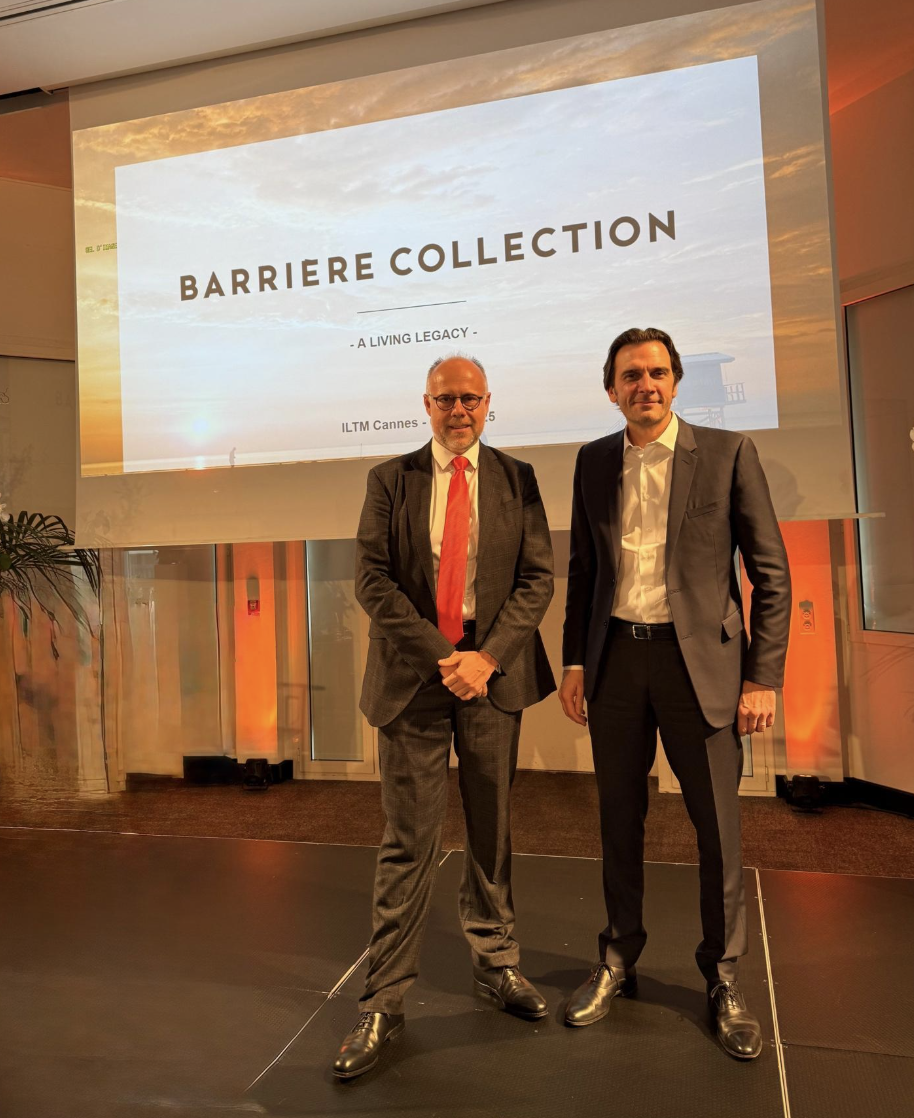
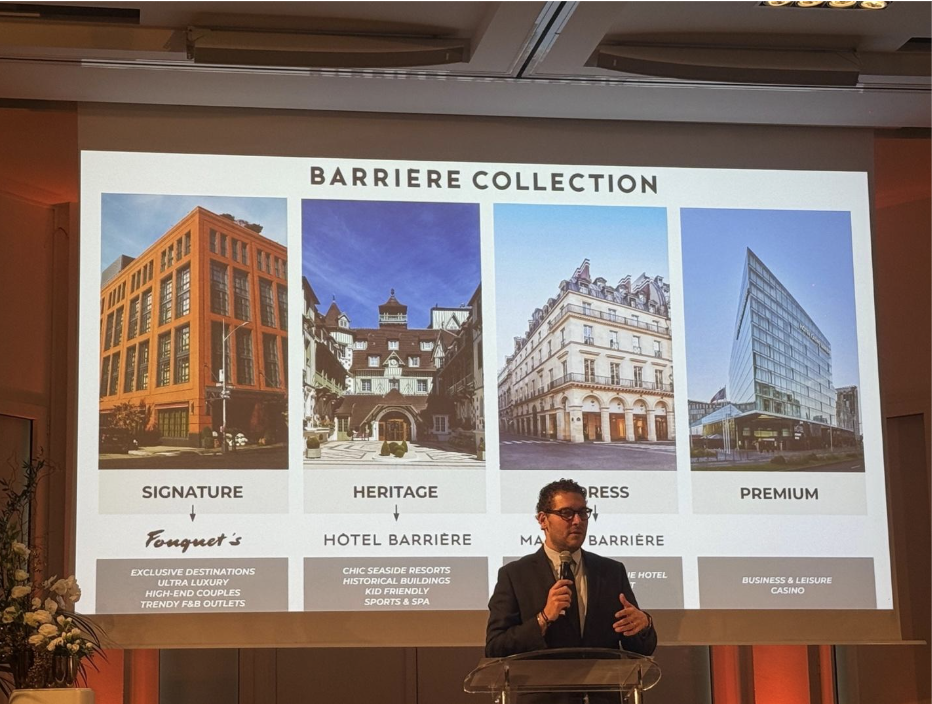
n December 2025, at the ILTM (International Luxury Travel Market in Cannes, Groupe Barrière presented the Majestic Barrière with a major reorganization of its hotel portfolio. This strategic turning point, unveiled by Grégory Rabuel, the group’s General Manager, and his team, now structures all hotels under the Barrière Collection banner, designed to assert the group’s international reach and French identity. This new brand architecture, designed around four universes: Signature, Heritage, Address and Premium, aims to make the offering clearer for travelers and investors alike, while retaining the authenticity, emotion and historical excellence that characterize Barrier Reef hospitality.
Grégory Rabuel has headed the family group since 2023. It is carrying out this strategic transformation against a backdrop of growth and internationalization, with the ambition of doubling the number of hotels over the next ten years and further exporting the “art de vivre à la française” around the world.
What is your vision of the art of entertaining at Barrière hotels, and how is it reflected in the brand’s identity, both in France and abroad?
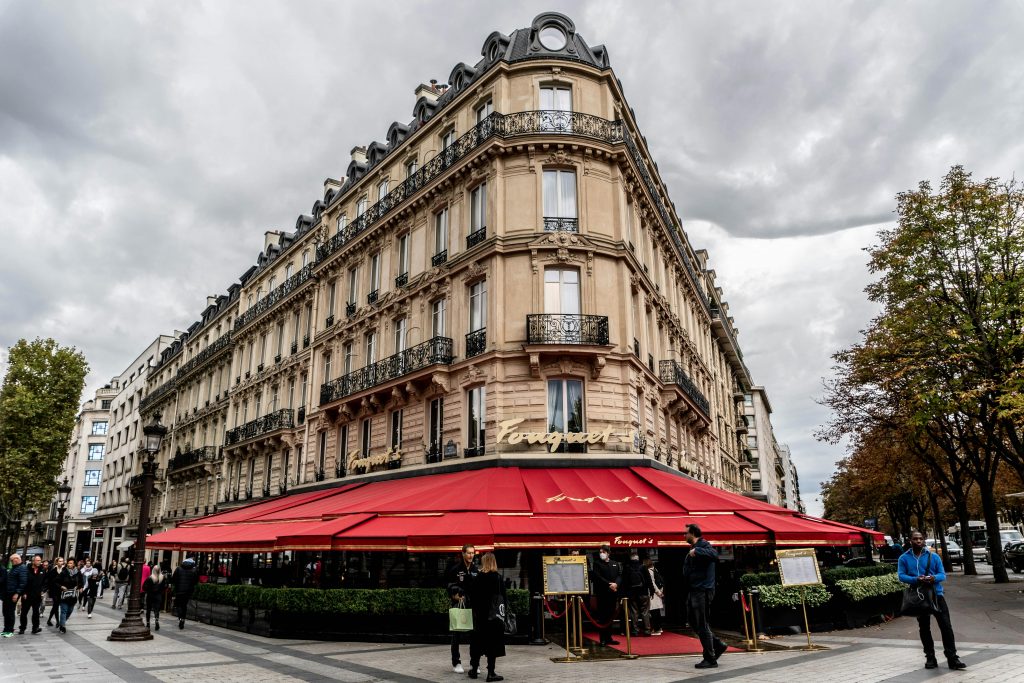
What we put forward first is a story. Fouquet’s is part of more than a century of heritage within the Barrière group. This story begins with an emblematic house on the Champs-Élysées, deeply rooted in the Parisian imagination, which we are now in the process of completely rethinking and remodeling.
This story also extends internationally. The Fouquet’s Hotel in New York has become one of the city’s most prominent establishments. It embodies the export of French art de vivre: precise service gestures, codes that we find again and again from one hotel to another, elements that can be told and others that can’t always be explained, but that create emotion.
We don’t make standardized hotels. Today, the Fouquet’s collection has been extended to include the Fouquet’s Courchevel hotel and the five-star Le Carl Gustaf hotel in Saint-Barthélemy. Today, four iconic hotels make up this collection. They’re all different, but linked by a clear guiding thread: the ambience, the quality of service, the exacting standards of the cuisine, the atmosphere of the bars, the signature cocktails, the gestures of service and the attention paid to personalized welcome.
The objective remains the same: to recreate a fragment of France, and a fragment of the Fouquet’s spirit, throughout the world, without ever losing the soul of the place.
How does French art de vivre remain a fundamental pillar of the Fouquet’s brand and the Barrière group?
Yes, it’s something totally assumed and voluntary. Barrière has long had a very specific way of thinking about the hotel business: creating living spaces, imagining uses, giving a central place to shared moments around sport, dining, breakfast or Sunday lunch.
This approach to hospitality is profoundly French and, to my mind, quite unique. In other models, notably in some American chains, the focus is more on square meters or operational efficiency. At Barrière, emotion remains central.
When we think of Fouquet’s, the image of France immediately comes to mind. The brand enjoys strong international recognition, but was historically under-exploited. The decision was therefore made to reserve it exclusively for the hotel industry.
This is why the existing Fouquet’s restaurants are gradually moving to other brands, in order to concentrate French art de vivre in the Fouquet’s Hôtel brand. When a customer arrives in a city and discovers a Fouquet’s, he knows exactly what he’s going to find: an assertive DNA, specific amenities, signature cocktails, French-style service gestures, a lively brasserie or restaurant.
Adapting to each destination is essential, but it must never be at the expense of the French DNA that sets Fouquet’s apart in the sometimes highly standardized world of luxury.
How does Groupe Barrière combine the preservation of its historical heritage with its development and growth strategy?
The heritage section is based on the Barrière group’s historic and iconic hotels. They are the ones who built this story and its reputation. Our role is to maintain and develop them, without trying to artificially recreate new emblematic establishments like the Normandy or the Hermitage.
That said, the Group remains open to opportunities. When a truly iconic building presents itself, in Europe or elsewhere, as part of a management contract or, more occasionally, an acquisition, the opportunity can be studied, even if it is not the main focus of development.
Today, the company’s strategy is primarily focused on developing management contracts, with a conscious move upmarket into the ultra-luxury segment, driven in particular by the Fouquet’s brand for hotels and the Loulou brand for restaurants.
What is the philosophy behind the Barrière houses and the boutique hotels you are developing today?
These are primarily hotels, but luxury boutique-hotels. When a hotel has 20 or 30 rooms, the experience is very different from that of a 100 or 200-room hotel.
Maison Barrière Vendôme, located on Place Vendôme opposite the Hôtel Costes, is a good example. It’s an iconic 26-room building. Some suites have kitchens, but this is not the central element of the concept.
The idea is for a discreet, luxurious hotel with room service, restaurant and bar. The kitchen is an integral part of the experience, even if not all rooms are equipped with one.
How do you integrate residences and new uses into the hotel experience, particularly through projects like Lisbon?
In Lisbon, we are developing both a Maison Barrière hotel and branded Barrière residences. The residences will open first, followed by the hotel around two years later.
By definition, residences have kitchens, unlike hotels. I think this hybrid model is particularly relevant. Some customers don’t want to go out to dinner every night, and are looking for more independence.
At Maison Barrière Vendôme, around half the suites are equipped with a kitchen. Customers can call on the chef, the butler, or choose total autonomy. This freedom transforms the way you experience your stay and deeply enriches the experience.
What role do people play in the Barrière culture, and how do you recruit, train and retain your teams today?
People are the Barrière group’s number one asset. That’s what has always made the difference. Throughout the Group’s history, quality of service and the commitment of our teams have always been at the heart of our story.
Since Covid, many things have changed: employee expectations, working conditions, remuneration, training and loyalty. We have both seasonal and year-round hotels, which makes team management a complex task.
We therefore invest heavily in internal training, retention and career development. We encourage internal promotion and managerial development. Barrière remains a large family, a company on a human scale, despite its size.
Today, the Group employs around 7,500 people, divided between hotels, casinos and catering, which also allows for numerous bridges between professions and activities.
For further reflection, Laurent Delporte’s reading keys:This exchange sheds light on a long, patiently-constructed history that goes beyond the question of Parisian roots. The history of Groupe Barrière hotels is above all rooted in a culture of place, service and longevity, with multiple roots anchored in emblematic destinations, each with a strong identity. Today, this historical continuity gives the group a particular legitimacy for thinking about hospitality in its cultural and emotional dimensions.
In this landscape, the role of the Fouquet’s brand is central. Long before it was a hotel brand, Fouquet’s was an iconic Parisian restaurant created in 1899, whose name has gradually become an international benchmark. This reputation has led to the development of a number of Fouquet’s restaurants around the world, building over time a brand in its own right, associated with a certain idea of luxury, elegance and the French art of living.
Groupe Barrière’s decision to turn Fouquet’s into a luxury hotel brand therefore seems particularly appropriate. It is the codes, aura and imagination of the Fouquet’s restaurant that today lend their luxurious character to the hotels that bear its name. A hotel brand isn’t built from scratch: it’s an extension of an existing history, already recognized and desirable on an international scale.
The new brand organization also makes this strategy easier to understand. On the one hand, there are the collection hotels and historic establishments, grouped together in the Group’s heritage categories, which embody memory and heritage. On the other, hotels resolutely positioned for contemporary luxury under the Fouquet’s brand, in Paris, New York, Courchevel and Saint-Barthélemy, reflecting a clear ambition: to offer an identifiable, coherent and international expression of French luxury. Already awarded the “Palace” label by Atout France in Courchevel, future hotels will probably be candidates for this label.
Finally, this vision reminds us of an essential reality of the upscale hotel business: brand, history and architecture are never enough without people. The real challenge remains the ability to recruit, train and retain teams capable of delivering, day after day, a service that lives up to its stated positioning. In luxury, there’s no room for error. The experience is based on a succession of details, gestures and attentions, responses that, put together, make all the difference. It is here that the credibility of a home and the durability of its promise of hospitality are at stake.