
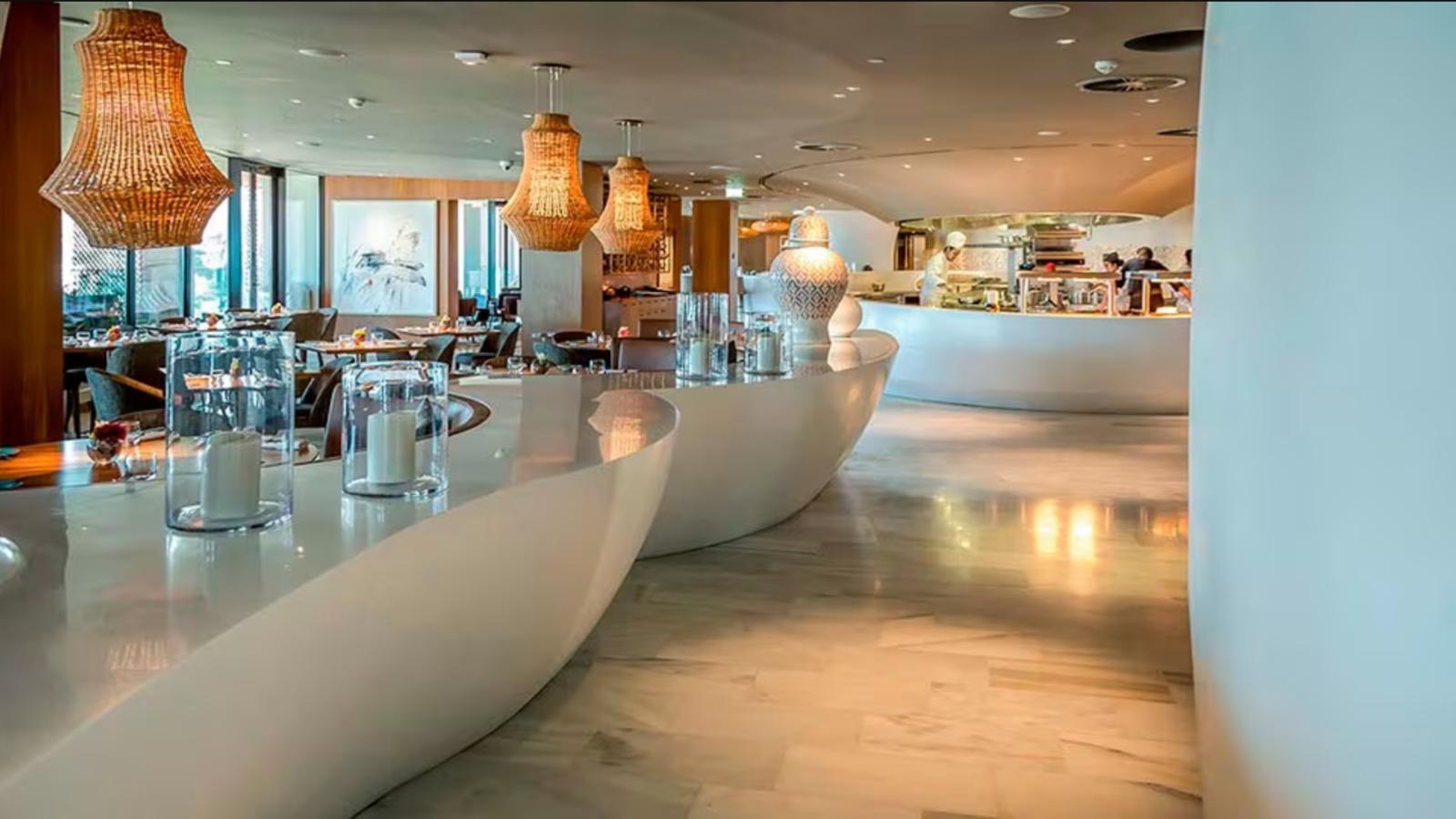
While service quality and the relationship built up by our teams remain at the heart of the hotel experience, design is now emerging as another equally structuring pillar. It’s no longer a question of simply decorating a place, but of giving it meaning, an identity, a capacity to make a lasting impression.
This makes interior design a real performance driver. It influences perception, guides usage, and plays a direct role in creating value. In this sense, it can no longer be considered a cost. It’s a financial strategy in its own right, capable of generating revenue, attracting new customers and reinforcing a property’s positioning.
This evolution is taking place in a context where images occupy a central place. Choosing a hotel no longer depends solely on its reputation or location. It is now built through photos, videos and shared content. The gaze precedes the experience. Visual projection becomes decisive.
Thinking about design also means thinking about its ability to exist in these images. Telling a story in seconds. To arouse desire even before you arrive.
Today, this is a major theme in the sector, supported by key events such as EquipHotel, held in Paris. The show brings together all the players in the hospitality industry to address these issues, with a particular focus on design, decoration and experience. It is an ideal place to observe how these dimensions evolve and are integrated into plant strategies.
Three major lessons emerge from this reflection:
- design as a direct lever for revenue creation,
- the need for intelligent investment decisions,
- and the importance of a global, aligned and sustainable vision.
Transforming spaces: from design to revenue generation
How do you transform a hotel space into a genuine revenue generator?
This is a pressing issue today, in a context where every square meter must generate value, particularly in major international capitals.
For a long time, spaces were conceived according to fixed functions. This approach is now showing its limitations, particularly in cities such as Paris and New York City, where land constraints mean that constant optimization is essential. An inactive space at certain times of the day immediately becomes a loss of income.
The challenge is clear: to move from a logic of function to a logic of use. A hotel can no longer be conceived as a succession of independent spaces, but as a dynamic system, capable of adapting to different times of day.
In my past experience at Sofitel, as international brand manager, I challenged the architects on projects around a central requirement: what will be the real use of this space at every moment of the day and year, and how can we ensure that it lives permanently?
This involved integrating the question of transforming the ambience very early on. Lighting, in particular, had to be considered as a design tool in its own right. It allows a place to evolve without changing its structure: more functional in the morning, more neutral during the day, warmer and more enveloping in the evening. In urban environments where night falls early, this ability to transform a space through light becomes essential to maintain its attractiveness throughout the day.
To be concrete, let’s take the example of a bar.
A bar can no longer be conceived solely as an evening drinking venue. It needs to be pleasant in the morning for a coffee or an informal breakfast, functional during the day for work or meetings, capable of offering a quick service at lunchtime, then gradually evolve towards a more convivial atmosphere in the afternoon and finally become an attractive place at the end of the day and in the evening.
Design and decoration must accompany this ongoing transformation. The ambience, lighting, seating and flow must enable the space to remain coherent while changing use. It’s this ability to move through the day that enables us to optimize occupancy and generate continuous sales, with a view to economic performance.
Beyond this example, this approach is part of a broader logic of modularity. A high-performance space is one that can accommodate multiple uses, without losing coherence or perceived quality. Furnishings, volumes and circulation must be flexible enough to accommodate this.
The solutions offered today by a number of players move in this direction, facilitating the rapid transformation of spaces and their adaptation to different moments in life.
The impact on performance is immediate. Better activation of locations increases their utilization rate, generates ongoing sales and reinforces the perception of value. This translates directly into an improvement in average price (ADR) and revenue per customer.
Transforming spaces ultimately means rethinking the role of design.
It’s no longer just a question of creating a framework, but of organizing uses capable of continuously producing value.
Investing in the right place: balancing image, use and cost
Where to invest to maximize hotel performance?
This is a key question, because not all expenses have the same impact on perception, usage and, ultimately, profitability.
One of the most common pitfalls is to focus budgets on items that are visible in the short term, without taking into account their influence on day-to-day operations and the asset’s lifespan. In the hotel industry, certain often underestimated positions play a decisive role.
Equipment, furniture and all experience-related items – grouped under the FF&E and OS&E categories – account for a significant proportion of the initial investment. Their importance far exceeds their mere cost, as they determine both customer-perceived quality and operational performance.
Poorly anticipated arbitration can generate particularly penalizing deferred effects: high maintenance costs, premature renewals, gradual degradation of experience. Conversely, a well-considered investment from the outset will optimize results over the long term.
Another important dimension is the hierarchy of spaces.
Today, common spaces occupy a strategic position. They convey the hotel’s image, create first impressions, generate visual content and attract outside guests. Their role goes far beyond their initial function. They become levers of differentiation.
Conversely, chambers, which are more costly to transform, require a more stable approach over time. This reality calls for a rebalancing of investments in favor of areas capable of evolving and adapting more easily.
This logic introduces the notion of “signature moments”. Certain precisely designed areas focus attention and structure the overall perception of the facility. They embody positioning and play a direct role in desirability.
In this balance, the budget is not a constraint, but a steering tool. It enables you to prioritize, arbitrate and make coherent choices between image, use and costs.
Investing in the right place means abandoning a one-size-fits-all approach in favor of a strategic approach to space, based on its ability to create value.
Long-term thinking: alignment, sustainability and experience
How do you design a hotel that will remain successful over time, without losing its coherence or attractiveness? The answer lies not in an isolated arbitration or a purely budgetary decision, but in a global vision in which each choice is part of a structured and aligned whole.
A hotel project mobilizes a variety of players, each with their own priorities. Without a clear alignment between the initial vision, design choices and operational constraints, the project becomes progressively fragmented. This challenge becomes particularly acute in the final stages, when budgetary constraints become more acute.
I’ve worked on projects where, at the end of the development phase, certain decisions were made to reduce investment in areas considered secondary, notably meeting rooms. These decisions were made in response to the customer’s real constraints, which were sometimes strong, sometimes unavoidable. Yet they created an immediate gap between the worlds of the lobby, rooms and restaurants, and those of the seminar areas, introducing a perceptible break in the overall experience.
This situation raises questions. Does it make sense to invest heavily in visible spaces while weakening other parts of the customer journey? The experience cannot be segmented. It is lived as a whole.
In my speeches, I’ve always stressed this point: each space contributes to the overall perception and to the promise made to the customer. To waive the requirement for certain locations is to undermine the whole. This alignment logic must be applied from the outset of the project and maintained right through to completion, without giving in to a partial vision of value.
This requirement naturally ties in with the question of sustainability. Creating a design that can withstand the test of time means integrating the quality of materials, the relevance of uses and the ability of spaces to evolve. Certain investments, which are more demanding in the short term, reduce maintenance costs, avoid premature renovations and preserve asset value. Conversely, immediate trade-offs can generate lasting imbalances.
But beyond alignment and sustainability, a third dimension is essential: experience. A place, no matter how well designed, only creates value if it is properly activated by teams and fully experienced by customers. Aesthetics alone are not enough; it’s the coherence between design, use and execution that gives a project its real strength.
Thinking in the long term means choosing consistency rather than compromise.
Because a hotel is not judged by its opening, but by the consistency of the experience it delivers over time.
Things to remember
Through this article, one conviction becomes clear: design can no longer be dissociated from performance and experience. It is fully in line with a broader approach I’m developing around generous hospitality, a method that places the sense of place at the heart of reflection. Conceiving a meaningful place, capable of expressing identity, culture and emotion, is the starting point. Design and decoration are essential levers, as they help us to see, feel and experience this intention.
Things to remember :
- Design is a direct lever of economic performance: it influences revenues, perception and asset value.
- By transforming the uses of the space, new sources of income can be created without increasing the surface area.
- Investments need to be carefully weighed up, taking into account their impact on operations and lifespan.
- Common spaces become strategic, as they convey image and differentiation.
- Aligning the players from the outset is essential to guarantee project coherence.
- Sustainability is not just an ethical choice, but also a profitability factor.
- Design is only as good as the experience it provides, for customers and teams alike.
Against this backdrop, events such as EquipHotel Paris 2026, scheduled for November in Paris, offer a valuable opportunity to compare these ideas with market realities. The show provides an opportunity to discover the approaches, innovations and partners capable of supporting this transformation, while feeding a broader reflection on how to design places that are desirable, efficient and sustainable.
